


Page 573 - Cardiac Nursing
P. 573
7-5
                    p53
                         54.
                           qxd
                         54.
                                                    49
                                                  e 5
                                                       Apt
                                                         ara
                                                    49
                                             M
                                           9 A
                                               P
                                                 g
                                               P
                                9/0
                               0
                                  9/2
                                        8:2
                                    009
            K34
               0-c
                 23_
            K34
         LWB K34 0-c 23_ p53 7-5 54. qxd  0 9/0 9/2 009  0 0 8:2 9 A M  P a a g e 5 49  Apt ara
         L L LWB
         LWBK340-c23_23_p537-554.qxd  09/09/2009  08:29 AM  Page 549 Aptara
                                   C HAPTER 2 3 / Interventional Cardiology Techniques: Percutaneous Coronary Intervention  549

                     A                                B                                C
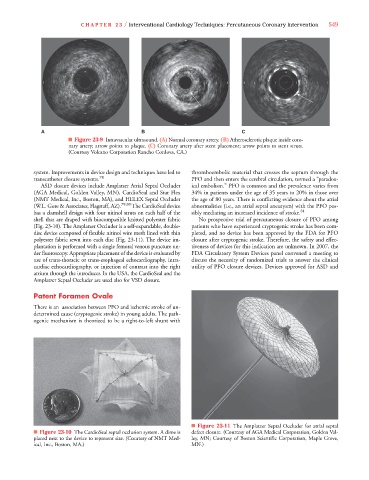
                              ■ Figure 23-9 Intravascular ultrasound. (A) Normal coronary artery. (B) Atherosclerotic plaque inside coro-
                              nary artery; arrow points to plaque. (C) Coronary artery after stent placement; arrow points to stent struts.
                              (Courtesy Volcano Corporation Rancho Cordova, CA.)


                   system. Improvements in device design and techniques have led to  thromboembolic material that crosses the septum through the
                   transcatheter closure systems. 78                   PFO and then enters the cerebral circulation, termed a “paradox-
                     ASD closure devices include Amplatzer Atrial Septal Occluder  ical embolism.” PFO is common and the prevalence varies from
                   (AGA Medical, Golden Valley, MN), CardioSeal and Star Flex  34% in patients under the age of 35 years to 20% in those over
                   (NMT Medical, Inc., Boston, MA), and HELEX Septal Occluder  the age of 80 years. There is conflicting evidence about the atrial
                   (W.L. Gore & Associates, Flagstaff, AZ). 79,80 The CardioSeal device  abnormalities (i.e., an atrial septal aneurysm) with the PFO pos-
                   has a clamshell design with four nitinol struts on each half of the  sibly mediating an increased incidence of stroke. 81
                   shell that are draped with biocompatible knitted polyester fabric  No prospective trial of percutaneous closure of PFO among
                   (Fig. 23-10). The Amplatzer Occluder is a self-expandable, double-  patients who have experienced cryptogenic stroke has been com-
                   disc device composed of flexible nitinol wire mesh lined with thin  pleted, and no device has been approved by the FDA for PFO
                   polyester fabric sewn into each disc (Fig. 23-11). The device im-  closure after cryptogenic stroke. Therefore, the safety and effec-
                   plantation is performed with a single femoral venous puncture un-  tiveness of devices for this indication are unknown. In 2007, the
                   der fluoroscopy. Appropriate placement of the device is evaluated by  FDA Circulatory System Devices panel convened a meeting to
                   use of trans-thoracic or trans-esophageal echocardiography, intra-  discuss the necessity of randomized trials to answer the clinical
                   cardiac echocardiography, or injection of contrast into the right  utility of PFO closure devices. Devices approved for ASD and
                   atrium through the introducer. In the USA, the CardioSeal and the
                   Amplatzer Septal Occluder are used also for VSD closure.

                   Patent Foramen Ovale
                   There is an  association between PFO and ischemic stroke of un-
                   determined cause (cryptogenic stroke) in young adults. The path-
                   ogenic mechanism is theorized to be a right-to-left shunt with


                                                                       ■ Figure 23-11 The Amplatzer Septal Occluder for atrial septal
                   ■ Figure 23-10 The CardioSeal septal occlusion system. A dime is  defect closure. (Courtesy of AGA Medical Corporation, Golden Val-
                   placed next to the device to represent size. (Courtesy of NMT Med-  ley, MN; Courtesy of Boston Scientific Corporation, Maple Grove,
                   ical, Inc., Boston, MA.)                            MN.)

