


Page 642 - Cardiac Nursing
P. 642
1
                                     1
                                  009
                                  009
                                      7:4
                                        5
                                         Pa
                                      7:4
                                        5
                              0
                             0
                           xd
                           xd
                             0
                                0/2
                                0/2
                              6/3
                              6/3
                                         Pa
                                                 p
                                                 p
                                                A
                                                A
                                                 p
                                                  ara
                                                  ara
                                                 t
                                                 t
                                           g
                                           g
                                         Pa
                                           g
                                            e 6
                                              18
                                                A
                                            e 6
                                              18
                          q
                      5-6
                    59
                    59
                        22.
                        22.
                      5-6
                          q
         LWB
            K34
         LWB K34 0-c 25_ p p pp595-622.qxd  06/30/2009  17:45  Page 618 Aptara
         LWBK340-c25_
                          q
                 25_
               0-c
                  618    PA R T  I V / Pathophysiology and Management of Heart Disease
                                     P
                                a
                              C
                                   e
                                  r
                                       l
                                             5
                                            2
                    Nursing Care Plan 25-1           (c (continued) ) )
                                               1
                                        a
                                        a
                                            2
                                         n
                          i
                            g
                                                         nu
                                                           ed
                                                      on
                                                        ti
                        NURSING INTERVENTIONS                           RATIONALE
                        4. Obtain sputum cultures if quantity, composition, color, or
                          odor changes dramatically.
                        5. Observe all wound, intravenous, and pacemaker wire sites  5–6. Wound and insertion site infections can be well estab-
                          daily for signs of suspect drainage, redness, swelling, or  lished by the time overt signs are present in the
                          heat, and report any of these findings to the physician.  immunosuppressed patient. Prompt treatment and
                        6. Obtain cultures of any suspicious drainage.      insertion site changes are indicated.
                        7. Obtain temperature every 4 hours. Immediately document  7–8. Corticosteroid therapy reduces normal basal and maxi-
                          and report any temperature greater than 37 C.     mal body temperature. A temperature rise greater than
                        8. Obtain aerobic and anaerobic blood cultures if   37 C may indicate the presence of systemic infection. It
                          temperature is greater than 37 C.                 is important to obtain cultures when the temperature
                                                                            elevation occurs to identify possible organisms and
                                                                            appropriate antimicrobial therapy.
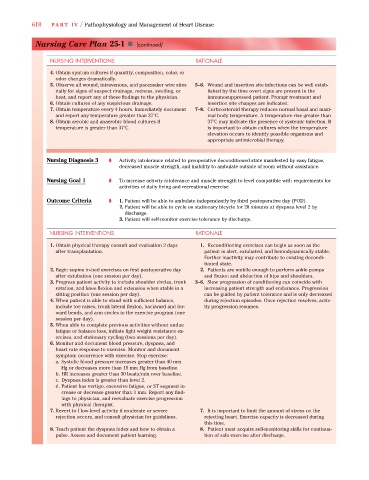
                       Nursing Diagnosis 3   ➧  Activity intolerance related to preoperative deconditioned state manifested by easy fatigue,
                                               decreased muscle strength, and inability to ambulate outside of room without assistance.
                       Nursing Goal 1       ➧  To increase activity intolerance and muscle strength to level compatible with requirements for
                                               activities of daily living and recreational exercise
                       Outcome Criteria     ➧  1. Patient will be able to ambulate independently by third postoperative day (POD).
                                               2. Patient will be able to cycle on stationary bicycle for 20 minutes at dyspnea level 2 by
                                                 discharge.
                                               3. Patient will self-monitor exercise tolerance by discharge.
                        NURSING INTERVENTIONS                           RATIONALE
                        1. Obtain physical therapy consult and evaluation 2 days  1. Reconditioning exercises can begin as soon as the
                          after transplantation.                           patient is alert, extubated, and hemodynamically stable.
                                                                           Further inactivity may contribute to existing decondi-
                                                                           tioned state.
                        2. Begin supine in-bed exercises on first postoperative day  2. Patients are mobile enough to perform ankle pumps
                          after extubation (one session per day).          and flexion and abduction of hips and shoulders.
                        3. Progress patient activity to include shoulder circles, trunk  3–6. Slow progression of conditioning can coincide with
                          rotation, and knee flexion and extension when stable in a  increasing patient strength and endurance. Progression
                          sitting position (one session per day).          can be guided by patient tolerance and is only decreased
                        4. When patient is able to stand with sufficient balance,  during rejection episodes. Once rejection resolves, activ-
                          include toe raises, trunk lateral flexion, backward and for-  ity progression resumes.
                          ward bends, and arm circles in the exercise program (one
                          session per day).
                        5. When able to complete previous activities without undue
                          fatigue or balance loss, initiate light weight resistance ex-
                          ercises, and stationary cycling (two sessions per day).
                        6. Monitor and document blood pressure, dyspnea, and
                          heart rate response to exercise. Monitor and document
                          symptom occurrence with exercise. Stop exercise:
                          a. Systolic blood pressure increases greater than 40 mm
                            Hg or decreases more than 15 mm Hg from baseline.
                          b. HR increases greater than 30 beats/min over baseline.
                          c. Dyspnea index is greater than level 2.
                          d. Patient has vertigo, excessive fatigue, or ST segment in-
                            crease or decrease greater than 1 mm. Report any find-
                            ings to physician, and reevaluate exercise progression
                            with physical therapist.
                        7. Revert to l low-level activity if moderate or severe  7. It is important to limit the amount of stress on the
                          rejection occurs, and consult physician for guidelines.  rejecting heart. Exercise capacity is decreased during
                                                                           this time.
                        8. Teach patient the dyspnea index and how to obtain a  8. Patient must acquire self-monitoring skills for continua-
                          pulse. Assess and document patient learning.     tion of safe exercise after discharge.

