


Page 639 - Cardiac Nursing
P. 639
LWBK340-c25_p595-622.qxd  06/30/2009  17:45  Page 615 Aptara


                                                                                   C HAPTER 2 5 / Cardiac Surgery  615


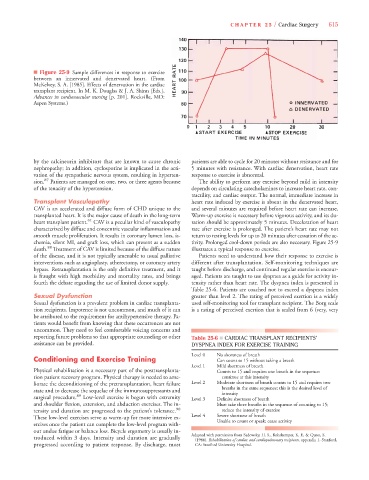
                   ■ Figure 25-9 Sample differences in response to exercise
                   between an innervated and denervated heart.  (From
                   McKelvey, S. A. [1985]. Effects of denervation in the cardiac
                   transplant recipient. In M. K. Douglas & J. A. Shinn [Eds.],
                   Advances in cardiovascular nursing [p. 201]. Rockville, MD:
                   Aspen Systems.)


                   by the calcineurin inhibitors that are known to cause chronic  patients are able to cycle for 20 minutes without resistance and for
                   nephropathy; in addition, cyclosporine is implicated in the acti-  5 minutes with resistance. With cardiac denervation, heart rate
                   vation of the sympathetic nervous system, resulting in hyperten-  response to exercise is abnormal.
                   sion. 87  Patients are managed on one, two, or three agents because  The ability to perform any exercise beyond mild in intensity
                   of the tenacity of the hypertension.                depends on circulating catecholamines to increase heart rate, con-
                                                                       tractility, and cardiac output. The normal, immediate increase in
                   Transplant Vasculopathy                             heart rate induced by exercise is absent in the denervated heart,
                   CAV is an accelerated and diffuse form of CHD unique to the  and several minutes are required before heart rate can increase.
                   transplanted heart. It is the major cause of death in the long-term  Warm-up exercise is necessary before vigorous activity, and its du-
                                     61
                   heart transplant patient. CAV is a peculiar kind of vasculopathy  ration should be approximately 5 minutes. Deceleration of heart
                   characterized by diffuse and concentric vascular inflammation and  rate after exercise is prolonged. The patient’s heart rate may not
                   smooth muscle proliferation. It results in coronary lumen loss, is-  return to resting levels for up to 20 minutes after cessation of the ac-
                   chemia, silent MI, and graft loss, which can present as a sudden  tivity. Prolonged cool-down periods are also necessary. Figure 25-9
                        88
                   death. Treatment of CAV is limited because of the diffuse nature  illustrates a typical response to exercise.
                   of the disease, and it is not typically amenable to usual palliative  Patients need to understand how their response to exercise is
                   interventions such as angioplasty, atherectomy, or coronary artery  different after transplantation. Self-monitoring techniques are
                   bypass. Retransplantation is the only definitive treatment, and it  taught before discharge, and continued regular exercise is encour-
                   is fraught with high morbidity and mortality rates, and brings  aged. Patients are taught to use dyspnea as a guide for activity in-
                   fourth the debate regarding the use of limited donor supply.  tensity rather than heart rate. The dyspnea index is presented in
                                                                       Table 25-6. Patients are coached not to exceed a dyspnea index
                   Sexual Dysfunction                                  greater than level 2. The rating of perceived exertion is a widely
                   Sexual dysfunction is a prevalent problem in cardiac transplanta-  used self-monitoring tool for transplant recipient. The Borg scale
                   tion recipients. Impotence is not uncommon, and much of it can  is a rating of perceived exertion that is scaled from 6 (very, very
                   be attributed to the requirement for antihypertensive therapy. Pa-
                   tients would benefit from knowing that these occurrences are not
                   uncommon. They need to feel comfortable voicing concerns and
                   reporting future problems so that appropriate counseling or other  Table 25-6 ■ CARDIAC TRANSPLANT RECIPIENTS’
                   assistance can be provided.                         DYSPNEA INDEX FOR EXERCISE TRAINING
                                                                       Level 0  No shortness of breath
                   Conditioning and Exercise Training                          Can count to 15 without taking a breath
                                                                       Level 1  Mild shortness of breath
                   Physical rehabilitation is a necessary part of the posttransplanta-  Counts to 15 and requires one breath in the sequence:
                   tion patient recovery program. Physical therapy is needed to ame-  continue at this intensity
                   liorate the deconditioning of the pretransplantation, heart failure  Level 2  Moderate shortness of breath counts to 15 and requires two
                                                                                 breaths in the same sequence; this is the desired level of
                   state and to decrease the sequelae of the immunosuppressants and  intensity
                   surgical procedure. 89  Low-level exercise is begun with extremity  Level 3  Definite shortness of breath
                   and shoulder flexion, extension, and abduction exercises. The in-  Must take three breaths in the sequence of counting to 15;
                   tensity and duration are progressed to the patient’s tolerance. 90  reduce the intensity of exercise
                   These low-level exercises serve as warm-up for more intensive ex-  Level 4  Severe shortness of breath
                                                                               Unable to count or speak; cease activity
                   ercises once the patient can complete the low-level program with-
                   out undue fatigue or balance loss. Bicycle ergometry is usually in-
                                                                       Adapted with permission from Sadowsky, H. S., Rohrkemper, K. F., & Quon, S.
                   troduced within 3 days. Intensity and duration are gradually
                                                                        (1986). Rehabilitation of cardiac and cardiopulmonary recipients, appendix 1. Stanford,
                   progressed according to patient response. By discharge, most   CA: Stanford University Hospital.

