


Page 901 - Cardiac Nursing
P. 901
LWBK340-c39_p876-888.qxd  29/06/2009  10:01 PM  Page 877 Aptara


                                                             C HAP TE R  39 / Diabetes Mellitus and Metabolic Syndrome  877

                                                                       to 80% percent of deaths in people with diabetes and this chronic
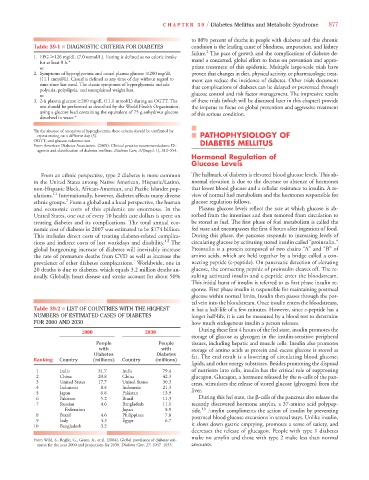
                   Table 39-1 ■ DIAGNOSTIC CRITERIA FOR DIABETES       condition is the leading cause of blindness, amputation, and kidney
                                                                           2
                                                                       failure. The pace of growth and the complications of diabetes de-
                   1. FPG  126 mg/dL (7.0 mmol/L). Fasting is defined as no caloric intake
                     for at least 8 h.*                                mand a concerted, global effort to focus on prevention and appro-
                     or                                                priate treatment of this epidemic. Multiple large-scale trials have
                   2. Symptoms of hyperglycemia and casual plasma glucose  200 mg/dL  proven that changes in diet, physical activity, or pharmacologic treat-
                     (11.1 mmol/L). Casual is defined as any time of day without regard to  ment can reduce the incidence of diabetes. Other trials document
                     time since last meal. The classic symptoms of hyperglycemia include
                     polyuria, polydipsia, and unexplained weight loss.  that complications of diabetes can be delayed or prevented through
                     or                                                glucose control and risk factor management. The impressive results
                   3. 2-h plasma glucose  200 mg/dL (11.1 mmol/L) during an OGTT. The  of these trials (which will be discussed later in this chapter) provide
                     test should be performed as described by the World Health Organization,  the impetus to focus on global prevention and aggressive treatment
                     using a glucose load containing the equivalent of 75 g anhydrous glucose  of this serious condition.
                     dissolved in water.*

                   *In the absence of unequivocal hyperglycemia, these criteria should be confirmed by
                    repeat testing on a different day (5).               PATHOPHYSIOLOGY OF
                   OGTT, oral glucose tolerance test.                    DIABETES MELLITUS
                   From American Diabetes Association. (2008). Clinical practice recommendations: Di-
                    agnosis and classification of diabetes mellitus. Diabetes Care, 31(Suppl. 1), S12–S54.
                                                                                      g
                                                                                      g
                                                                       Hormonal Regulation of
                                                                       Glucose Levels
                     From an ethnic perspective, type 2 diabetes is more common  The hallmark of diabetes is elevated blood glucose levels. This ab-
                   in the United States among Native American, Hispanic/Latino,  normal elevation is due to the decrease or absence of hormones
                   non-Hispanic Black, African-American, and Pacific Islander pop-  that lower blood glucose and a cellular resistance to insulin. A re-
                   ulations. 11  Internationally, however, diabetes affects many diverse  view of normal fuel metabolism and the hormones responsible for
                              7
                   ethnic groups. From a global and a local perspective, the human  glucose regulation follows.
                   and economic costs of this epidemic are enormous. In the  Plasma glucose levels reflect the rate at which glucose is ab-
                   United States, one out of every 10 health care dollars is spent on  sorbed from the intestines and then removed from circulation to
                   treating diabetes and its complications. The total annual eco-  be stored as fuel. The first phase of fuel metabolism is called the
                   nomic cost of diabetes in 2007 was estimated to be $174 billion.  fed state and encompasses the first 4 hours after ingestion of food.
                   This includes direct costs of treating diabetes-related complica-  During this phase, the pancreas responds to increasing levels of
                   tions and indirect costs of lost workdays and disability. 12  The  circulating glucose by activating stored insulin called “proinsulin.”
                   global burgeoning increase of diabetes will inevitably increase  Proinsulin is a protein composed of two chains “A” and “B” of
                   the rate of premature deaths from CVD as well as increase the  amino acids, which are held together by a bridge called a con-
                                                    7
                   prevalence of other diabetes complications. Worldwide, one in  necting peptide (c-peptide). On pancreatic detection of elevating
                   20 deaths is due to diabetes, which equals 3.2 million deaths an-  glucose, the connecting peptide of proinsulin cleaves off. The re-
                   nually. Globally, heart disease and stroke account for about 50%  sulting activated insulin and c-peptide enter the bloodstream.
                                                                       This initial burst of insulin is referred to as first phase insulin re-
                                                                       sponse. First phase insulin is responsible for maintaining postmeal
                                                                       glucose within normal limits. Insulin then passes through the por-
                                                                       tal vein into the bloodstream. Once insulin enters the bloodstream,
                   Table 39-2 ■ LIST OF COUNTRIES WITH THE HIGHEST     it has a half-life of a few minutes. However, since c-peptide has a
                   NUMBERS OF ESTIMATED CASES OF DIABETES              longer half-life, it is can be measured by a blood test to determine
                   FOR 2000 AND 2030                                   how much endogenous insulin a person releases.
                                                                         During these first 4 hours of the fed state, insulin promotes the
                                   2000                2030
                                                                       storage of glucose as glycogen in the insulin-sensitive peripheral
                                       People               People     tissues, including hepatic and muscle cells. Insulin also promotes
                                        with                 with      storage of amino acids as protein and excess glucose is stored as
                                       Diabetes            Diabetes    fat. The end result is a lowering of circulating blood glucose,
                   Ranking  Country   (millions)  Country  (millions)
                                                                       lipids, and other energy substrates. Besides promoting the disposal
                    1       India       31.7    India        79.4      of nutrients into cells, insulin has the critical role of suppressing
                    2       China       20.8    China        42.3      glucagon. Glucagon, a hormone released by the
-cells of the pan-
                    3       United States  17.7  United States  30.3   creas, stimulates the release of stored glucose (glycogen) from the
                    4       Indonesia    8.4    Indonesia    21.3
                    5       Japan        6.8    Pakistan     13.9      liver.
                    6       Pakistan     5.2    Brazil       11.3        During this fed state, the  -cells of the pancreas also release the
                    7       Russian      4.6    Bangladesh   11.1      recently discovered hormone amylin, a 37-amino acid polypep-
                             Federation         Japan         8.9      tide. 13  Amylin compliments the action of insulin by preventing
                    8       Brazil       4.6    Philippines   7.8      postmeal blood glucose excursions in several ways. Unlike insulin,
                    9       Italy        4.3    Egypt         6.7
                   10       Bangladesh   3.2                           it slows down gastric emptying, promotes a sense of satiety, and
                                                                       decreases the release of glucagon. People with type 1 diabetes
                                                                       make no amylin and those with type 2 make less than normal
                   From Wild, S., Roglic, G., Green, A., et al. (2004). Global prevalence of diabetes esti-
                    mates for the year 2000 and projections for 2030. Diabetes Care, 27, 1047–1053.7 7  amounts.

