


Page 905 - Cardiac Nursing
P. 905
6-8
                        6-8
                                        009
                                        009
                             qx
                             qx
                          88.
                          88.
                                            1
                                            1
                                             0:0
                                             0:0
                     p87
                     p87
                                             1
                                        009
                               d
                                    0
                                       2
                                       2
                                    0
                                      /
                                      /
                                     6
                                     6
                                 2
                                  9
                               d
                                 2
                                   /
                                   /
                                  9
                                  9
                                                                a
                                                                a
                  39_
                                                              ar
                                                            Apt
                                                            Apt
                                                              ar
                  39_
         LWB
         L L LWB
         LWBK340-c39_39_p87p876-888.qxd  29/06/2009  10:01 PM  Page 881 Aptara
            K34
                0-c
                0-c
            K34
                                                      g
                                                      g
                                               1 P
                                                    Pa
                                                  M
                                                  M
                                                    Pa
                                               1 P
                                                         81
                                                         81
                                                            Apt
                                             0:0
                                                       e 8
                                                       e 8
                                                             C HAPTER  39 / Diabetes Mellitus and Metabolic Syndrome  881
                                  Factors Contributing to Cardiometabolic Risk
                                                                                       Abnormal Lipid
                                                        Overweight/Obesity             Metabolism
                                                                                       • LDL
                                   Genetics          Age
                                                                                       • ApoB
                                                                                       • HDL
                                         Insulin Resistance
                                         nsulin Resistance
                                                           ?                           • Triglycerides
                                     Insulin Resistance Syndrome
                                                                 Cardiometabolic
                                      Lipids  BP    Glucose
                                                                       Risk
                                                                Global Diabetes CVD Risk
                                                                                           Age, Race, Sex,
                                                                                           Family History
                                             Smoking,
                                             Physical inactivity,
                                             Unhealthy Eating                          Inflammation,
                                                                                       Hypercoagulation
                                                        Hypertension
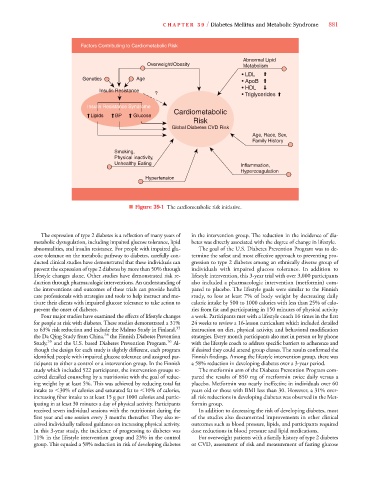
                                                  ■ Figure 39-1 The cardiometabolic risk initiative.
                     The expression of type 2 diabetes is a reflection of many years of  in the intervention group. The reduction in the incidence of dia-
                   metabolic dysregulation, including impaired glucose tolerance, lipid  betes was directly associated with the degree of change in lifestyle.
                   abnormalities, and insulin resistance. For people with impaired glu-  The goal of the U.S. Diabetes Prevention Program was to de-
                   cose tolerance on the metabolic pathway to diabetes, carefully con-  termine the safest and most effective approach to preventing pro-
                   ducted clinical studies have demonstrated that these individuals can  gression to type 2 diabetes among an ethnically diverse group of
                   prevent the expression of type 2 diabetes by more than 50% through  individuals with impaired  glucose tolerance. In addition to
                   lifestyle changes alone. Other studies have demonstrated risk re-  lifestyle intervention, this 3-year trial with over 3,000 participants
                   duction through pharmacologic interventions. An understanding of  also included a pharmacologic intervention (metformin) com-
                   the interventions and outcomes of these trials can provide health  pared to placebo. The lifestyle goals were similar to the Finnish
                   care professionals with strategies and tools to help instruct and mo-  study, to lose at least 7% of body weight by decreasing daily
                   tivate their clients with impaired glucose tolerance to take action to  caloric intake by 500 to 1000 calories with less than 25% of calo-
                   prevent the onset of diabetes.                      ries from fat and participating in 150 minutes of physical activity
                     Four major studies have examined the effects of lifestyle changes  a week. Participants met with a lifestyle coach 16 times in the first
                   for people at risk with diabetes. These studies demonstrated a 31%  24 weeks to review a 16-lesson curriculum which included detailed
                   to 63% risk reduction and include the Malmo Study in Finland, 33  instruction on diet, physical activity, and behavioral modification
                                          34
                   the Da Qing Study from China, the Finnish Diabetes Prevention  strategies. Every month participants also met in person or by phone
                   Study, 35  and the U.S. based Diabetes Prevention Program. 16  Al-  with the lifestyle coach to address specific barriers to adherence and
                   though the design for each study is slightly different, each program  if desired they could attend group classes. The results confirmed the
                   identified people with impaired glucose tolerance and assigned par-  Finnish findings. Among the lifestyle intervention group, there was
                   ticipants to either a control or a intervention group. In the Finnish  a 58% reduction in developing diabetes over a 3-year period.
                   study which included 522 participants, the intervention groups re-  The metformin arm of the Diabetes Prevention Program com-
                   ceived detailed counseling by a nutritionist with the goal of reduc-  pared the results of 850 mg of metformin twice daily versus a
                   ing weight by at least 5%. This was achieved by reducing total fat  placebo. Metformin was nearly ineffective in individuals over 60
                   intake to  30% of calories and saturated fat to  10% of calories,  years old or those with BMI less than 30. However, a 31% over-
                   increasing fiber intake to at least 15 g per 1000 calories and partic-  all risk reductions in developing diabetes was observed in the Met-
                   ipating in at least 30 minutes a day of physical activity. Participants  formin group.
                   received seven individual sessions with the nutritionist during the  In addition to decreasing the risk of developing diabetes, most
                   first year and one session every 3 months thereafter. They also re-  of the studies also documented improvements in other clinical
                   ceived individually tailored guidance on increasing physical activity.  outcomes such as blood pressure, lipids, and participants required
                   In this 3-year study, the incidence of progressing to diabetes was  dose reductions in blood pressure and lipid medications.
                   11% in the lifestyle intervention group and 23% in the control  For overweight patients with a family history of type 2 diabetes
                   group. This equaled a 58% reduction in risk of developing diabetes  or CVD, assessment of risk and measurement of fasting glucose

