


Page 923 - Cardiac Nursing
P. 923
9
                                  9
                                   /
                                 2
                                 2
                                  9
                                   /
                                     6
                                      /
                                      /
                                    0
                                    0
                                     6
                               d
                        9-9
                        9-9
                          0
                     p88
                     p88
                        9-9
                          0
                             qx
                             qx
                               d
                           5
                           5
                            .
                                                       e 8
                                                       e 8
                                                         99
                                                    Pa
                                                      g
                                                      g
                                                         99
                                                              ar
                                                                a
                                                                a
                                                            Apt
                                                            Apt
                                                              ar
                                                    Pa
                                        009
                                        009
                                            1
                                       2
                                       2
                                        009
                                            1
                                               7 P
                                                  M
                                                  M
                                             0:1
                                             0:1
                                               7 P
            K34
         LWBK340-c40_p88p889-905..qxd  29/06/2009  10:17 PM  Page 899 Aptara
            K34
                0-c
            K34
                  40_
                  40_
                0-c
                                                       C HAPTER 4 0 / Adherence to Cardiovascular Treatment Regimens  899
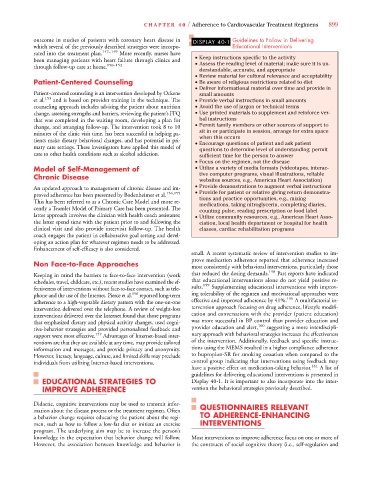
                   outcome in studies of patients with coronary heart disease in  DISPLAY 40-1  Guidelines to Follow in Delivering
                   which several of the previously described strategies were incorpo-  Educational Interventions
                   rated into the treatment plan. 147–149  More recently, nurses have
                   been managing patients with heart failure through clinics and  • Keep instructions specific to the activity
                                                                        • Assess the reading level of material; make sure it is un-
                   through follow-up care at home. 150–152
                                                                         derstandable, accurate, and appropriate
                                                                        • Review material for cultural relevance and acceptability
                   Patient-Centered Counseling                          • Be aware of religious restrictions related to diet
                                                                        • Deliver informational material over time and provide in
                   Patient-centered counseling is an intervention developed by Ockene  small amounts
                   et al. 153  and is based on provider training in the technique. The  • Provide verbal instructions in small amounts
                   counseling approach includes advising the patient about nutrition  • Avoid the use of jargon or technical terms
                   change, assessing strengths and barriers, reviewing the patient’s FFQ  • Use printed materials to supplement and reinforce ver-
                   that was completed in the waiting room, developing a plan for  bal instructions
                   change, and arranging follow-up. The intervention took 8 to 10  • Permit family members or other sources of support to
                   minutes of the clinic visit time, has been successful in helping pa-  sit in or participate in session, arrange for extra space
                                                                         when this occurs
                   tients make dietary behavioral changes, and has potential in pri-  • Encourage questions of patient and ask patient
                   mary care settings. These investigators have applied this model of  questions to determine level of understanding; permit
                   care to other health conditions such as alcohol addiction.  sufficient time for the person to answer
                                                                        • Focus on the regimen, not the disease
                   Model of Self-Management of                          • Utilize a variety of media formats (videotapes, interac-
                   Chronic Disease                                       tive computer programs, visual illustrations, reliable
                                                                         websites sources, e.g., American Heart Association)
                   An updated approach to management of chronic disease and im-  • Provide demonstrations to augment verbal instructions
                   proved adherence has been presented by Bodenheimer et al. 154,155  • Provide for patient or relative giving return demonstra-
                                                                         tions and practice opportunities, e.g., mixing
                   This has been referred to as a Chronic Care Model and more re-  medications, taking nitroglycerin, completing diaries,
                   cently a Teamlet Model of Primary Care has been presented. The  counting pulse, reading prescription or food label
                   latter approach involves the clinician with health coach assistants;  • Utilize community resources, e.g., American Heart Asso-
                   the latter spend time with the patient prior to and following the  ciation, local health department or hospital for health
                   clinical visit and also provide intervisit follow-up. The health  classes, cardiac rehabilitation programs
                   coach engages the patient in collaborative goal setting and devel-
                   oping an action plan for whatever regimen needs to be addressed.
                   Enhancement of self-efficacy is also considered.
                                                                       small. A recent systematic review of intervention studies to im-
                                                                       prove medication adherence reported that adherence increased
                   Non Face-to-Face Approaches                         most consistently with behavioral interventions, particularly those
                   Keeping in mind the barriers to face-to-face intervention (work  that reduced the dosing demands. 158  Past reports have indicated
                   schedules, travel, childcare, etc.), recent studies have examined the ef-  that educational interventions alone do not yield positive re-
                                                                          159
                   fectiveness of interventions without face-to-face contact, such as tele-  sults.  Supplementing educational interventions with improv-
                   phone and the use of the Internet. Pierce et al. 156  reported long-term  ing tolerability of the regimen and motivational approaches were
                                                                                                      159
                   adherence to a high-vegetable dietary pattern with the one-on-one  effective and improved adherence by 41%.  A multifactorial in-
                   intervention delivered over the telephone. A review of weight-loss  tervention approach focusing on drug adherence, lifestyle modifi-
                   interventions delivered over the Internet found that those programs  cation and conversations with the provider (patient education)
                   that emphasized dietary and physical activity changes, used cogni-  was more successful in BP control than provider education and
                                                                                            160
                   tive-behavior strategies and provided personalized feedback and  provider education and alert,  suggesting a more interdiscipli-
                   support were most effective. 157  Advantages of Internet-based inter-  nary approach with behavioral strategies increases the effectiveness
                   ventions are that they are available at any time, may provide tailored  of the intervention. Additionally, feedback and specific instruc-
                   information and messages, and provide privacy and anonymity.  tions using the MEMS resulted in a higher compliance adherence
                   However, literacy, language, culture, and limited skills may preclude  to bupropion-SR for smoking cessation when compared to the
                   individuals from utilizing Internet-based interventions.  control group indicating that interventions using feedback may
                                                                       have a positive effect on medication-taking behavior. 161  A list of
                                                                       guidelines for delivering educational interventions is presented in
                      EDUCATIONAL STRATEGIES TO                        Display 40-1. It is important to also incorporate into the inter-
                      IMPROVE ADHERENCE                                vention the behavioral strategies previously described.
                   Didactic, cognitive interventions may be used to transmit infor-  QUESTIONNAIRES RELEVANT
                   mation about the disease process or the treatment regimen. Often
                   a behavior change requires educating the patient about the regi-  TO ADHERENCE-ENHANCING
                   men, such as how to follow a low-fat diet or initiate an exercise  INTERVENTIONS
                   program. The underlying aim may be to increase the person’s
                   knowledge in the expectation that behavior change will follow.  Most interventions to improve adherence focus on one or more of
                   However, the association between knowledge and behavior is  the constructs of social cognitive theory (i.e., self-regulation and

