


Page 931 - Cardiac Nursing
P. 931
LWBK340-c41_p906-920.qxd  29/06/2009  11:20 PM  Page 907 Aptara


                                      C HAP TE R 41 / Complementary and Alternative Approaches in Cardiovascular Disease  907


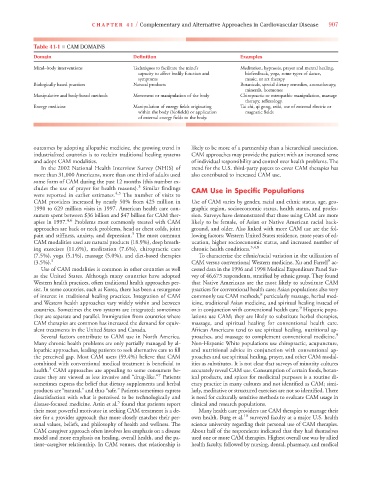
                   Table 41-1 ■ CAM DOMAINS
                   Domain                           Definition                          Examples
                   Mind–body interventions          Techniques to facilitate the mind’s  Meditation, hypnosis, prayer and mental healing,
                                                     capacity to affect bodily function and   biofeedback, yoga, some types of dance,
                                                     symptoms                           music, or art therapy
                   Biologically based practices     Natural products                   Botanicals, special dietary remedies, aromatherapy,
                                                                                        minerals, hormones
                   Manipulative and body-based methods  Movement or manipulation of the body  Chiropractic or osteopathic manipulation, massage
                                                                                        therapy, reflexology.
                   Energy medicine                  Manipulation of energy fields originating   Tai chi, qi gong, reiki, use of external electric or
                                                     within the body (biofields) or application  magnetic fields
                                                     of external energy fields to the body.


                   outcomes by adopting allopathic medicine, the growing trend in  likely to be more of a partnership than a hierarchical association.
                   industrialized countries is to reclaim traditional healing systems  CAM approaches may provide the patient with an increased sense
                   and adopt CAM modalities.                           of individual responsibility and control over health problems. The
                     In the 2002 National Health Interview Survey (NHIS) of  trend for the U.S. third-party payers to cover CAM therapies has
                   more than 31,000 Americans, more than one third of adults used  also contributed to increased CAM use.
                   some form of CAM during the past 12 months (this number ex-
                                                     3
                   cludes the use of prayer for health reasons). Similar findings  CAM Use in Specific Populations
                   were reported in earlier estimates. 4,5  The number of visits to
                   CAM providers increased by nearly 50% from 425 million in  Use of CAM varies by gender, racial and ethnic status, age, geo-
                   1990 to 629 million visits in 1997. American health care con-  graphic region, socioeconomic status, health status, and profes-
                   sumers spent between $36 billion and $47 billion for CAM ther-  sion. Surveys have demonstrated that those using CAM are more
                   apies in 1997. 4,6  Problems most commonly treated with CAM  likely to be female, of Asian or Native American racial back-
                   approaches are back or neck problems, head or chest colds, joint  ground, and older. Also linked with more CAM use are the fol-
                                                   3
                   pain and stiffness, anxiety, and depression. The most common  lowing factors: Western United States residence, more years of ed-
                   CAM modalities used are natural products (18.9%), deep breath-  ucation, higher socioeconomic status, and increased number of
                   ing exercises (11.6%), meditation (7.6%), chiropractic care  chronic health conditions. 3,4,8
                   (7.5%), yoga (5.1%), massage (5.0%), and diet-based therapies  To characterize the ethnic/racial variation in the utilization of
                                                                                                                   9
                   (3.5%). 3                                           CAM versus conventional Western medicine, Xu and Farrell ac-
                     Use of CAM modalities is common in other countries as well  cessed data in the 1996 and 1998 Medical Expenditure Panel Sur-
                   as the United States. Although many countries have adopted  vey of 46,673 respondents, stratified by ethnic group. They found
                   Western health practices, often traditional health approaches per-  that Native Americans are the most likely to substitute CAM
                   sist. In some countries, such as Korea, there has been a resurgence  practices for conventional health care; Asian populations also very
                                                                                             8
                   of interest in traditional healing practices. Integration of CAM  commonly use CAM methods, particularly massage, herbal med-
                   and Western health approaches vary widely within and between  icine, traditional Asian medicine, and spiritual healing instead of
                                                                                                          9
                   countries. Sometimes the two systems are integrated; sometimes  or in conjunction with conventional health care. Hispanic popu-
                   they are separate and parallel. Immigration from countries where  lations use CAM; they are likely to substitute herbal therapies,
                   CAM therapies are common has increased the demand for equiv-  massage, and spiritual  healing  for conventional  health care.
                   alent treatments in the United States and Canada.   African Americans tend to use spiritual healing, nutritional ap-
                     Several factors contribute to CAM use in North America.  proaches, and massage to complement conventional medicine. 9
                   Many chronic health problems are only partially managed by al-  Non-Hispanic White populations use chiropractic, acupuncture,
                   lopathic approaches, leading patients to seek alternative care to fill  and nutritional advice in conjunction with conventional ap-
                   the perceived gap. Most CAM users (59.4%) believe that CAM  proaches and use spiritual healing, prayer, and other CAM modal-
                   combined with conventional medical treatment is beneficial to  ities as substitutes. It is not clear that surveys of minority cultures
                        3
                   health. CAM approaches are appealing to some consumers be-  accurately reveal CAM use. Consumption of certain foods, botan-
                                                            7
                   cause they are viewed as less invasive and “drug-like.” Patients  ical products, and spices for medicinal purposes is a routine di-
                   sometimes express the belief that dietary supplements and herbal  etary practice in many cultures and not identified as CAM; simi-
                   products are “natural,” and thus “safe.” Patients sometimes express  larly, meditative or structured exercises are not so identified. There
                   dissatisfaction with what is perceived to be technologically and  is need for culturally sensitive methods to evaluate CAM usage in
                                              5
                   disease-focused medicine. Astin et al. found that patients report  clinical and research populations.
                   their most powerful motivator in seeking CAM treatment is a de-  Many health care providers use CAM therapies to manage their
                   sire for a provider approach that more closely matches their per-  own health. Burg et al. 10  surveyed faculty at a major U.S. health
                   sonal values, beliefs, and philosophy of health and wellness. The  science university regarding their personal use of CAM therapies.
                   CAM caregiver approach often involves less emphasis on a disease  About half of the respondents indicated that they had themselves
                   model and more emphasis on healing, overall health, and the pa-  used one or more CAM therapies. Highest overall use was by allied
                   tient–caregiver relationship. In CAM venues, that relationship is  health faculty, followed by nursing, dental, pharmacy, and medical

