


Page 952 - Cardiac Nursing
P. 952
9
                                   /
                                   /
                                 2
                                  9
                                  9
                                    0
                                      /
                                      /
                                       2
                                    0
                                     6
                                     6
                        1-9
                        1-9
                          32.
                     p92
                     p92
                        1-9
                          32.
                               d
                               d
                                 2
                          32.
                             qx
                             qx
                                                       e 9
                                                       e 9
                                                         28
                                                    Pa
                                                      g
                                                      g
                                                         28
                                                              ar
                                                                a
                                                                a
                                                            Apt
                                                            Apt
                                                              ar
                                        009
                                            1
                                            1
                                       2
                                        009
                                        009
                                             1:1
                                                  M
                                                  M
                                                    Pa
                                             1:1
                                               3 P
                                               3 P
                0-c
            K34
                0-c
                  42_
                  42_
            K34
         LWB
         LWBK340-c42_p921-932.qxd  29/06/2009  11:13 PM  Page 928 Aptara
            K34
         LWB
                  928    PA R T  V / Health Promotion and Disease Prevention
                  conducting groups is essential when the program is offered in a   Important Lessons for Program
                             72
                  group format. Most often, nurses have bachelor degrees or mas-  DISPLAY 42-1  Implementation in Disease Management
                  ter degrees and have been specially trained for the position. Many
                  are Advanced Practice Nurses specializing in case management or  •Physician leadership/support is key to program viability
                  disease management. A strong background in cardiovascular nurs-  • Ongoing marketing is essential
                  ing (minimum 3 years) and cardiac rehabilitation are desirable  • Program modifications save time and resources
                  qualifications for disease management.                • Protocols require annual updates and alignment with
                     Core competencies in chronic disease management may be  national guidelines
                  mastered through a curriculum that includes knowledge of the  •Defining caseload requirements and reevaluating is nec-
                                                                         essary for quality control
                  disease process, medical management of risk factors, treatment
                  protocols, lifestyle and psychosocial interventions, information
                  systems, and institutional operations. Patient education and be-
                  havioral counseling skills include motivational interviewing and
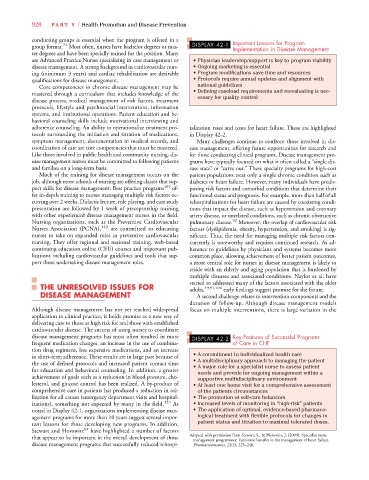
                  adherence counseling. An ability to operationalize treatment pro-  talization rates and costs for heart failure. These are highlighted
                  tocols surrounding the initiation and titration of medications,  in Display 42-2.
                  symptom management, documentation in medical records, and  Many challenges continue to confront those involved in dis-
                  coordination of care are core competencies that must be mastered.  ease management, offering future opportunities for research and
                  Like those involved in public health and community nursing, dis-  for those conducting clinical programs. Disease management pro-
                  ease management nurses must be committed to following patients  grams have typically focused on what is often called a “single dis-
                  and families on a long-term basis.                  ease state” or “carve out.” These specialty programs for high-cost
                     Much of the training for disease management occurs on the  patient populations treat only a single chronic condition such as
                  job, although more schools of nursing are offering classes that sup-  diabetes or heart failure. However, many individuals have predis-
                  port skills for disease management. Best practice programs 109  of-  posing risk factors and comorbid conditions that determine their
                  fer in-depth training to nurses managing multiple risk factors oc-  functional status and prognosis. For example, more than half of all
                  curring over 2 weeks. Didactic lecture, role playing, and case study  rehospitalizations for heart failure are caused by coexisting condi-
                  presentation are followed by 1 week of preceptorship training  tions that impact the disease, such as hypertension and coronary
                  with other experienced disease management nurses in the field.  artery disease, or unrelated conditions, such as chronic obstructive
                  Nursing organizations, such as the Preventive Cardiovascular  pulmonary disease. 92  Moreover, the overlap of cardiovascular risk
                  Nurses Association  (PCNA), 123  are committed to educating  factors (dyslipidemia, obesity, hypertension, and smoking) is sig-
                  nurses to take on expanded roles in preventive cardiovascular  nificant. Thus, the need for managing multiple risk factors con-
                  nursing. They offer regional and national training, web-based  currently is noteworthy and requires continued research. As ad-
                  continuing education online (CEU) courses and important pub-  herence to guidelines by physicians and systems becomes more
                  lications including cardiovascular guidelines and tools that sup-  common place, allowing achievement of better patient outcomes,
                  port those undertaking disease management roles.    a more central role for nurses in disease management is likely to
                                                                      reside with an elderly and aging population that is burdened by
                                                                      multiple diseases and associated conditions. Naylor et al. have
                                                                      started to addressed many of the factors associated with the older
                     THE UNRESOLVED ISSUES FOR                        adults, 49,91,108  early findings suggest promise for the future.
                     DISEASE MANAGEMENT                                 A second challenge relates to intervention components and the
                                                                      duration of follow-up. Although disease management models
                  Although disease management has not yet reached widespread  focus on multiple interventions, there is large variation in the
                  application in clinical practice, it holds promise as a new way of
                  delivering care to those at high risk for and those with established
                  cardiovascular disease. The success of using nurses to coordinate
                  disease management programs has most often resulted in more  DISPLAY 42-2  Key Features of Successful Programs
                  frequent medication changes, an increase in the use of combina-   of Care in CHF
                  tion drug regimens, less expensive medications, and an increase
                  in short-term adherence. These results are in large part because of  • A commitment to individualized health care
                  the use of defined protocols and increased patient contact time  • A multidisciplinary approach to managing the patient
                                                                       • A major role for a specialist nurse to assess patient
                  for education and behavioral counseling. In addition, a greater  needs and provide for ongoing management within a
                  achievement of goals such as a reduction in blood pressure, cho-  supportive multidisciplinary environment
                  lesterol, and glucose control has been realized. A by-product of  • At least one home visit for a comprehensive assessment
                  comprehensive care in patients has produced a reduction in uti-  of the patients circumstances
                  lization for all causes (emergency department visits and hospital-  • The promotion of self-care behaviors
                  izations), something not expected by many in the field. 124  As  • Increased levels of monitoring in “high-risk” patients
                  noted in Display 42-1, organizations implementing disease man-  • The application of optimal, evidence-based pharmaco-
                  agement programs for more than 10 years suggest several impor-  logical treatment with flexible protocols for changes in
                  tant lessons for those developing new programs. In addition,  patient status and titration to maximal tolerated doses.
                  Stewart and Horowitz 69  have highlighted a number of factors
                                                                      Adapted with permission from Stewart, S., & Horowitz, J. (2003). Specialist nurse
                  that appear to be important in the overall development of those
                                                                       management programmes: Economic benefits in the management of heart failure.
                  disease management programs that successfully reduced rehospi-  Pharmacoeconomics, 21(4), 225–240.

