


Page 948 - Cardiac Nursing
P. 948
0
                                    0
                                     6
                                  9
                                   /
                                   /
                                     6
                                       2
                                        009
                                        009
                                      /
                                      /
                                       2
                          32.
                          32.
                             qx
                        1-9
                        1-9
                        1-9
                             qx
                                 2
                                  9
                                  9
                               d
                               d
                                 2
                                                       e 9
                                                         24
                                                         24
                                                      g
                                                      g
                                                       e 9
                                                            Apt
                                                              ar
                                                                a
                                                                a
                                                            Apt
                                                            Apt
                                                              ar
                                            1
                                             1:1
                                             1:1
                                        009
                                             1
                                            1
                                             1:1
                                                  M
                                                    Pa
                                                    Pa
                                               3 P
                                               3 P
                                                  M
                0-c
            K34
            K34
                  42_
                  42_
                0-c
                     p92
         LWB
         LWBK340-c42_42_p92p921-932.qxd  29/06/2009  11:13 PM  Page 924 Aptara
                     p92
         LWB
                  924    PA R T  V / Health Promotion and Disease Prevention
                  highlight the barriers and facilitators of effective case manage-  to disseminate and study the translation of these models into clin-
                  ment in multiethnic, low-income populations, and offer impor-  ical practice settings.
                  tant suggestions for future work based on experiences with such  Approaches to disease management have shown promise and
                  populations. 84                                     documented the leadership and contribution nurses can make in
                                                                      the care of patients with cardiovascular health problems. Although
                  Is Disease Management                               the names of such models may differ, the specific components,
                  Cost-Effective?                                     format, and distribution of health care professionals contributing
                                                                      to the multidisciplinary approaches vary by setting and scope of
                  The majority of work in the area of the cost-effectiveness of dis-  practice according to various health care professional practice acts,
                  ease management is still in its infancy. Due to the burden of  geographic region, payors, and by nationality. Examples of bene-
                  heart failure and the high costs associated with 2.5 million read-  ficial models have been cited from Europe, Australia, the United
                  missions annually, much of the evaluation of costs has been con-  States, and Canada.
                  ducted in this population. Chan et al. 90  applied a Markov model
                  to assess the incremental life expectancy and cost of disease man-
                  agement to both low- and high-risk patients. They looked at the  COMPONENTS OF DISEASE
                  cost of providing disease management to all patients for a period  MANAGEMENT SYSTEMS
                  of 15 years and found that the average coverage at 15 years was
                  $12,882 per life-year saved with 95% CI of $6,486 to $29,293  Identifying a Patient Population
                  per life-year saved. The incremental cost-effectiveness ratio of
                  extending care to all patients was $9,700 per life-year gained and  Effective disease management involves a process of identifying at-
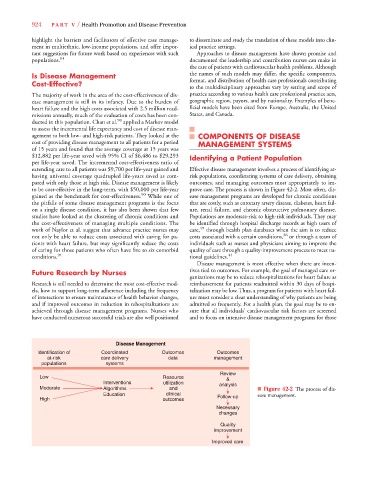
                  having universal coverage quadrupled life-years saved as com-  risk populations, coordinating systems of care delivery, obtaining
                  pared with only those at high risk. Disease management is likely  outcomes, and managing outcomes most appropriately to im-
                  to be cost-effective in the long-term, with $50,000 per life-year  prove care. The process is shown in Figure 42-2. Most often, dis-
                  gained as the benchmark for cost-effectiveness. 90  While one of  ease management programs are developed for chronic conditions
                  the pitfalls of some disease management programs is the focus  that are costly, such as coronary artery disease, diabetes, heart fail-
                  on a single disease condition, it has also been shown that few  ure, renal failure, and chronic obstructive pulmonary disease.
                  studies have looked at the clustering of chronic conditions and  Populations are moderate-risk to high-risk individuals. They may
                  the cost-effectiveness of managing multiple conditions. The  be identified through hospital discharge records as high users of
                  work of Naylor et al. suggest that advance practice nurses may  care, 49  through health plan databases when the aim is to reduce
                  not only be able to reduce costs associated with caring for pa-  costs associated with a certain conditions, 36  or through a team of
                  tients with heart failure, but may significantly reduce the costs  individuals such as nurses and physicians aiming to improve the
                  of caring for those patients who often have five to six comorbid  quality of care through a quality-improvement process to meet na-
                  conditions. 91                                      tional guidelines. 44
                                                                        Disease management is most effective when there are incen-
                  Future Research by Nurses                           tives tied to outcomes. For example, the goal of managed care or-
                                                                      ganizations may be to reduce rehospitalizations for heart failure as
                  Research is still needed to determine the most cost-effective mod-  reimbursement for patients readmitted within 30 days of hospi-
                  els, how to support long-term adherence including the frequency  talization may be low. Thus, a program for patients with heart fail-
                  of interactions to ensure maintenance of health behavior changes,  ure must consider a clear understanding of why patients are being
                  and if improved outcomes in reduction in rehospitalizations are  admitted so frequently. For a health plan, the goal may be to en-
                  achieved through disease management programs. Nurses who  sure that all individuals’ cardiovascular risk factors are screened
                  have conducted numerous successful trials are also well positioned  and to focus on intensive disease management programs for those
                    Identification of    Coordinated         Outcomes          Outcomes
                       at-risk           care delivery         data           management
                      populations          systems
                                                                                Review
                     Low                                     Resource             &
                                          Interventions      utilization        analysis
                     Moderate             Algorithms           and                          ■ Figure 42-2 The process of dis-
                                          Education           clinical                      ease management.
                     High                                    outcomes          Follow-up
                                                                               Necessary
                                                                                changes
                                                                                Quality
                                                                              improvement
                                                                             Improved care

