


Page 431 - Encyclopedia of Nursing Research
P. 431
398  n  PeT THeRAPY


              AAT  is  not  theory  specific;  therefore,   countless  articles  that  provide  heartwarm-
           a variety of theories can be used. Common   ing anecdotes, but because most of the work
   P       theories  cited  and  often  supported  in  AAT   is done by individuals outside the academic
           include  but  are  not  limited  to  attachment   world,  resources  to  conduct  such  extensive
           theory,  attention  egens,  Rogerian  theory,   research are not sufficient (Beck & Hatcher,
           biophilia hypothesis, learning theory, social   2003).
           mediation theory, object relations theory, and   Most of the studies that have been con-
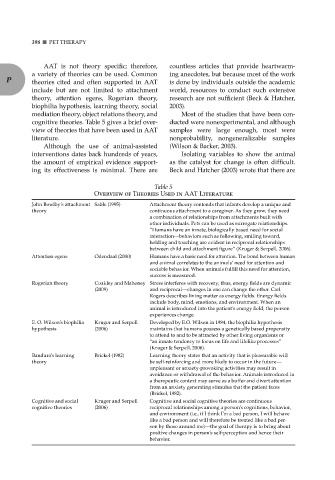
           cognitive theories. Table 5 gives a brief over-  ducted were nonexperimental, and although
           view of theories that have been used in AAT   samples  were  large  enough,  most  were
           literature.                              nonprobability,  nongeneralizable  samples
              Although  the  use  of  animal-assisted   (Wilson & Barker, 2003).
           interventions dates back hundreds of years,   Isolating  variables  to  show  the  animal
           the  amount  of  empirical  evidence  support-  as  the  catalyst  for  change  is  often  difficult.
           ing  its  effectiveness  is  minimal.  There  are   Beck and Hatcher (2003) wrote that there are

                                               Table 5
                             Overview of Theories Used in AAT literature
           John Bowlby’s attachment  Sable (1995)  Attachment theory contends that infants develop a unique and
           theory                             continuous attachment to a caregiver. As they grow, they need
                                              a combination of relationships from attachments built with
                                              other individuals. Pets can be used as surrogate relationships.
                                              “Humans have an innate, biologically based need for social
                                              interaction—behaviors such as following, smiling toward,
                                              holding and touching are evident in reciprocal relationships
                                              between child and attachment figure” (Kruger & Serpell, 2006).
           Attention egens   Odendaal (2000)  Humans have a basic need for attention. The bond between human
                                              and animal correlates to the animals’ need for attention and
                                              sociable behavior. When animals fulfill this need for attention,
                                              success is measured.
           Rogerian theory    Coakley and Mahoney  Stress interferes with recovery; thus, energy fields are dynamic
                              (2009)          and reciprocal—changes in one can change the other. Carl
                                              Rogers describes living matter as energy fields. energy fields
                                              include body, mind, emotions, and environment. When an
                                              animal is introduced into the patient’s energy field, the person
                                              experiences change.
           e. O. Wilson’s biophilia   Kruger and Serpell   Developed by e.O. Wilson in 1984, the biophilia hypothesis
           hypothesis        (2006)           maintains that humans possess a genetically based propensity
                                              to attend to and to be attracted by other living organisms or
                                              “an innate tendency to focus on life and lifelike processes”
                                              (Kruger & Serpell, 2006).
           Bandura’s learning    Brickel (1982)  learning theory states that an activity that is pleasurable will
           theory                             be self-reinforcing and more likely to occur in the future—
                                              unpleasant or anxiety-provoking activities may result in
                                              avoidance or withdrawal of the behavior. Animals introduced in
                                              a therapeutic context may serve as a buffer and divert attention
                                              from an anxiety generating stimulus that the patient faces
                                              (Brickel, 1982).
           Cognitive and social    Kruger and Serpell   Cognitive and social cognitive theories are continuous
           cognitive theories   (2006)          reciprocal relationships among a person’s cognitions, behavior,
                                              and environment (i.e., if I think I’m a bad person, I will behave
                                              like a bad person and will therefore be treated like a bad per-
                                              son by those around me)—the goal of therapy is to bring about
                                              positive changes in person’s self-perception and hence their
                                              behavior.

