


Page 267 - ACCCN's Critical Care Nursing
P. 267
244  P R I N C I P L E S   A N D   P R A C T I C E   O F   C R I T I C A L   C A R E

         ●  vascular  signs:  arterial  emboli,  intracranial  haemor-  Artery
            rhage,  Janeway  lesions  (erythematous  spots  on  the
            palms and feet) or conjunctival haemorrhages
         ●  immunological  signs:  Osler  nodes  (painful,  red-
            dened  nodules  on  the  fingers  and  the  feet),  or
            glomerulonephritis 98
                                                                  A
         Echocardiography  may  reveal  vegetations,  abscess  and                               Fusiform area
         valvular abnormalities, but endocarditis is more a clinical   Artery
         diagnosis based on the appearance of febrile illness, posi-
         tive blood cultures with organisms known to cause endo-
         carditis, new murmur and vascular features.
         Management
                                                                  B                            Sacculated area
         Prosthetic  valve  endocarditis  must  be  aggressively
                                                100
         managed, as mortality may be as high as 65%.  Impaired
         valvular  opening,  even  obstruction,  may  occur  or  the                               Torn intima
                                           100
         prosthetic valve may become unseated.  Reoperation to                                        False
         replace  the  affected  valve  should  be  undertaken  when   Blood                          channel
         valvular dysfunction is present. Antibiotic therapy is pro-  flow                            created
         vided empirically until blood culture and sensitivities are
         established. Cardiac failure, if present, is managed along   C
         standard lines (see section on Nursing management of                                 Ruptured area with
         acute  heart  failure).  Observations  during  endocarditis                          clot covering the
         should  be  directed  at  detecting  embolic  complications                          opening
         involving the brain, kidneys, or spleen; development and
         progress  of  heart  failure;  progress  of  the  febrile  illness,   Blood
                                                                    flow
         including hydration and dietary status.
                                                                  D
         Prophylactic  antibiotic  coverage  should  be  undertaken
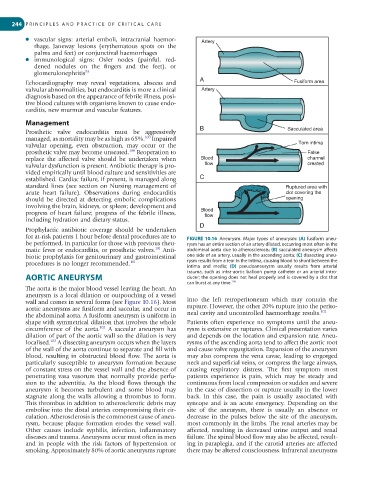
         for at-risk patients 1 hour before dental procedures are to   FIGURE  10.16  Aneurysm.  Major  types  of  aneurysm:  (A)  fusiform  aneu-
         be performed, in particular for those with previous rheu-  rysm has an entire section of an artery dilated, occurring most often in the
                                                    101
         matic fever or endocarditis, or prosthetic valves.  Anti-  abdominal aorta due to atherosclerosis; (B) sacculated aneurysm affects
         biotic prophylaxis for genitourinary and gastrointestinal   one side of an artery, usually in the ascending aorta; (C) dissecting aneu-
         procedures is no longer recommended. 101             rysm results from a tear in the intima, causing blood to shunt between the
                                                              intima  and  media;  (D)  pseudoaneurysm  usually  results  from  arterial
                                                              trauma,  such  as  intra-aortic  balloon  pump  catheter  or  an  arterial  intro-
         AORTIC ANEURYSM                                      ducer; the opening does not heal properly and is covered by a clot that
                                                                             106
                                                              can burst at any time.
         The aorta is the major blood vessel leaving the heart. An
         aneurysm is a local dilation or outpouching of a vessel
         wall and comes in several forms (see Figure 10.16). Most   into  the  left  retroperitoneum  which  may  contain  the
         aortic aneurysms are fusiform and saccular, and occur in   rupture. However, the other 20% rupture into the perito-
                                                                                                          102
         the abdominal aorta. A fusiform aneurysm is uniform in   neal cavity and uncontrolled haemorrhage results.
         shape with symmetrical dilation that involves the whole   Patients often experience no symptoms until the aneu-
                                  102
         circumference  of  the  aorta.   A  saccular  aneurysm  has   rysm is extensive or ruptures. Clinical presentation varies
         dilation of part of the aortic wall so the dilation is very   and depends on the location and expansion rate. Aneu-
                  102
         localised.  A dissecting aneurysm occurs when the layers   rysms of the ascending aorta tend to affect the aortic root
         of the wall of the aorta continue to separate and fill with   and cause valve regurgitation. Expansion of the aneurysm
         blood,  resulting  in  obstructed  blood  flow.  The  aorta  is   may also compress the vena cavae, leading to engorged
         particularly  susceptible  to  aneurysm  formation  because   neck and superficial veins, or compress the large airways,
         of constant stress on the vessel wall and the absence of   causing  respiratory  distress.  The  first  symptom  most
         penetrating  vasa  vasorum  that  normally  provide  perfu-  patients  experience  is  pain,  which  may  be  steady  and
         sion  to  the  adventitia.  As  the  blood  flows  through  the   continuous from local compression or sudden and severe
         aneurysm  it  becomes  turbulent  and  some  blood  may   in the case of dissection or rupture usually in the lower
         stagnate  along  the  walls  allowing  a  thrombus  to  form.   back.  In  this  case,  the  pain  is  usually  associated  with
         This thrombus in addition to atherosclerotic debris may   syncope  and  is  an  acute  emergency.  Depending  on  the
         embolise into the distal arteries compromising their cir-  site  of  the  aneurysm,  there  is  usually  an  absence  or
         culation. Atherosclerosis is the commonest cause of aneu-  decrease  in  the  pulses  below  the  site  of  the  aneurysm,
         rysm, because plaque formation erodes the vessel wall.   most commonly in the limbs. The renal arteries may be
         Other  causes  include  syphilis,  infection,  inflammatory   affected,  resulting  in  decreased  urine  output  and  renal
         diseases and trauma. Aneurysms occur most often in men   failure. The spinal blood flow may also be affected, result-
         and  in  people  with  the  risk  factors  of  hypertension  or   ing in paraplegia, and if the carotid arteries are affected
         smoking. Approximately 80% of aortic aneurysms rupture   there may be altered consciousness. Infrarenal aneurysms

