


Page 264 - ACCCN's Critical Care Nursing
P. 264
Cardiovascular Alterations and Management 241


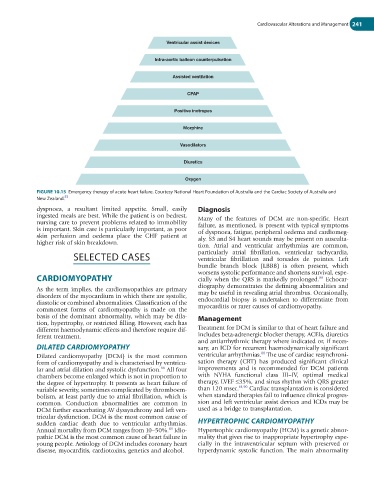
                                                        Ventricular assist devices


                                                    Intra-aortic balloon counterpulsation

                                                          Assisted ventilation

                                                              CPAP


                                                          Positive inotropes


                                                             Morphine

                                                            Vasodilators

                                                             Diuretics


                                                              Oxygen
             FIGURE 10.15  Emergency therapy of acute heart failure. Courtesy National Heart Foundation of Australia and the Cardiac Society of Australia and
                      55
             New Zealand.
             dyspnoea,  a  resultant  limited  appetite.  Small,  easily   Diagnosis
             ingested meals are best. While the patient is on bedrest,   Many  of  the  features  of  DCM  are  non-specific.  Heart
             nursing care to prevent problems related to immobility   failure, as mentioned, is present with typical symptoms
             is important. Skin care is particularly important, as poor   of dyspnoea, fatigue, peripheral oedema and cardiomeg-
             skin  perfusion  and  oedema  place  the  CHF  patient  at   aly. S3 and S4 heart sounds may be present on ausculta-
             higher risk of skin breakdown.
                                                                  tion.  Atrial  and  ventricular  arrhythmias  are  common,
                         SELECTED CASES                           particularly  atrial  fibrillation,  ventricular  tachycardia,
                                                                  ventricular  fibrillation  and  torsades  de  pointes.  Left
                                                                  bundle  branch  block  (LBBB)  is  often  present,  which
                                                                  worsens systolic performance and shortens survival, espe-
             CARDIOMYOPATHY                                       cially when the QRS is markedly prolonged.  Echocar-
                                                                                                         88
                                                                  diography demonstrates the defining abnormalities and
             As  the  term  implies,  the  cardiomyopathies  are  primary
             disorders of the myocardium in which there are systolic,   may be useful in revealing atrial thrombus. Occasionally,
             diastolic or combined abnormalities. Classification of the   endocardial  biopsy  is  undertaken  to  differentiate  from
             commonest  forms  of  cardiomyopathy  is  made  on  the   myocarditis or rarer causes of cardiomyopathy.
             basis of the dominant abnormality, which may be dila-  Management
             tion, hypertrophy, or restricted filling. However, each has
             different haemodynamic effects and therefore require dif-  Treatment for DCM is similar to that of heart failure and
             ferent treatment.                                    includes beta-adrenergic blocker therapy, ACEIs, diuretics
                                                                  and antiarrhythmic therapy where indicated or, if neces-
             DILATED CARDIOMYOPATHY                               sary, an ICD for recurrent haemodynamically significant
                                                                                      88
             Dilated  cardiomyopathy  (DCM)  is  the  most  common   ventricular arrhythmias.  The use of cardiac resynchroni-
             form of cardiomyopathy and is characterised by ventricu-  sation  therapy  (CRT)  has  produced  significant  clinical
             lar and atrial dilation and systolic dysfunction.  All four   improvements  and  is  recommended  for  DCM  patients
                                                      88
             chambers become enlarged which is not in proportion to   with  NYHA  functional  class  III–IV,  optimal  medical
             the degree of hypertrophy. It presents as heart failure of   therapy, LVEF ≤35%, and sinus rhythm with QRS greater
             variable severity, sometimes complicated by thromboem-  than 120 msec. 61,90  Cardiac transplantation is considered
             bolism, at least partly due to atrial fibrillation, which is   when standard therapies fail to influence clinical progres-
             common.  Conduction  abnormalities  are  common  in   sion and left ventricular assist devices and ICDs may be
             DCM further exacerbating AV dyssynchrony and left ven-  used as a bridge to transplantation.
             tricular dysfunction. DCM is the most common cause of
             sudden  cardiac  death  due  to  ventricular  arrhythmias.   HYPERTROPHIC CARDIOMYOPATHY
             Annual mortality from DCM ranges from 10–50%.  Idio-  Hypertrophic cardiomyopathy (HCM) is a genetic abnor-
                                                        89
             pathic DCM is the most common cause of heart failure in   mality that gives rise to inappropriate hypertrophy espe-
             young people. Aetiology of DCM includes coronary heart   cially  in  the  intraventricular  septum  with  preserved  or
             disease, myocarditis, cardiotoxins, genetics and alcohol.  hyperdynamic  systolic  function.  The  main  abnormality

