


Page 605 - ACCCN's Critical Care Nursing
P. 605
582  S P E C I A LT Y   P R A C T I C E   I N   C R I T I C A L   C A R E

                                          2-6
         sort and analyse relevant information.  This foundation
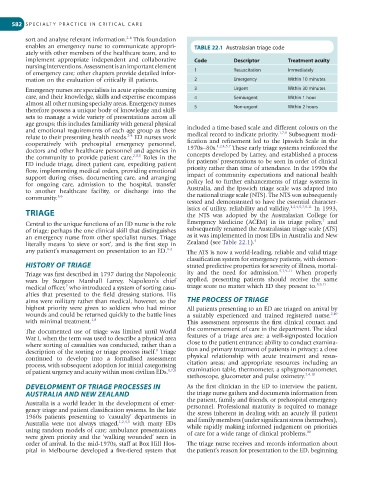
         enables an emergency nurse to communicate appropri-     TABLE 22.1  Australasian triage code
         ately with other members of the healthcare team, and to
         implement  appropriate  independent  and  collaborative   Code       Descriptor       Treatment acuity
         nursing interventions. Assessment is an important element
         of emergency care; other chapters provide detailed infor-  1         Resuscitation    Immediately
         mation on the evaluation of critically ill patients.    2            Emergency        Within 10 minutes
         Emergency nurses are specialists in acute episodic nursing   3       Urgent           Within 30 minutes
         care, and their knowledge, skills and expertise encompass   4        Semiurgent       Within 1 hour
         almost all other nursing specialty areas. Emergency nurses
         therefore possess a unique body of knowledge and skill-  5           Non-urgent       Within 2 hours
         sets to manage a wide variety of presentations across all
         age groups; this includes familiarity with general physical
         and emotional requirements of each age group as these   included a time-based scale and different colours on the
                                                                                            1,7,8
         relate to their presenting health needs.  ED nurses work   medical record to indicate priority.   Subsequent modi-
                                           2-4
         cooperatively  with  prehospital  emergency  personnel,   fication and refinement led to the Ipswich Scale in the
                                                                        1,2,4,5,7
         doctors and other healthcare personnel and agencies in   1970s–80s.   These early triage systems reinforced the
         the community to provide patient care. 2,3,5  Roles in the   concepts developed by Larrey, and established a process
         ED include triage, direct patient care, expediting patient   for patients’ presentations to be seen in order of clinical
         flow, implementing medical orders, providing emotional   priority rather than time of attendance. In the 1990s the
         support during crises, documenting care, and arranging   impact of community expectations and national health
         for  ongoing  care,  admission  to  the  hospital,  transfer     policy led to further enhancements of triage systems in
         to  another  healthcare  facility,  or  discharge  into  the   Australia, and the Ipswich triage scale was adapted into
         community. 5,6                                       the national triage scale (NTS). The NTS was subsequently
                                                              tested and demonstrated to have the essential character-
         TRIAGE                                               istics of utility, reliability and validity. 1,2,4,5,7,9-11  In 1993,
                                                              the  NTS  was  adopted  by  the  Australasian  College  for
                                                                                                           7
         Central to the unique functions of an ED nurse is the role   Emergency  Medicine  (ACEM)  in  its  triage  policy,   and
         of triage; perhaps the one clinical skill that distinguishes   subsequently renamed the Australasian triage scale (ATS)
         an emergency nurse from other specialist nurses. Triage   as it was implemented in most EDs in Australia and New
                                                                                    4
         literally means ‘to sieve or sort’, and is the first step in   Zealand (see Table 22.1).
         any patient’s management on presentation to an ED. 1-3  The ATS is now a world-leading, reliable and valid triage
                                                              classification system for emergency patients, with demon-
         HISTORY OF TRIAGE                                    strated predictive properties for severity of illness, mortal-
         Triage was first described in 1797 during the Napoleonic   ity  and  the  need  for  admission. 5,7,9-11   When  properly
         wars  by  Surgeon  Marshall  Larrey,  Napoleon’s  chief   applied,  presenting  patients  should  receive  the  same
                       7
         medical officer,  who introduced a system of sorting casu-  triage score no matter which ED they present to. 5,9,11
         alties  that  presented  to  the  field  dressing  stations.  His
         aims were military rather than medical, however, so the   THE PROCESS OF TRIAGE
         highest  priority  were  given  to  soldiers  who  had  minor   All patients presenting to an ED are triaged on arrival by
         wounds and could be returned quickly to the battle lines   a  suitably  experienced  and  trained  registered  nurse. 2,10
         with minimal treatment. 1,8                          This assessment represents the first clinical contact and
         The  documented  use  of  triage  was  limited  until  World   the commencement of care in the department. The ideal
         War I, when the term was used to describe a physical area   features  of  a  triage  area  are:  a  well-signposted  location
         where sorting of casualties was conducted, rather than a   close to the patient entrance; ability to conduct examina-
         description of the sorting or triage process itself.  Triage   tion and primary treatment of patients in privacy; a close
                                                    8
         continued  to  develop  into  a  formalised  assessment   physical  relationship  with  acute  treatment  and  resus-
         process, with subsequent adoption for initial categorising   citation  areas;  and  appropriate  resources  including  an
         of patient urgency and acuity within most civilian EDs. 1,7,8  examination table, thermometer, a sphygmomanometer,
                                                              stethoscope, glucometer and pulse oximetry. 2,4,10
         DEVELOPMENT OF TRIAGE PROCESSES IN                   As the first clinician in the ED to interview the patient,
         AUSTRALIA AND NEW ZEALAND                            the triage nurse gathers and documents information from

         Australia is a world leader in the development of emer-  the patient, family and friends, or prehospital emergency
                                                              personnel. Professional maturity is required to manage
         gency triage and patient classification systems. In the late   the stress inherent in dealing with an acutely ill patient
         1960s  patients  presenting  to  ‘casualty’  departments  in   and family members (under significant stress themselves),
         Australia  were  not  always  triaged, 1,2,4,5   with  many  EDs   while rapidly making informed judgement on priorities
         using random models of care; ambulance presentations   of care for a wide range of clinical problems. 10
         were  given  priority  and  the  ‘walking  wounded’  seen  in
         order of arrival. In the mid-1970s, staff at Box Hill Hos-  The triage nurse receives and records information about
         pital  in  Melbourne  developed  a  five-tiered  system  that   the patient’s reason for presentation to the ED, beginning

