


Page 608 - ACCCN's Critical Care Nursing
P. 608
Emergency Presentations 585

             system  to  discover  abnormalities  (i.e.  central  nervous   Mental Health Presentations
             system, cardiovascular system, respiratory system, gastro-  Patients with psychiatric problems presenting to an ED
             intestinal system, etc.). 6,11,12  See also the relevant ‘system-  should  be  triaged,  assessed  and  treated  as  for  other
             based’ chapters.
                                                                  presenting  patients,  with  particular  attention  to  appro-
                                                                  priate initial medical assessment and management. 6,11,12
             TRIAGE ASSESSMENT OF SPECIFIC                        Resources outlining specific mental health triage category
             PATIENT GROUPS                                       descriptors  are  readily  available,  and  relate  specific
             While triage assessment is a complex process for a range   aspects  of  mental  health  presentation  with  clinical
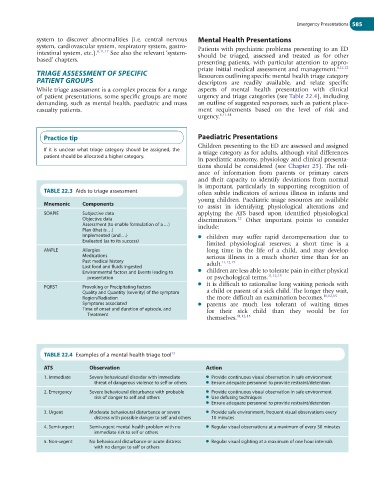
             of patient presentations, some specific groups are more   urgency and triage categories (see Table 22.4), including
             demanding, such as mental health, paediatric and mass   an outline of suggested responses, such as patient place-
             casualty patients.                                   ment  requirements  based  on  the  level  of  risk  and
                                                                  urgency. 6,11-14


               Practice tip                                       Paediatric Presentations
                                                                  Children presenting to the ED are assessed and assigned
               If  it  is  unclear  what  triage  category  should  be  assigned,  the   a triage category as for adults, although vital differences
               patient should be allocated a higher category.
                                                                  in paediatric anatomy, physiology and clinical presenta-
                                                                  tions  should  be  considered  (see  Chapter  25).  The  reli-
                                                                  ance  of  information  from  parents  or  primary  carers
                                                                  and  their  capacity  to  identify  deviations  from  normal
                                                                  is  important,  particularly  in  supporting  recognition  of
               TABLE 22.3  Aids to triage assessment              often subtle indicators of serious illness in infants and
                                                                  young children. Paediatric triage resources are available
               Mnemonic     Components                            to  assist  in  identifying  physiological  alterations  and
               SOAPIE       Subjective data                       applying  the  ATS  based  upon  identified  physiological
                            Objective data                        discriminators.   Other  important  points  to  consider
                                                                               12
                            Assessment (to enable formulation of a …)  include:
                            Plan (that is …)
                            Implemented (and …)                   l  children  may  suffer  rapid  decompensation  due  to
                            Evaluated (as to its success)            limited  physiological  reserves;  a  short  time  is  a
               AMPLE        Allergies                                long  time  in  the  life  of  a  child,  and  may  develop
                            Medications                              serious  illness  in  a  much  shorter  time  than  for  an
                            Past medical history                     adult. 11,12,15
                            Last food and fluids ingested
                            Environmental factors and Events leading to   l  children are less able to tolerate pain in either physical
                              presentation                           or psychological terms. 11,12,15
                                                                  l  it is difficult to rationalise long waiting periods with
               PQRST        Provoking or Precipitating factors
                            Quality and Quantity (severity) of the symptom  a child or parent of a sick child. The longer they wait,
                            Region/Radiation                         the more difficult an examination becomes. 11,12,15
                            Symptoms associated                   l  parents  are  much  less  tolerant  of  waiting  times
                            Time of onset and duration of episode, and   for  their  sick  child  than  they  would  be  for
                              Treatment
                                                                     themselves. 11,12,15


               TABLE 22.4  Examples of a mental health triage tool 13
               ATS            Observation                           Action
               1. Immediate   Severe behavioural disorder with immediate   l  Provide continuous visual observation in safe environment
                                threat of dangerous violence to self or others  l  Ensure adequate personnel to provide restraint/detention
               2. Emergency   Severe behavioural disturbance with probable   l  Provide continuous visual observation in safe environment
                                risk of danger to self and others   l  Use defusing techniques
                                                                    l  Ensure adequate personnel to provide restraint/detention
               3. Urgent      Moderate behavioural disturbance or severe   l  Provide safe environment, frequent visual observations every
                                distress with possible danger to self and others  10 minutes
               4. Semi-urgent  Semi-urgent mental health problem with no   l  Regular visual observations at a maximum of every 30 minutes
                                immediate risk to self or others
               5. Non-urgent  No behavioural disturbance or acute distress   l  Regular visual sighting at a maximum of one hour intervals
                                with no danger to self or others

