


Page 678 - ACCCN's Critical Care Nursing
P. 678
Resuscitation 655

                                                                  as standardised recording of outcome data did not exist,
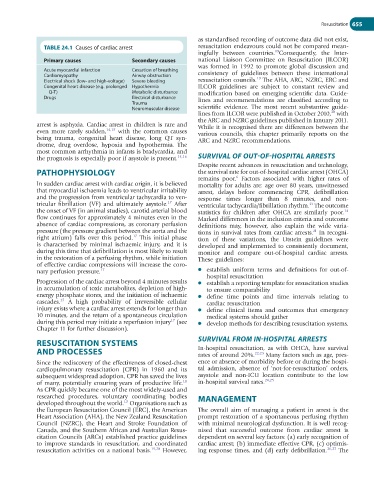
               TABLE 24.1  Causes of cardiac arrest               resuscitation endeavours could not be compared mean-
                                                                                           19
                                                                  ingfully  between  countries. Consequently,  the  Inter-
               Primary causes               Secondary causes      national  Liaison  Committee  on  Resuscitation  (ILCOR)
                                                                  was formed in 1992 to promote global discussion and
               Acute myocardial infarction  Cessation of breathing
               Cardiomyopathy               Airway obstruction    consistency  of  guidelines  between  these  international
                                                                                     19
               Electrical shock (low- and high-voltage)  Severe bleeding  resuscitation councils.  The AHA, ARC, NZRC, ERC and
               Congenital heart disease (e.g. prolonged  Hypothermia  ILCOR  guidelines  are  subject  to  constant  review  and
                 Q-T)                       Metabolic disturbance  modification  based  on  emerging  scientific  data.  Guide-
               Drugs                        Electrical disturbance  lines  and  recommendations  are  classified  according  to
                                            Trauma
                                            Neuromuscular disease  scientific  evidence.  The  most  recent  substantive  guide-
                                                                                                             20
                                                                  lines from ILCOR were published in October 2010,  with
                                                                  the ARC and NZRC guidelines published in January 2011.
             arrest is asphyxia. Cardiac arrest in children is rare and   While it is recognised there are differences between the
             even  more  rarely  sudden, 14,15   with  the  common  causes   various  councils,  this  chapter  primarily  reports  on  the
             being  trauma,  congenital  heart  disease,  long  QT  syn-  ARC and NZRC recommendations.
             drome,  drug  overdose,  hypoxia  and  hypothermia.  The
             most common arrhythmia in infants is bradycardia, and
             the prognosis is especially poor if asystole is present. 14,16  SURVIVAL OF OUT-OF-HOSPITAL ARRESTS
                                                                  Despite recent advances in resuscitation and technology,
             PATHOPHYSIOLOGY                                      the survival rate for out-of-hospital cardiac arrest (OHCA)
                                                                              6
                                                                  remains  poor.   Factors  associated  with  higher  rates  of
             In sudden cardiac arrest with cardiac origin, it is believed   mortality for adults are: age over 80 years, unwitnessed
             that myocardial ischaemia leads to ventricular irritability   arrest,  delays  before  commencing  CPR,  defibrillation
             and the progression from ventricular tachycardia to ven-  response  times  longer  than  8  minutes,  and  non-
                                                        17
             tricular  fibrillation  (VF)  and  ultimately  asystole.   After   ventricular tachycardia/fibrillation rhythm.  The outcome
                                                                                                      21
             the onset of VF (in animal studies), carotid arterial blood   statistics  for  children  after  OHCA  are  similarly  poor.
                                                                                                                  14
             flow continues for approximately 4 minutes even in the   Marked differences in the inclusion criteria and outcome
             absence of cardiac compressions, as coronary perfusion   definitions  may,  however,  also  explain  the  wide  varia-
             pressure (the pressure gradient between the aorta and the   tions in survival rates from cardiac arrests.  In recogni-
                                                                                                       21
                                             17
             right  atrium)  falls  over  this  period.   This  initial  phase   tion  of  these  variations,  the  Utstein  guidelines  were
             is  characterised  by  minimal  ischaemic  injury,  and  it  is   developed and implemented to consistently document,
             during this time that defibrillation is most likely to result   monitor  and  compare  out-of-hospital  cardiac  arrests.
             in the restoration of a perfusing rhythm, while initiation   These guidelines:
             of effective cardiac compressions will increase the coro-
             nary perfusion pressure. 17                          l  establish  uniform  terms  and  definitions  for  out-of-
                                                                     hospital resuscitation
             Progression of the cardiac arrest beyond 4 minutes results   l  establish a reporting template for resuscitation studies
             in accumulation of toxic metabolites, depletion of high-  to ensure comparability
             energy phosphate stores, and the initiation of ischaemic   l  define  time  points  and  time  intervals  relating  to
             cascades.   A  high  probability  of  irreversible  cellular   cardiac resuscitation
                     17
             injury exists where a cardiac arrest extends for longer than   l  define  clinical  items  and  outcomes  that  emergency
             10 minutes, and the return of a spontaneous circulation   medical systems should gather
                                                         17
             during this period may initiate a reperfusion injury  (see   l  develop methods for describing resuscitation systems.
             Chapter 11 for further discussion).
             RESUSCITATION SYSTEMS                                SURVIVAL FROM IN-HOSPITAL ARRESTS
             AND PROCESSES                                        In-hospital  resuscitation,  as  with  OHCA,  have  survival
                                                                                        Many factors such as age, pres-
                                                                                    22,23
                                                                  rates of around 20%.
             Since the rediscovery of the effectiveness of closed-chest   ence or absence of morbidity before or during the hospi-
             cardiopulmonary  resuscitation  (CPR)  in  1960  and  its   tal  admission,  absence  of  ‘not-for-resuscitation’  orders,
             subsequent widespread adoption, CPR has saved the lives   asystole  and  non-ICU  location  contribute  to  the  low
                                                             18
             of many, potentially ensuring years of productive life.    in-hospital survival rates. 24,25
             As CPR quickly became one of the most widely-used and
             researched  procedures,  voluntary  coordinating  bodies   MANAGEMENT
                                          13
             developed throughout the world.  Organisations such as
             the European Resuscitation Council (ERC), the American   The  overall  aim  of  managing  a  patient  in  arrest  is  the
             Heart Association (AHA), the New Zealand Resuscitation   prompt  restoration  of  a  spontaneous  perfusing  rhythm
             Council  (NZRC),  the  Heart  and  Stroke  Foundation  of   with minimal neurological dysfunction. It is well recog-
             Canada, and the Southern African and Australian Resus-  nised  that  successful  outcome  from  cardiac  arrest  is
             citation Councils (ARCs) established practice guidelines   dependent on several key factors: (a) early recognition of
             to  improve  standards  in  resuscitation,  and  coordinated   cardiac arrest; (b) immediate effective CPR, (c) optimis-
             resuscitation activities on a national basis. 19,20  However,   ing response times, and (d) early defibrillation. 26,27  The

