


Page 679 - ACCCN's Critical Care Nursing
P. 679
656  S P E C I A LT Y   P R A C T I C E   I N   C R I T I C A L   C A R E

         probability of an unsuccessful outcome grows with the   always been adequate when a cardiac arrest occurs in the
         length of time taken to restore spontaneous circulation.  hospital,  from  the  point  of  view  of  early  recognition,
                                                              timeliness or availability of equipment or staff. 24,25  The
         CHAIN OF SURVIVAL                                    traditional cardiac arrest team responded to the seriously
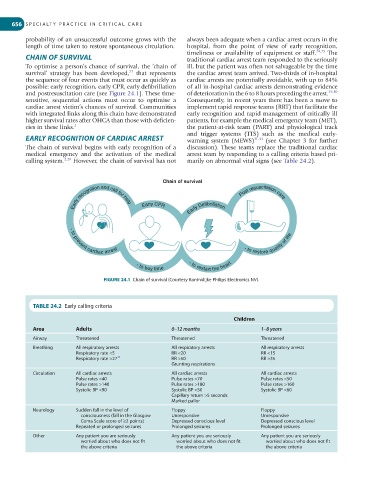
         To optimise a person’s chance of survival, the ‘chain of   ill, but the patient was often not salvageable by the time
                                           27
         survival’  strategy  has  been  developed,   that  represents   the cardiac arrest team arrived. Two-thirds of in-hospital
         the sequence of four events that must occur as quickly as   cardiac arrests are potentially avoidable, with up to 84%
         possible: early recognition, early CPR, early defibrillation   of all in-hospital cardiac arrests demonstrating evidence
         and postresuscitation care (see Figure 24.1). These time-  of deterioration in the 6 to 8 hours preceding the arrest. 29,30
         sensitive,  sequential  actions  must  occur  to  optimise  a   Consequently, in recent years there has been a move to
         cardiac arrest victim’s chances of survival. Communities   implement rapid response teams (RRT) that facilitate the
         with integrated links along this chain have demonstrated   early recognition and rapid management of critically ill
         higher survival rates after OHCA than those with deficien-  patients, for example the medical emergency team (MET),
         cies in these links. 2                               the  patient-at-risk  team  (PART)  and  physiological  track
                                                              and  trigger  systems  (TTS)  such  as  the  medical  early-
         EARLY RECOGNITION OF CARDIAC ARREST                  warning  system  (MEWS) 31-33   (see  Chapter  3  for  further
         The chain of survival begins with early recognition of a   discussion). These teams replace the traditional cardiac
         medical  emergency  and  the  activation  of  the  medical   arrest team by responding to a calling criteria based pri-
         calling system. 2,28  However, the chain of survival has not   marily on abnormal vital signs (see Table 24.2).


                                                      Chain of survival


                                                                                Post resuscitation care
                         Early recognition and call for help  Early CPR
                                                               Early Defibrillation


                                                                                 - to restore quality of life

                        - to prevent cardiac arrest

                                                               - to restart the heart
                                              - to buy time
                                   FIGURE 24.1  Chain of survival (Courtesy Koninklijke Philips Electronics NV).


            TABLE 24.2  Early calling criteria
                                                                              Children
            Area          Adults                         0–12 months                  1–8 years
            Airway        Threatened                     Threatened                   Threatened
            Breathing     All respiratory arrests        All respiratory arrests      All respiratory arrests
                          Respiratory rate <5            RR <20                       RR <15
                          Respiratory rate >27 32        RR >50                       RR >35
                                                         Grunting respirations
            Circulation   All cardiac arrests            All cardiac arrests          All cardiac arrests
                          Pulse rates <40                Pulse rates <70              Pulse rates <50
                          Pulse rates >140               Pulse rates >180             Pulse rates >160
                          Systolic BP <90                Systolic BP <50              Systolic BP <60
                                                         Capillary return >5 seconds
                                                         Marked pallor
            Neurology     Sudden fall in the level of    Floppy                       Floppy
                           consciousness (fall in the Glasgow   Unresponsive          Unresponsive
                           Coma Scale score of ≥2 points)  Depressed conscious level  Depressed conscious level
                          Repeated or prolonged seizures  Prolonged seizures          Prolonged seizures
            Other         Any patient you are seriously   Any patient you are seriously   Any patient you are seriously
                           worried about who does not fit   worried about who does not fit   worried about who does not fit
                           the above criteria              the above criteria           the above criteria

