


Page 65 - APPENDIX B: Trials Investigating the Management of Acute Radiation-Induced Skin Reactions Reading Qualitative Research
P. 65
65
               WOUND CARE

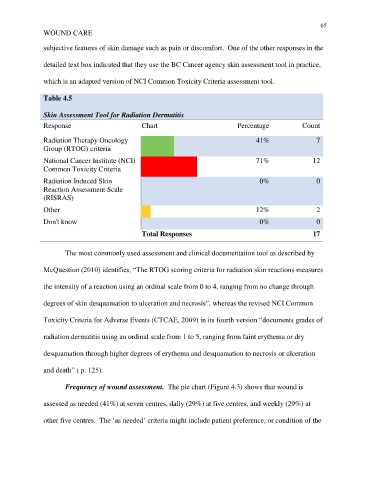
               subjective features of skin damage such as pain or discomfort.  One of the other responses in the

               detailed text box indicated that they use the BC Cancer agency skin assessment tool in practice,


               which is an adapted version of NCI Common Toxicity Criteria assessment tool.

               Table 4.5

               Skin Assessment Tool for Radiation Dermatitis
               Response                         Chart                           Percentage           Count

               Radiation Therapy Oncology                                             41%                 7
               Group (RTOG) criteria
               National Cancer Institute (NCI)                                        71%               12
               Common Toxicity Criteria
               Radiation Induced Skin                                                  0%                 0
               Reaction Assessment Scale
               (RISRAS)
               Other                                                                  12%                 2

               Don't know                                                              0%                 0
                                                Total Responses                                         17


                       The most commonly used assessment and clinical documentation tool as described by


               McQuestion (2010) identifies, “The RTOG scoring criteria for radiation skin reactions measures

               the intensity of a reaction using an ordinal scale from 0 to 4, ranging from no change through


               degrees of skin desquamation to ulceration and necrosis”, whereas the revised NCI Common

               Toxicity Criteria for Adverse Events (CTCAE, 2009) in its fourth version “documents grades of


               radiation dermatitis using an ordinal scale from 1 to 5, ranging from faint erythema or dry

               desquamation through higher degrees of erythema and desquamation to necrosis or ulceration


               and death” ( p. 125).

                       Frequency of wound assessment.  The pie chart (Figure 4.3) shows that wound is

               assessed as needed (41%) at seven centres, daily (29%) at five centres, and weekly (29%) at


               other five centres.  The ‘as needed’ criteria might include patient preference, or condition of the

