


Page 21 - E BOOK ENGINE MECHANICAL M2
P. 21
3. TURBOCHARGER


           1. OUTLINES
           The output of an engine can be increased by increasing the amount of air-fuel mixture drawn into the
           cylinder and setting the engine operational parameters, like ignition timing to correspond to the in-
           crease accordingly.  The supercharger is the component responsible for increasing the amount of air
           into the cylinder.
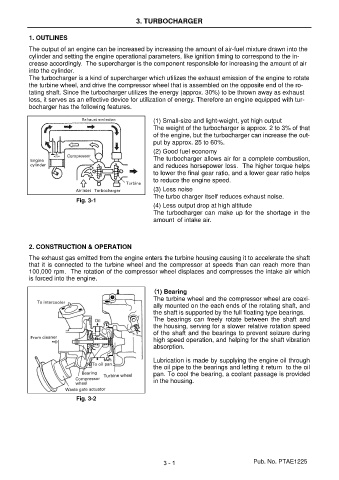
           The turbocharger is a kind of supercharger which utilizes the exhaust emission of the engine to rotate
           the turbine wheel, and drive the compressor wheel that is assembled on the opposite end of the ro-
           tating shaft. Since the turbocharger utilizes the energy (approx. 30%) to be thrown away as exhaust
           loss, it serves as an effective device for utilization of energy. Therefore an engine equipped with tur-
           bocharger has the following features.

                                                       (1) Small-size and light-weight, yet high output
                                                       The weight of the turbocharger is approx. 2 to 3% of that
                                                       of the engine, but the turbocharger can increase the out-
                                                       put by approx. 25 to 60%.

                                                       (2) Good fuel economy
                                                       The turbocharger allows air for a complete combustion,
                                                       and reduces horsepower loss.  The higher torque helps
                                                       to lower the final gear ratio, and a lower gear ratio helps
                                                       to reduce the engine speed.

                                                       (3) Less noise
                                                       The turbo charger itself reduces exhaust noise.
                            Fig. 3-1
                                                       (4) Less output drop at high altitude
                                                       The turbocharger can make up for the shortage in the
                                                       amount of intake air.


           2. CONSTRUCTION & OPERATION
           The exhaust gas emitted from the engine enters the turbine housing causing it to accelerate the shaft
           that it is connected to the turbine wheel and the compressor at speeds than can reach more than
           100,000 rpm.  The rotation of the compressor wheel displaces and compresses the intake air which
           is forced into the engine.

                                                       ( (( (1) Bearing
                                                       The turbine wheel and the compressor wheel are coaxi-
                                                       ally mounted on the each ends of the rotating shaft, and
                                                       the shaft is supported by the full floating type bearings.
                                                       The  bearings  can  freely  rotate  between  the  shaft  and
                                                       the housing, serving for a slower relative rotation speed
                                                       of the shaft and the bearings to prevent seizure during
                                                       high speed operation, and helping for the shaft vibration
                                                       absorption.

                                                       Lubrication is made by supplying the engine oil through
                                                       the oil pipe to the bearings and letting it return  to the oil
                                                       pan. To cool the bearing, a coolant passage is provided
                                                       in the housing.


                            Fig. 3-2


                                                          3 - 1                           Pub. No. PTAE1225

