


Page 25 - E BOOK ENGINE MECHANICAL M2
P. 25
4. ENGINE OVERHAUL


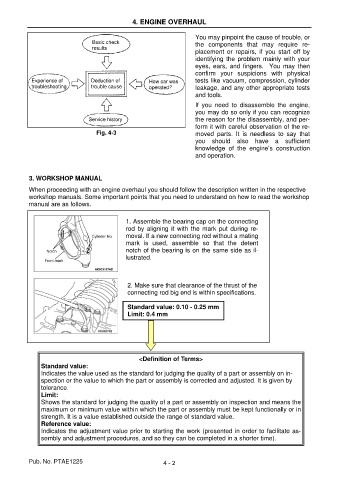
                                                                      You may pinpoint the cause of trouble, or
                                 Basic check                          the  components  that  may  require  re-
                                 results
                                                                      placement  or  repairs,  if  you  start  off  by
                                                                      identifying  the  problem  mainly  with  your
                                                                      eyes,  ears,  and  fingers.    You  may  then
                                                                      confirm  your  suspicions  with  physical
            Experience of        Deduction of        How car was      tests like vacuum, compression, cylinder
            troubleshooting      trouble cause       operated?        leakage, and any other appropriate tests
                                                                      and tools.
                                                                      If  you  need  to  disassemble  the  engine,
                                                                      you may do so only if you can recognize
                                Service history                       the reason for the disassembly, and per-
                                                                      form it with careful observation of the re-
                                   Fig. 4-3                           moved  parts.  It  is  needless  to  say  that
                                                                      you  should  also  have  a  sufficient
                                                                      knowledge  of  the  engine’s  construction
                                                                      and operation.


           3. WORKSHOP MANUAL
           When proceeding with an engine overhaul you should follow the description written in the respective
           workshop manuals. Some important points that you need to understand on how to read the workshop
           manual are as follows.


                                             1. Assemble the bearing cap on the connecting
                                             rod  by  aligning  it  with  the  mark  put  during  re-
                                             moval. If a new connecting rod without a mating
                                             mark  is  used,  assemble  so  that  the  detent
                                             notch of the bearing is on the same side as il-
                                             lustrated.


                                              2. Make sure that clearance of the thrust of the
                                              connecting rod big end is within specifications.

                                              Standard value: 0.10 - 0.25 mm
                                              Limit: 0.4 mm


                                                  <Definition of Terms>
               Standard value:
               Indicates the value used as the standard for judging the quality of a part or assembly on in-
               spection or the value to which the part or assembly is corrected and adjusted. It is given by
               tolerance.
               Limit:
               Shows the standard for judging the quality of a part or assembly on inspection and means the
               maximum or minimum value within which the part or assembly must be kept functionally or in
               strength. It is a value established outside the range of standard value.
               Reference value:
               Indicates the adjustment value prior to starting the work (presented in order to facilitate as-
               sembly and adjustment procedures, and so they can be completed in a shorter time).


           Pub. No. PTAE1225                              4 - 2

