


Page 166 - Concise Pathology for Exam Preparation ( PDFDrive )
P. 166
7  Infections  151


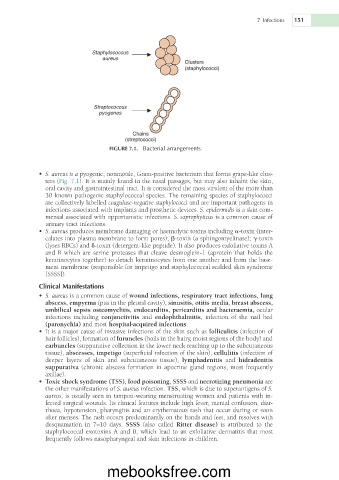
                             Staphylococcus
                                 aureus
                                                          Clusters
                                                          (staphylococci)


                              Streptococcus
                               pyogenes


                                          Chains
                                        (streptococci)
                                   FIGURE 7.1.  Bacterial arrangements.


             •  S. aureus is a pyogenic, nonmotile, Gram-positive bacterium that forms grape-like clus-
               ters (Fig. 7.1). It is mainly found in the nasal passages, but may also inhabit the skin,
               oral cavity and gastrointestinal tract. It is considered the most virulent of the more than
               30 known pathogenic staphylococcal species. The remaining species of staphylococci
               are collectively labelled coagulase-negative staphylococci and are important pathogens in
               infections associated with implants and prosthetic devices. S. epidermidis is a skin com-
               mensal associated with opportunistic infections. S. saprophyticus is a common cause of
               urinary tract infections.
             •  S. aureus produces membrane damaging or haemolytic toxins including a-toxin (inter-
               calates into plasma membrane to form pores); b-toxin (a sphingomyelinase); g-toxin
               (lyses RBCs) and d-toxin (detergent-like peptide). It also produces exfoliative toxins A
               and B which are serine proteases that cleave desmoglein-1 (aprotein that holds the
               keratinocytes together) to detach keratinocytes from one another and from the base-
               ment membrane (responsible for impetigo and staphylococcal scalded skin syndrome
               [SSSS]).
             Clinical Manifestations
             •  S. aureus is a common cause of wound infections, respiratory tract infections, lung
               abscess, empyema (pus in the pleural cavity), sinusitis, otitis media, breast abscess,
               umbilical sepsis osteomyelitis, endocarditis, pericarditis and bacteraemia, ocular
               infections  including  conjunctivitis  and  endophthalmitis,  infection  of  the  nail  bed
               (paronychia) and most hospital-acquired infections.
             •  It is a major cause of invasive infections of the skin such as folliculitis (infection of
               hair follicles), formation of furuncles (boils in the hairy, moist regions of the body) and
               carbuncles (suppurative collection in the lower neck reaching up to the subcutaneous
               tissue), abscesses, impetigo (superficial infection of the skin), cellulitis (infection of
               deeper  layers  of  skin  and  subcutaneous  tissue),  lymphadenitis  and  hidradenitis
               suppurativa  (chronic  abscess  formation  in  apocrine  gland  regions,  most  frequently
               axillae).
             •  Toxic shock syndrome (TSS), food poisoning, SSSS and necrotizing pneumonia are
               the other manifestations of S. aureus infection. TSS, which is due to superantigens of S.
               aureus, is usually seen in tampon-wearing menstruating women and patients with in-
               fected surgical wounds. Its clinical features include high fever, mental confusion, diar-
               rhoea, hypotension, pharyngitis and an erythematous rash that occur during or soon
               after menses. The rash occurs predominantly on the hands and feet, and resolves with
               desquamation  in  7–10  days.  SSSS  (also  called  Ritter  disease)  is  attributed  to  the
               staphylococcal  exotoxins  A  and  B,  which  lead  to  an  exfoliative  dermatitis  that  most
               frequently follows nasopharyngeal and skin infections in children.


                                  mebooksfree.com

