


Page 246 - Concise Pathology for Exam Preparation ( PDFDrive )
P. 246
10  Blood Vessels  231


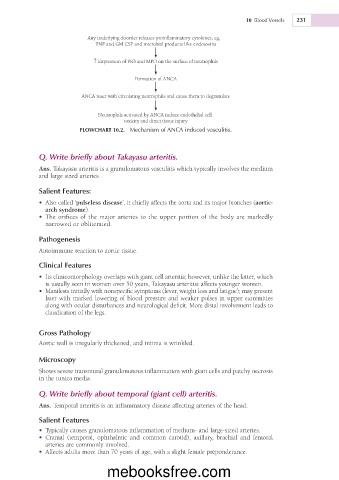
                            Any underlying disorder releases proinflammatory cytokines, eg,
                              TNF and GM CSF and microbial products like endotoxins

                              ↑ Expression of PR3 and MPO on the surface of neutrophils


                                           F  r o  m  o i t a  A   f o   n  N C A

                          ANCA react with circulating neutrophils and cause them to degranulate


                               Neutrophils activated by ANCA induce endothelial cell
                                             n a   y t i c i x o t  y r u j n i   e u s s i t   t c e r i d   d
                          FLOWCHART 10.2.  Mechanism of ANCA induced vasculitis.


             Q. Write briefly about Takayasu arteritis.

             Ans. Takayasu arteritis is a granulomatous vasculitis which typically involves the medium
             and large sized arteries.

             Salient Features:
             •  Also called ‘pulseless disease’, it chiefly affects the aorta and its major branches (aortic-
               arch syndrome).
             •  The orifices of the major arteries to the upper portion of the body are markedly
               narrowed or obliterated.

             Pathogenesis

             Autoimmune reaction to aortic tissue.
             Clinical Features
             •  Its clinicomorphology overlaps with giant cell arteritis; however, unlike the latter, which
               is usually seen in women over 50 years, Takayasu arteritist affects younger women.
             •  Manifests initially with nonspecific symptoms (fever, weight loss and fatigue); may present
               later with marked lowering of blood pressure and weaker pulses in upper extremities
               along with ocular disturbances and neurological deficit. More distal involvement leads to
               claudication of the legs.


             Gross Pathology
             Aortic wall is irregularly thickened, and intima is wrinkled.

             Microscopy

             Shows severe transmural granulomatous inflammation with giant cells and patchy necrosis
             in the tunica media.

             Q. Write briefly about temporal (giant cell) arteritis.
             Ans. Temporal arteritis is an inflammatory disease affecting arteries of the head.

             Salient Features
             •  Typically causes granulomatous inflammation of medium- and large-sized arteries.
             •  Cranial  (temporal,  ophthalmic  and  common  carotid),  axillary,  brachial  and  femoral
               arteries are commonly involved.
             •  Affects adults more than 70 years of age, with a slight female preponderance.


                                  mebooksfree.com

