


Page 245 - Concise Pathology for Exam Preparation ( PDFDrive )
P. 245
230    SECTION II  Diseases of Organ Systems


                             (iii)  Churg–Strauss  syndrome  (eosinophilic  granulomatosis  with  polyangiitis):
                               Eosinophil-rich granulomatous inflammation involving respiratory tract and
                               necrotizing vasculitis affecting medium- and small-sized blood vessels associ-
                               ated with asthma and blood eosinophilia.
                            (iv)  Microscopic polyangiitis: Necrotizing vasculitis with minimal immune deposits;
                               affects small vessels (necrotizing glomerulonephritis and pulmonary capillaritis
                               are common).
                       3.  Duration
                         (a)  Acute vasculitis
                         (b)  Chronic vasculitis
                     Q. Describe the aetiopathogenesis of vasculitis.

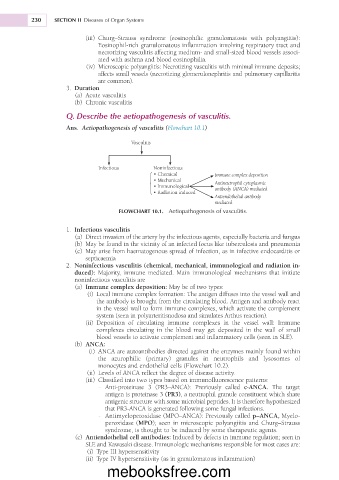
                     Ans.  Aetiopathogenesis of vasculitis (Flowchart 10.1)

                                         Vasculitis


                               Infectious       Noninfectious
                                                • Chemical         Immune complex deposition
                                                • Mechanical       Antineutrophil cytoplasmic
                                                • Immunological    antibody (ANCA) mediated
                                                •  Radiation induced
                                                                   Antiendothelial antibody
                                                                   mediated
                                      FLOWCHART 10.1.  Aetiopathogenesis of vasculitis.


                       1.  Infectious vasculitis
                         (a)  Direct invasion of the artery by the infectious agents, especially bacteria and fungus
                         (b)  May be found in the vicinity of an infected focus like tuberculosis and pneumonia
                         (c)  May arise from haematogenous spread of infection, as in infective endocarditis or
                           septicaemia
                       2.  Noninfectious vasculitis (chemical, mechanical, immunological and radiation in-
                        duced):  Majority,  immune  mediated.  Main  immunological  mechanisms  that  initiate
                        noninfectious vasculitis are
                         (a)  Immune complex deposition: May be of two types:
                            (i)  Local immune complex formation: The antigen diffuses into the vessel wall and
                               the antibody is brought from the circulating blood. Antigen and antibody react
                               in the vessel wall to form immune complexes, which activate the complement
                               system (seen in polyarteritisnodosa and simulates Arthus reaction).
                             (ii)  Deposition  of  circulating  immune  complexes  in  the  vessel  wall:  Immune
                               complexes  circulating  in  the  blood  may  get  deposited  in  the  wall  of  small
                               blood vessels to activate complement and inflammatory cells (seen in SLE).
                         (b)  ANCA:
                             (i)  ANCA are autoantibodies directed against the enzymes mainly found within
                               the  azurophilic  (primary)  granules  in  neutrophils  and  lysosomes  of
                               monocytes and endothelial cells (Flowchart 10.2).
                            (ii)  Levels of ANCA reflect the degree of disease activity.
                             (iii)  Classified into two types based on immunofluorescence patterns:
                               -  Anti-proteinase  3  (PR3–ANCA):  Previously  called  c-ANCA.  The  target
                                 antigen is proteinase 3 (PR3), a neutrophil granule constituent which share
                                 antigenic structure with some microbial peptides. It is therefore hypothesized
                                 that PR3-ANCA is generated following some fungal infections.
                               -  Antimyeloperoxidase (MPO–ANCA): Previously called p–ANCA, Myelo-
                                 peroxidase (MPO); seen in microscopic polyangiitis and Churg–Strauss
                                 syndrome, is thought to be induced by some therapeutic agents.
                         (c)  Antiendothelial cell antibodies: Induced by defects in immune regulation; seen in
                           SLE and Kawasaki disease. Immunologic mechanisms responsible for most cases are:
                            (i)  Type III hypersensitivity
                             (ii)  Type IV hypersensitivity (as in granulomatous inflammation)
                                  mebooksfree.com

