


Page 1300 - Hematology_ Basic Principles and Practice ( PDFDrive )
P. 1300
1146   Part VII  Hematologic Malignancies


             1.0                                                 Occasionally, patients with PMF after allogeneic transplant can
                                                              experience relapse of their underlying disease, failure of engraftment,
                                       Age ≤55 years          or graft failure. Relapse can frequently be treated with donor lym-
            Probability of overall survival  0.6  Age >55 years  infusions  or  experience  difficulty  with  engraftment  or  late  graft
             0.8
                                                              phocyte  infusions.  Second  RIC  allogeneic  transplants  should  be
                                                              considered for individuals who do not respond to donor lymphocyte
                                                              failure.  In  JAK2V617F-positive  patients,  monitoring  allele  burden
                                                              following SCT can help predict patients at risk for relapse and prompt
                                                              early intervention. The feasibility of utilizing aSCT as the front-line
             0.4
                                                              therapy for all intermediate- and high-risk patients is limited by the
                                                              presence of competing comorbidities or a poor performance status
             0.2
                                                              due  to  the  systemic  effects  of  the  underlying  PMF.  Although  the
                                                              JAK2 inhibitors are largely palliative, they do reduce the degree of
                                                              splenomegaly  and  often  improve  the  performance  status  of  such
             0.0                                              patients,  frequently  resulting  in  weight  gain,  and  improve  their
                                                              candidacy for transplant. The reported outcomes with JAK2 inhibitor
                  0.0     20.0     40.0     60.0     80.0     therapy as a component of the conditioning regimen for allogeneic
          A               Months after transplantation        transplantation have resulted in conflicting results, and will require
                                                              rigorous testing to determine its effect on immediate and long-term
             1.0                                              survival and transplant-related complications. This approach is cur-
                                                              rently  being  evaluated  within  the  MPD-RC  as  a  phase  II  trial  of
                                                              preconditioning ruxolitinib treatment (MPD-RC 114).
                                           Related donor
            Probability of overall survival  0.6  MUD         ditioning regimens and supportive therapy make this a viable first-line
                                                                 The fact that allogeneic RIC transplant is curative in appropriate
             0.8
                                                              patients is undeniable, and the improvements in the design of con-
                                                              approach for individuals with HLA-matched donors and advanced
                                                              disease. Whether such an approach should also be implemented in
                                                              patients with earlier phases of the disease is a point of contention that
             0.4
                                                              requires  further  careful  investigation.  This  decision  is  especially
                                           MMUD
                                                              important in young patients with early forms of PMF because their
                                                              disease  is  likely  to  eventually  progress,  and  the  best  results  with
             0.2
                                                              allogeneic  transplant  have  been  reported  in  lower  risk  patients,
                                                              especially if they do not have a related donor. The flaw in the argu-
             0.0                                              ment to proceed with immediate transplant in young patients with
                                                              early PMF is the exposure to significant mortality and morbidity in
                  0.0     20.0     40.0     60.0     80.0     a patient population that frequently can anticipate a decade or more
          B               Months after transplantation        of a good-quality life with no or minimal therapeutic interventions.
                                                              New  molecular  markers  such  as  JAK2V617F,  EZH2,  ASXL1,  and
                                                              CALR mutations will help further refine risk stratification and likely
             1.0                            Low risk          better guide treatment decision.
                                                                 Many  unresolved  issues  remain  to  be  clarified  concerning  the
                                                              optimal strategy for aSCT in PMF. The need for splenectomy before
                          Intermediate risk
            Probability of overall survival  0.6  High risk   results in faster hematopoietic recovery but at the cost of potentially
             0.8
                                                              aSCT remains a major issue. Splenectomy before aHSCT in PMF
                                                              prolonged and complicated postoperative recovery. Although some
                                                              analyses suggest improved survival with pretransplant splenectomy, it
                                                              has  also  been  associated  with  a  potential  increased  risk  of  relapse.
             0.4
                                                              Moreover, even extensive splenomegaly (>30-cm longitudinal size by
                                                              computed tomography scan) does not appear to prolong hematologic
                                                              reconstitution after transplant.
             0.2
                                                                 The establishment of valid complete remission criteria of PMF
                                                              for response after aSCT are often influenced by GVHD, infections,
             0.0                                              after aSCT remains a major issue because the conventional criteria
                                                              or poor graft function, and cannot be used. Conversely, normal blood
                  0.0     20.0     40.0     60.0     80.0     counts and disappearance of disease-related symptoms do not exclude
          C               Months after transplantation        residual  disease.  In  JAK2V617F-positive  patients,  the  mutational
                                                              allele  burden  following  transplantation  may  serve  as  a  surrogate
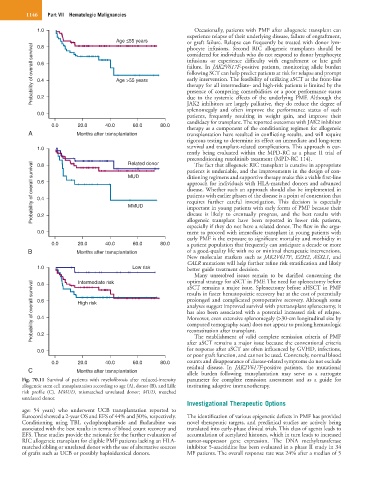
        Fig.  70.11  Survival  of  patients  with  myelofibrosis  after  reduced-intensity   parameter  for  complete  remission  assessment  and  as  a  guide  for
        allogeneic stem cell transplantation according to age (A), donor (B), and Lille   instituting adoptive immunotherapy.
        risk  profile  (C).  MMUD,  mismatched  unrelated  donor;  MUD,  matched
        unrelated donor.
                                                              Investigational Therapeutic Options
        age:  54  years)  who  underwent  UCB  transplantation  reported  to
        Eurocord showed a 2-year OS and EFS of 44% and 30%, respectively.   The identification of various epigenetic defects in PMF has provided
        Conditioning  using  TBI,  cyclophosphamide  and  fludarabine  was   novel  therapeutic  targets,  and  preclinical  studies  are  actively  being
        associated with the best results in terms of blood count recovery and   translated into early-phase clinical trials. This class of agents leads to
        EFS. These studies provide the rationale for the further evaluation of   accumulation of acetylated histones, which in turn leads to increased
        RIC allogeneic transplant for eligible PMF patients lacking an HLA-  tumor-suppressor  gene  expression.  The  DNA  methyltransferase
        matched sibling or unrelated donor with the use of alternative sources   inhibitor 5-azacitidine has been evaluated in a phase II study in 34
        of grafts such as UCB or possibly haploidentical donors.  MF patients. The overall response rate was 24% after a median of 5

