


Page 1297 - Hematology_ Basic Principles and Practice ( PDFDrive )
P. 1297
Chapter 70  Primary Myelofibrosis  1143


            thrombocytopenia, which occurred in approximately 30% of patients   of patients with long-term maintenance therapy enjoy sustained relief
            but resolved with discontinuation of therapy. In several patients with   of  symptoms.  Hematologic  toxicity  often  necessitates  cessation  of
            del(5)(q31)-associated  PMF  or  post-PV  MF,  lenalidomide  therapy   therapy. Inhibition of the activated JAK-STAT pathway is an attrac-
            was associated with reduction of the numbers of cells with a marker   tive therapeutic target in PMF and has led to the development of oral
            chromosome as assayed by FISH and reduction of the JAK2V617F   small-molecule inhibitors.  Ruxolitinib,  a  selective JAK1  and  JAK2
            burden.  Lenalidomide  therapy  in  combination  with  prednisone   tyrosine kinase inhibitor, was approved in 2011 for the treatment of
            therapy  in  PMF  has  been  evaluated  in  a  phase  II  trial  within  the   patients with MF; this is the first drug approved by the United States
            Eastern Cooperative Oncology Group and appears to be modestly   Food and Drug Administration (US FDA) where the indication for
            active  and  myelosuppressive.  Forty  two  MF  patients  with  anemia   use is intermediate- or high-risk MF. The phase I/II study determined
            were treated with lenalidomide at 10 mg/day in combination with a   the optimal starting dose of 15 mg twice daily, and that thrombocy-
            3-month  prednisone  taper.  Grade  3  and  higher  myelotoxicity  was   topenia and worsening anemia were dose-limiting toxicities. A dose-
            noted in 88% of patients, and a response rate of 23% by IWG-MRT   dependent suppression of phospho-STAT3 was seen in both WT and
            was obtained (19% clinical improvement in anemia or 10% clinical   mutated JAK2 patients treated with ruxolitinib, demonstrating that
            improvement in spleen size). Whether either of these immunomodu-  drug activity does not discriminate between mutated and WT JAK2
            latory drugs (IMiDs) is superior to the other is the subject of specula-  in its inhibitory activity. Fifty two percent of treated patients achieved
            tion,  which  would  require  a  large  randomized  clinical  trial.  The   a greater than 50% reduction in splenomegaly for greater than 12
            mechanism by which these agents achieve these clinical responses also   months, which was irrespective of their JAK2 mutational status. The
            remains of larger speculation.                        debilitating  symptoms  associated  with  MF  were  dramatically
              Because IMiDs as a class have shown activity in MF and their use   improved, and this was correlated with reduction in inflammatory
            is  often  undermined  by  neurotoxicity  or  myelosuppression,  recent   cytokines believed to be mediated through inhibition of JAK1 signal-
            interest in the structurally related but more potent pomalidomide in   ing. This compound was then evaluated in two randomized phase III
            the treatment of MF-associated anemia has led to the completion of   trials,  COMFORT  1  (United  States,  Canada,  and  Australia),  in
            several early-phase studies and a randomized phase III study. The first   which ruxolitinib therapy was compared with a placebo control, and
            study to evaluate the response of pomalidomide in MF was a phase   COMFORT  2  trial  (Europe),  in  which  ruxolitinib  therapy  was
            II  randomized,  double-blind,  placebo-controlled  adaptive  design   compared with the best available therapy. 12,13  The results of each of
            study  with  four  treatment  arms.  This  study  reported  an  overall   these  trials  are  remarkably  similar,  and  each  trial  was  adequately
            response in anemia of 24% (10 patients), and 15 of these patients   powered. Patients with intermediate-2 or high-risk MF as assessed
            achieved transfusion independence that was durable at 7.5 months.   using the IPSS were eligible regardless of JAK2 mutational status. All
                                                                                                 9
            Pomalidomide at 0.5 mg/day with or without a prednisone taper was   patients had platelet counts over 100 × 10 /L and had a spleen pal-
            found to have better anemia responses with less toxicity compared   pated at least 5 cm below the left costal margin. In COMFORT 1,
            with pomalidomide at 2 mg/day with or without prednisone. Grade   the primary endpoint of 35% or greater reduction in spleen volume
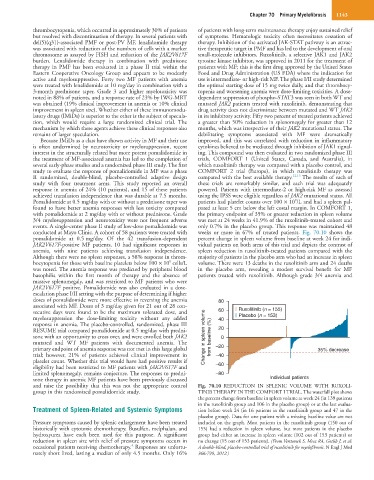
            3/4 myelosuppression and neurotoxicity were not frequent adverse   was met at 24 weeks in 41.9% of the ruxolitinib-treated cohort and
            events. A single-center phase II study of low-dose pomalidomide was   only 0.7% in the placebo group. This response was maintained 48
            conducted at Mayo Clinic. A cohort of 58 patients were treated with   weeks  or  more  in  67%  of  treated  patients.  Fig.  70.10  shows  the
            pomalidomide  at  0.5 mg/day.  Of  the  42  transfusion-dependent   percent change in spleen volume from baseline at week 24 for indi-
            JAK2V617F-positive  MF  patients,  10  had  significant  responses  in   vidual patients on both arms of this trial and depicts the contrast of
            anemia,  with  nine  patients  achieving  transfusion  independence.   spleen reduction in ruxolitinib-treated patients compared with the
            Although there were no spleen responses, a 58% response in throm-  majority of patients in the placebo arm who had an increase in spleen
                                                        9
            bocytopenia for those with baseline platelets below 100 × 10  cells/L   volume. There were 13 deaths in the ruxolitinib arm and 24 deaths
            was noted. The anemia response was predicted by peripheral blood   in  the  placebo  arm,  revealing  a  modest  survival  benefit  for  MF
            basophilia  within  the  first  month  of  therapy  and  the  absence  of   patients  treated  with  ruxolitinib.  Although  grade  3/4  anemia  and
            massive splenomegaly, and was restricted to MF patients who were
            JAK2V617F  positive.  Pomalidomide  was  also  evaluated  in  a  dose-
            escalation phase I/II setting with the purpose of determining if higher
            doses of pomalidomide were more effective in reversing the anemia   80
            associated with MF. Doses of 3 mg/day given for 21 out of 28 con-  Ruxolitinib (n = 155)
            secutive  days  were  found  to  be  the  maximum  tolerated  dose,  and   60  Placebo (n = 153)
            myelosuppression  the  dose-limiting  toxicity  without  any  added   40
            response in anemia. The placebo-controlled, randomized, phase III
            RESUME trial compared pomalidomide at 0.5 mg/day with predni-  20
            sone with an opportunity to cross over, and were enrolled both JAK2   Change in spleen volume  from baseline (%)  0
            mutated  and  WT  MF  patients  with  documented  anemia.  The
            primary endpoint of anemia response was not met in this large global   –20                   35% decrease
            trial;  however,  21%  of  patients  achieved  clinical  improvement  in   –40
            platelet count. Whether this trial would have had positive results if
            eligibility had been restricted to MF patients with JAK2V617F and   –60
            limited splenomegaly, remains conjecture. The responses to predni-  –80
            sone therapy in anemic MF patients have been previously discussed            Individual patients
            and  raise  the  possibility  that  this  was  not  the  appropriate  control   Fig.  70.10  REDUCTION  IN  SPLENIC  VOLUME  WITH  RUXOLI-
            group in this randomized pomalidomide study.          TINIB THERAPY IN THE COMFORT I TRIAL. The waterfall plot shows
                                                                  the percent change from baseline in spleen volume at week 24 (in 139 patients
                                                                  in the ruxolitinib group and 106 in the placebo group) or at the last evalua-
            Treatment of Spleen-Related and Systemic Symptoms     tion before week 24 (in 16 patients in the ruxolitinib group and 47 in the
                                                                  placebo group). Data for one patient with a missing baseline value are not
            Pressure symptoms caused by splenic enlargement have been treated   included on the graph. Most patients in the ruxolitinib group (150 out of
            historically with cytotoxic chemotherapy. Busulfan, melphalan, and   155)  had  a  reduction  in  spleen  volume,  but  most  patients  in  the  placebo
            hydroxyurea  have  each  been  used  for  this  purpose.  A  significant   group had either an increase in spleen volume (102 out of 153 patients) or
            reduction in spleen size with relief of pressure symptoms occurs in   no change (15 out of 153 patients). (From Verstovsek S, Mesa RA, Gotlib J, et al:
                                            4
            occasional patients receiving chemotherapy.  Responses are unfortu-  A double-blind, placebo-controlled trial of ruxolitinib for myelofibrosis. N Engl J Med
            nately short lived, lasting a median of only 4.5 months. Only 16%   366:799, 2012.)

