


Page 1380 - Hematology_ Basic Principles and Practice ( PDFDrive )
P. 1380
1226   Part VII  Hematologic Malignancies


                                                                           CR    PR


                                  Lenalidomide
                                   Everolimus

                                     Idelalisib

                                  Mocetinostat

                                  Panobinostat
                                Pembrolizumab

                                   Nivolumab

                             Brentuximab vedotin

                                            0        20       40       60        80       100
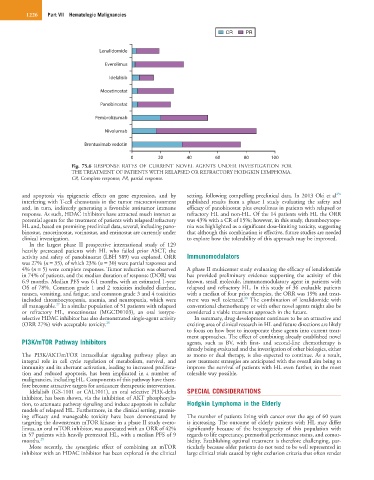
                        Fig.  75.6  RESPONSE  RATES  OF  CURRENT  NOVEL  AGENTS  UNDER  INVESTIGATION  FOR
                        THE TREATMENT OF PATIENTS WITH RELAPSED OR REFRACTORY HODGKIN LYMPHOMA.
                        CR, Complete response; PR, partial response.

                                                                                                               29a
        and  apoptosis  via  epigenetic  effects  on  gene  expression,  and  by   setting, following compelling preclinical data. In 2013 Oki et al
        interfering with T-cell chemotaxis in the tumor microenvironment   published  results  from  a  phase  I  study  evaluating  the  safety  and
        and,  in  turn,  indirectly  generating  a  favorable  antitumor  immune   efficacy of panobinostat plus everolimus in patients with relapsed or
        response. As such, HDAC inhibitors have attracted much interest as   refractory HL and non-HL. Of the 14 patients with HL the ORR
        potential agents for the treatment of patients with relapsed/refractory   was 43% with a CR of 15%; however, in this study, thrombocytope-
        HL and, based on promising preclinical data, several, including pano-  nia was highlighted as a significant dose-limiting toxicity, suggesting
        binostat, mocetinostat, vorinostat, and entinostat are currently under   that although this combination is effective, future studies are needed
        clinical investigation.                               to explore how the tolerability of this approach may be improved.
           In  the  largest  phase  II  prospective  international  study  of  129
        heavily  pretreated  patients  with  HL  who  failed  prior  ASCT,  the
        activity and safety of panobinostat (LBH 589) was explored. ORR   Immunomodulators
        was 27% (n = 35), of which 23% (n = 30) were partial responses and
        4% (n = 5) were complete responses. Tumor reduction was observed   A phase II multicenter study evaluating the efficacy of lenalidomide
        in 74% of patients, and the median duration of response (DOR) was   has  provided  preliminary  evidence  supporting  the  activity  of  this
        6.9 months. Median PFS was 6.1 months, with an estimated 1-year   known, small molecule, immunomodulatory agent in patients with
        OS of 78%. Common grade 1 and 2 toxicities included diarrhea,   relapsed and refractory HL. In this study of 36 evaluable patients
        nausea, vomiting, and fatigue, and common grade 3 and 4 toxicities   with a median of four prior therapies, the ORR was 19% and treat-
                                                                                 30
        included thrombocytopenia, anemia, and neutropenia, which were   ment  was  well  tolerated.  The  combination  of  lenalidomide  with
                   27
        all manageable.  In a similar population of 51 patients with relapsed   conventional chemotherapy or with other novel agents might also be
        or  refractory  HL,  mocetinostat  (MGCD0103),  an  oral  isotype-  considered a viable treatment approach in the future.
        selective HDAC inhibitor has also demonstrated single-agent activity   In summary, drug development continues to be an attractive and
        (ORR 27%) with acceptable toxicity. 28                exciting area of clinical research in HL and future directions are likely
                                                              to focus on how best to incorporate these agents into current treat-
                                                              ment approaches. The effect of combining already established novel
        PI3K/mTOR Pathway Inhibitors                          agents,  such  as  BV,  with  first-  and  second-line  chemotherapy  is
                                                              already being evaluated and the investigation of other biologics, either
        The  PI3K/AKT/mTOR  intracellular  signaling  pathway  plays  an   as mono or dual therapy, is also expected to continue. As a result,
        integral  role  in  cell  cycle  regulation  of  metabolism,  survival,  and   new treatment strategies are anticipated with the overall aim being to
        immunity and its aberrant activation, leading to increased prolifera-  improve the survival of patients with HL even further, in the most
        tion  and  reduced  apoptosis,  has  been  implicated  in  a  number  of   tolerable way possible.
        malignancies, including HL. Components of this pathway have there-
        fore become attractive targets for anticancer therapeutic intervention.
           Idelalisib  (GS-1101  or  CAL1011),  an  oral  selective  PI3K-delta   SPECIAL CONSIDERATIONS
        inhibitor, has been shown, via the inhibition of AKT phosphoryla-
        tion, to attenuate pathway signaling and induce apoptosis in cellular   Hodgkin Lymphoma in the Elderly
        models of relapsed HL. Furthermore, in the clinical setting, promis-
        ing  efficacy  and  manageable  toxicity  have  been  demonstrated  by   The number of patients living with cancer over the age of 60 years
        targeting the downstream mTOR kinase: in a phase II study evero-  is increasing. The outcome of elderly patients with HL may differ
        limus, an oral mTOR inhibitor, was associated with an ORR of 42%   significantly  because  of  the  heterogeneity  of  this  population  with
        in 57 patients with heavily pretreated HL, with a median PFS of 9   regards to life expectancy, premorbid performance status, and comor-
        months. 29                                            bidity. Establishing optimal treatment is therefore challenging, par-
           More  recently,  the  synergistic  effect  of  combining  an  mTOR   ticularly because older patients do not tend to be well represented in
        inhibitor with an HDAC inhibitor has been explored in the clinical   large clinical trials caused by tight exclusion criteria that often render

