


Page 1658 - Hematology_ Basic Principles and Practice ( PDFDrive )
P. 1658
1476   Part VIII  Comprehensive Care of Patients with Hematologic Malignancies


                       WHO ANALGESIC LADDER                   can precipitate bronchospasm in as many as 20%. Significant edema
                                                                                                            21
                                                              can occur in patients with cirrhosis or congestive heart failure.  The
                                            Severe pain       relatively selective COX-2 inhibitors, such as meloxicam, celecoxib,
                                          Opioid + nonopioid  and nabumetone, have been shown to cause similar gastrointestinal
                                                                                          23
                                                              side  effects  as  nonselective  NSAIDs.   If  NSAIDs  are  required  in
                                             ± Adjuvant       patients with a history of significant gastritis or ulcer disease, or who
                                                              are older than 70 years, COX-2 inhibitors or a concomitant proton
                          Moderate pain
                                             Morphine         pump inhibitor should be considered. Cardiotoxicity is well described
                                                                                                24
                        Opioid + nonopioid   Oxycodone        in the literature for COX-2 selective inhibitors.  Recently, the cardiac
                                           Hydromorphone      risk  associated  with  traditional  NSAIDs  has  been  questioned.  In
                            ± Adjuvant       Methadone        a  metaanalysis  that  included  naproxen,  ibuprofen,  diclofenac,  and
                                              Fentanyl        several  COX-2–specific  inhibitors,  ibuprofen  and  diclofenac  dem-
                            Codeine          Ketorolac
            Mild pain      Hydrocodone        Step 3          onstrated an increased risk of stroke. Diclofenac was also associated
            Nonopioid       Tramadol                          with  an  increased  risk  of  cardiovascular  death.  Naproxen  was  not
                                                                                         24
                           Oxycodone*                         noted to increase risk in this study.  Nonopioid analgesics should
            ± Adjuvant       Step 2                           be  continued  when  opioid  analgesics  are  added  because  they  can
                                                                                                               25
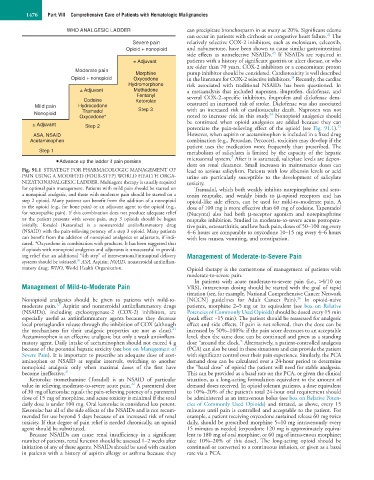
                                                              potentiate  the  pain-relieving  effect  of  the  opioid  (see  Fig.  91.1).
            ASA, NSAID                                        However, when aspirin or acetaminophen is included in a fixed drug
           Acetaminophen                                      combination (e.g., Percodan, Percocet), toxicities may develop if the
                                                              patient  uses  the  medication  more  frequently  than  prescribed. The
              Step 1                                          metabolism  of  salicylates  is  limited  by  the  capacity  of  the  hepatic
                                                                             9
                    Advance up the ladder if pain persists    microsomal system.  After it is saturated, salicylate levels are depen-
                                                              dent on renal clearance. Small increases in maintenance doses can
        Fig. 91.1  STRATEGY FOR PHARMACOLOGIC MANAGEMENT OF   lead to serious salicylism. Patients with low albumin levels or acid
        PAIN USING A MODIFIED (FOUR-STEP) WORLD HEALTH ORGA-  urine  are  particularly  susceptible  to  the  development  of  salicylate
        NIZATIONANALGESIC LADDER. Multiagent therapy is usually required   toxicity.
        for optimal pain management. Patients with mild pain should be started on   Tramadol, which both weakly inhibits norepinephrine and sero-
        a nonopioid analgesic, and those with moderate pain should be started on a   tonin  reuptake,  and  weakly  binds  to  µ-opioid  receptors  and  has
        step 2 opioid. Many patients can benefit from the addition of a nonopioid   opioid-like  side  effects,  can  be  used  for  mild-to-moderate  pain.  A
        to the opioid (e.g., for bone pain) or an adjuvant agent to the opioid (e.g.,   dose of 100 mg is more effective than 60 mg of codeine. Tapentadol
        for neuropathic pain). If this combination does not produce adequate relief   (Nucynta)  also  had  both  µ-receptor  agonism  and  norepinephrine
        or  the  patient  presents  with  severe  pain,  step  3  opioids  should  be  begun   reuptake inhibition. Studied in moderate-to-severe acute postopera-
        initially.  Toradol  (Ketorolac)  is  a  nonsteroidal  antiinflammatory  drug   tive pain, osteoarthritis, and low back pain, doses of 50–100 mg every
        (NSAID) with the pain-relieving potency of a step 3 opioid. Many patients   4–6 hours are comparable to oxycodone 10–15 mg every 4–6 hours
        can benefit from the addition of nonopioid analgesics or adjuvants, if indi-  with less nausea, vomiting, and constipation.
        cated. *Oxycodone in combination with products. It has been suggested that
        if opioids with nonopioid analgesics and adjuvants is unsuccessful in provid-
        ing relief that an additional “4th step” of interventional/intraspinal delivery   Management of Moderate-to-Severe Pain
        systems should be initiated.  ASA, Aspirin; NSAID, nonsteroidal antiinflam-
                          20
        matory drug; WHO, World Health Organisation.          Opioid therapy is the cornerstone of management of patients with
                                                              moderate-to-severe pain.
                                                                 In  patients  with  acute  moderate-to-severe  pain  (i.e.,  >4/10  on
        Management of Mild-to-Moderate Pain                   VRS), intravenous dosing should be started with the goal of rapid
                                                              titration (see, for example, National Comprehensive Cancer Network
                                                                                                  26
        Nonopioid  analgesics  should  be  given  to  patients  with  mild-to-  [NCCN]  guidelines  for  Adult  Cancer  Pain).   In  opioid-naive
                   1,7
        moderate pain.  Aspirin and nonsteroidal antiinflammatory drugs   patients,  morphine  2–5 mg  or  its  equivalent  (see  box  on  Relative
        (NSAIDs),  including  cyclooxygenase-2  (COX-2)  inhibitors,  are   Potencies of Commonly Used Opioids) should be dosed every 15 min
        especially  useful  as  antiinflammatory  agents  because  they  decrease   (peak effect ~15 min). The patient should be reassessed for analgesic
        local prostaglandin release through the inhibition of COX (although   effect and side effects. If pain is not relieved, then the dose can be
                                                         21
        the  mechanisms  for  their  analgesic  properties  are  not  as  clear).    increased by 50%–100%; if the pain score decreases to an acceptable
        Acetaminophen is an effective analgesic but only a weak antiinflam-  level, then the same dose can be continued and given as a standing
        matory agent. Daily intake of acetaminophen should not exceed 4 g   dose “around the clock.” Alternatively, a patient-controlled analgesia
        because of the potential hepatic toxicity (see box on Management of   (PCA) can also be used in these situations and can provide the patient
        Severe Pain). It is important to prescribe an adequate dose of acet-  with significant control over their pain experience. Similarly, the PCA
        aminophen  or  NSAID  at  regular  intervals,  switching  to  another   demand dose can be calculated over a 24-hour period to determine
        nonopioid  analgesic  only  when  maximal  doses  of  the  first  have   the “basal dose” of opioid the patient will need for stable analgesia.
        become ineffective. 21                                This can be provided as a basal rate on the PCA, or given the clinical
           Ketorolac  tromethamine  (Toradol)  is  an  NSAID  of  particular   situation, as a long-acting formulation equivalent to the amount of
                                            22
        value in relieving moderate-to-severe acute pain.  A parenteral dose   demand doses received. In opioid tolerant patients, a dose equivalent
        of 30 mg of ketorolac equals the pain-relieving potency of a parenteral   to 10%–20% of the patient’s total 24-hour oral requirement should
        dose of 15 mg of morphine, and acute toxicity is minimal if the total   be administered as an intravenous bolus (see box on Relative Poten-
        daily dose is under 100 mg. Oral ketorolac is considered less potent.   cies of Commonly Used Opioids) and titrated, as above, every 15
        Ketorolac has all of the side effects of the NSAIDs and is not recom-  minutes until pain is controlled and acceptable to the patient. For
        mended for use beyond 5 days because of an increased risk of renal   example, a patient receiving oxycodone sustained release 60 mg twice
        toxicity. If that degree of pain relief is needed chronically, an opioid   daily, should be prescribed morphine 5–10 mg intravenously every
        agent should be substituted.                          15 minutes as needed (oxycodone 120 mg is approximately equiva-
           Because  NSAIDs  can  cause  renal  insufficiency  in  a  significant   lent to 180 mg of oral morphine, or 60 mg of intravenous morphine;
        number of patients, renal function should be assessed 1–2 weeks after   take  10%–20%  of  this  dose).  The  long-acting  opioid  should  be
        initiation of any of these agents. NSAIDs should be used with caution   continued or converted to a continuous infusion, or given as a basal
        in patients with a history of aspirin allergy or asthma because they   rate via a PCA.

