


Page 1659 - Hematology_ Basic Principles and Practice ( PDFDrive )
P. 1659
Chapter 91  Pain Management and Antiemetic Therapy in Hematologic Disorders  1477


              Once the patient has an acceptable level of analgesia, this dose can
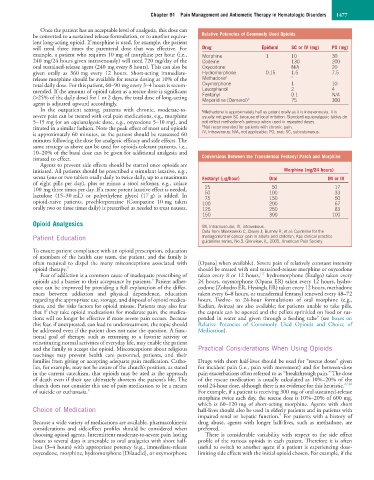
            be converted to a sustained release formulation, or to another equiva-  Relative Potencies of Commonly Used Opioids
            lent long-acting opioid. If morphine is used, for example, the patient
            will  need  three  times  the  parenteral  dose  that  was  effective.  For   Drug  Epidural  SC or IV (mg)  PO (mg)
            example, a patient who requires 10 mg of morphine per hour (i.e.,   Morphine  1     10            30
            240 mg/24 hours given intravenously) will need 720 mg/day of the   Codeine          130           200
            oral sustained-release agent (240 mg every 8 hours). This can also be   Oxycodone   N/A           20
            given  orally  as  360 mg  every  12  hours.  Short-acting  immediate-  Hydromorphone  0.15  1.5  7.5
            release morphine should be available for rescue dosing at 10% of the   Methadone a  a
            total daily dose. For this patient, 60–90 mg every 3–4 hours is recom-  Oxymorphone  1            10
            mended. If the amount of opioid taken as a rescue dose is significant   Levorphanol  2            4
            (>25% of the daily dose) for 1 or 2 days, the total dose of long-acting   Fentanyl  b  0.1        N/A
                                                                                                              300
                                                                                                75
                                                                   Meperidine (Demerol)
            agent is adjusted upward accordingly.
              In  the  outpatient  setting,  patients  with  chronic,  moderate-to-  a Methadone is approximately half as potent orally as it is intravenously. It is
            severe pain can be treated with oral pain medications, e.g., morphine   usually not given SC because of local irritation. Standard equianalgesic tables do
            5–15 mg (or an equianalgesic dose, e.g., oxycodone 5–10 mg), and   not reflect methadone’s potency when used in repeated doses.
            titrated in a similar fashion. Note the peak effect of most oral opioids   b Not recommended for patients with chronic pain.
            is approximately 60 minutes, so the patient should be reassessed 60   IV, Intravenous; N/A, not applicable; PO, oral; SC, subcutaneous.
            minutes following the dose for analgesic efficacy and side effects. The
            same strategy as above can be used for opioids-tolerant patients, i.e.,
            10–20% of the basal dose can be given for additional analgesia and
            titrated to effect.                                    Conversions Between the Transdermal Fentanyl Patch and Morphine
              Agents to prevent side effects should be started once opioids are
            initiated. All patients should be prescribed a stimulant laxative, e.g.,          Morphine (mg/24 hours)
            senna (one or two tablets orally daily to twice daily, up to a maximum   Fentanyl (µg/hour)  Oral  IM or IV
            of  eight  pills  per  day),  plus  or  minus  a  stool  softener,  e.g.,  colace
                                                                                          50
            100 mg three times per day. If a more potent laxative effect is needed,   25  100                  17
                                                                                                               33
                                                                    50
            lactulose  (15–30 mL)  or  polyethylene  glycol  (17 g)  is  added.  In   75  150                  50
            opioid-naive  patients,  prochlorperazine  (Compazine  10 mg  taken   100    200                   67
            orally two or three times daily) is prescribed as needed to treat nausea.  125  250                83
                                                                   150                   300                  100
            Opioid Analgesics                                      IM, Intramuscular; IV, intravenous.
                                                                   Data from Miaskowski C, Cleary J, Burney R, et al: Guideline for the
            Patient Education                                      management of cancer pain in adults and children, Aps clinical practice
                                                                   guidelines series, No.3. Glenview, IL, 2005, American Pain Society.
            To ensure patient compliance with an opioid prescription, education
            of members of the health care team, the patient, and the family is
            often  required  to  dispel  the  many  misconceptions  associated  with   [Opana] when available). Severe pain of relatively constant intensity
            opioid therapy. 9                                     should be treated with oral sustained-release morphine or oxycodone
                                                                                      1,7
              Fear of addiction is a common cause of inadequate prescribing of   taken every 8 or 12 hours,  hydromorphone (Exalgo) taken every
                                                   9
            opioids and a barrier to their acceptance by patients.  Patient adher-  24 hours, oxymorphone (Opana ER) taken every 12 hours, hydro-
            ence can be improved by providing a full explanation of the differ-  codone (Zohydro ER, Hysingla ER) taken every 12 hours, methadone
            ences  between  addiction  and  physical  dependence,  education   taken every 6–8 hours, or transdermal fentanyl renewed every 48–72
            regarding the appropriate use, storage, and disposal of opioid medica-  hours.  Twelve-  to  24-hour  formulations  of  oral  morphine  (e.g.,
            tions, and the risks factors for opioid misuse. Patients may also fear   Kadian, Avinza) are also available; for patients unable to take pills,
            that if they take opioid medications for moderate pain, the medica-  the capsule can be opened and the pellets sprinkled on food or sus-
                                                                                                         9
            tions will no longer be effective if more severe pain occurs. Because   pended in  water  and given  through a  feeding tube  (see boxes  on
            this fear, if unexpressed, can lead to undertreatment, the topic should   Relative  Potencies  of  Commonly  Used  Opioids  and  Choice  of
            be addressed even if the patient does not raise the question. A func-  Medication).
            tional  goal  of  therapy,  such  as  returning  to  a  favorite  activity  or
            reinstituting normal activities of everyday life, may enable the patient
            and the family to accept the opioid. Misconceptions about religious   Practical Considerations When Using Opioids
            teachings  may  prevent  health  care  personnel,  patients,  and  their
            families from giving or accepting adequate pain medication. Catho-  Drugs with short half-lives should be used for “rescue doses” given
            lics, for example, may not be aware of the church’s position, as stated   for incident pain (i.e., pain with movement) and for between-dose
            in the current catechism, that opioids may be used at the approach   pain exacerbations often referred to as “breakthrough pain.” The dose
            of death even if their use ultimately shortens the patient’s life. The   of the rescue medication is usually calculated as 10%–20% of the
            church does not consider this use of pain medication to be a means   total 24-hour dose, although there is no evidence for this heuristic. 27,28
            of suicide or euthanasia. 9                           For example, if a patient is receiving 300 mg of oral sustained-release
                                                                  morphine twice each day, the rescue dose is 10%–20% of 600 mg,
                                                                  which  is  60–120 mg  of  short-acting  morphine.  Agents  with  short
            Choice of Medication                                  half-lives should also be used in elderly patients and in patients with
                                                                                            9
                                                                  impaired renal or hepatic function.  For patients with a history of
            Because a wide variety of medications are available, pharmacokinetic   drug  abuse,  agents  with  longer  half-lives,  such  as  methadone,  are
            considerations  and  side-effect  profiles  should  be  considered  when   preferred.
            choosing opioid agents. Intermittent moderate-to-severe pain lasting   There  is  considerable  variability  with  respect  to  the  side  effect
            hours to several days is amenable to oral analgesics with short half-  profile of the various opioids in each patient. Therefore it is often
            lives (3–4 hours) with appropriate potency (e.g., immediate-release   useful to switch to another agent if a patient is experiencing dose-
            oxycodone, morphine, hydromorphone [Dilaudid], or oxymorphone   limiting side effects with the initial opioid chosen. For example, if the

