


Page 1705 - Hematology_ Basic Principles and Practice ( PDFDrive )
P. 1705
C H A P T E R          94

                                                OVERVIEW AND HISTORICAL PERSPECTIVE OF

                                                                 CURRENT CELL-BASED THERAPIES


                                                                   Leslie E. Silberstein and Helen E. Heslop


            The discovery in 1900 by Karl Landsteiner of the ABO blood group   involving  hematopoietic/bone  marrow-derived  cells  has  evolved,
            system paved the way for transfusion therapy, that is, the ability to   similar  to  blood  banking  and  transfusion  medicine,  into  a  highly
            safely infuse living blood cells as a therapeutic modality (see Chapters   regulated  discipline  with  oversight  by  several  regulatory  agencies,
            95–109). Thus, the discipline began with the collection by venipunc-  including the FDA and the National Institutes of Health Recombi-
            ture of whole blood, which required anticoagulation and storage at   nant DNA Advisory Board (see Chapters 96 and 97).
            refrigerated temperatures. These procedures were optimized when it
            became possible to isolate different cell populations, such as red blood
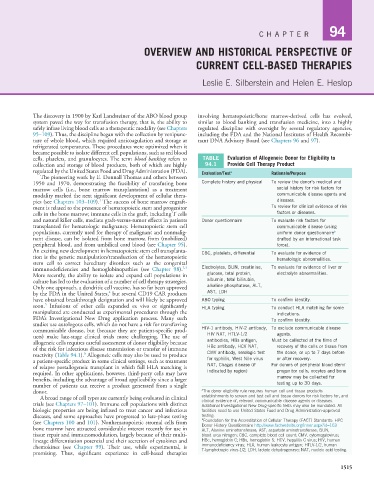
            cells, platelets, and granulocytes. The term blood banking refers to   TABLE   Evaluation of Allogeneic Donor for Eligibility to
            collection and storage of blood products, both of which are highly   94.1  Provide Cell Therapy Product
            regulated by the United States Food and Drug Administration (FDA).  Evaluation/Test a  Rationale/Purpose
              The pioneering work by E. Donnall Thomas and others between
            1950  and  1970,  demonstrating  the  feasibility  of  transfusing  bone   Complete history and physical  To review the donor’s medical and
            marrow  cells  (i.e.,  bone  marrow  transplantation)  as  a  treatment         social history for risk factors for
            modality marked the next significant development of cellular thera-             communicable disease agents and
                                  1
            pies (see Chapters 103–109).  The success of bone marrow engraft-               diseases.
            ment is related to the presence of hematopoietic stem and progenitor          To review for clinical evidence of risk
            cells in the bone marrow; immune cells in the graft, including T cells          factors or diseases.
            and natural killer cells, mediate graft-versus-tumor effects in patients   Donor questionnaire  To evaluate risk factors for
            transplanted  for  hematologic  malignancy.  Hematopoietic  stem  cell          communicable disease (using
            populations, currently used for therapy of malignant and nonmalig-              uniform donor questionnaire
                                                                                                              b
            nant disease, can be isolated from bone marrow, from (mobilized)                drafted by an international task
            peripheral blood, and from umbilical cord blood (see Chapter 95).               force).
            An exciting new development in hematopoietic stem cell transplanta-  CBC, platelets, differential  To evaluate for evidence of
            tion is the genetic manipulation/transduction of the hematopoietic              hematologic abnormalities.
            stem  cell  to  correct  hereditary  disorders  such  as  the  congenital
                                                             2,3
            immunodeficiencies  and  hemoglobinopathies  (see  Chapter  98).    Electrolytes, BUN, creatinine,   To evaluate for evidence of liver or
            More recently, the ability to isolate and expand cell populations in   glucose, total protein,   electrolyte abnormalities.
            culture has led to the evaluation of a number of cell therapy strategies.   albumin, total bilirubin,
            Only one approach, a dendritic cell vaccine, has so far been approved   alkaline phosphatase, ALT,
                                     4
            by the FDA in the United States,  but several CD19 CAR products   AST, LDH
            have obtained breakthrough designation and will likely be approved   ABO typing  To confirm identity.
                5
            soon.   Infusions  of  other  cells  expanded  ex  vivo  or  significantly   HLA typing  To conduct HLA matching for some
            manipulated are conducted as experimental procedures through the                indications.
            FDA’s  Investigational  New  Drug  application  process.  Many  such          To confirm identity.
            studies use autologous cells, which do not have a risk for transferring
            communicable disease, but (because they are patient-specific prod-  HIV-1 antibody, HIV-2 antibody,  To exclude communicable disease
            ucts)  make  late-stage  clinical  trials  more  challenging.  The  use  of   HIV NAT, HTLV-1/2   agents.
            allogeneic cells requires careful assessment of donor eligibility because   antibodies, HBs antigen,   Must be collected at the time of
            of the risk for infectious disease transmission or transfer of immune   HBc antibody, HCV NAT,   recovery of the cells or tissue from
                             6
            reactivity (Table 94.1).  Allogeneic cells may also be used to produce   CMV antibody, serologic test   the donor; or up to 7 days before
            a patient-specific product in some clinical settings, such as treatment   for syphilis, West Nile virus   or after recovery.
            of relapse postallogeneic transplant in which full HLA matching is   NAT, Chagas disease (if   For donors of peripheral blood stem/
            required. In other applications, however, third-party cells may have   indicated by region)  progenitor cells, oocytes and bone
            benefits, including the advantage of broad applicability since a larger         marrow may be collected for
            number  of  patients  can  receive  a  product  generated  from  a  single      testing up to 30 days.
            donor.                                                 a The donor eligibility rule requires human cell and tissue products
              A broad range of cell types are currently being evaluated in clinical   establishments to screen and test cell and tissue donors for risk factors for, and
            trials (see Chapters 97–101). Immune cell populations with distinct   clinical evidence of, relevant communicable disease agents or diseases.
                                                                   Additional Investigational New Drug-specific tests may also be mandated. All
            biologic properties are being infused to treat cancer and infectious   facilities need to use United States Food and Drug Administration-approved
            diseases, and some approaches have progressed to late-phase testing   testing.
                                                                   b
                                                                   Foundation for the Accreditation of Cellular Therapy (FACT) Standards: HPC
            (see Chapters 100 and 101). Nonhematopoietic stromal cells from   Donor History Questionnaire http://www.factwebsite.org/Inner.aspx?id=163
            bone marrow have attracted considerable interest recently for use in   ALT, Alanine aminotransferase; AST; aspartate aminotransferase; BUN,
            tissue repair and immunomodulation, largely because of their multi-  blood urea nitrogen; CBC, complete blood cell count; CMV, cytomegalovirus;
            lineage differentiation potential and their secretion of cytokines and   HBc, hemoglobin C; HBs, hemoglobin S; HCV, hepatitis C virus; HIV, human
            chemokines  (see  Chapter  99).  Their  use,  while  experimental,  is   immunodeficiency virus; HLA, human leukocyte antigen; HTLV-1/2, human
                                                                   T-lymphotropic virus-1/2; LDH, lactate dehydrogenase; NAT, nucleic acid testing.
            promising.  Thus,  significant  experience  in  cell-based  therapies
                                                                                                                1515

