


Page 1710 - Hematology_ Basic Principles and Practice ( PDFDrive )
P. 1710
1520   Part IX  Cell-Based Therapies


                                                              C
        A


                                                              D
        B
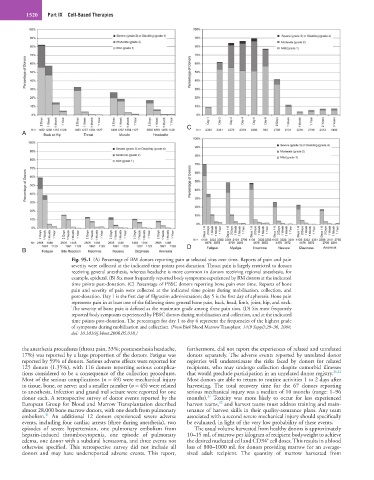
                        Fig. 95.1  (A) Percentage of BM donors reporting pain at selected sites over time. Reports of pain and pain
                        severity were collected at the indicated time points post-donation. Throat pain is largely restricted to donors
                        receiving general anesthesia, whereas headache is more common in donors receiving regional anesthesia, for
                        example, epidural. (B) Six most frequently reported body symptoms experienced by BM donors at the indicated
                        time points post-donation. (C) Percentage of PBSC donors reporting bone pain over time. Reports of bone
                        pain and severity of pain were collected at the indicated time points during mobilization, collection, and
                        post-donation. Day 1 is the first day of filgrastim administration; day 5 is the first day of apheresis. Bone pain
                        represents pain in at least one of the following sites: general bone pain, back, head, limb, joint, hip, and neck.
                        The severity of bone pain is defined as the maximum grade among these pain sites. (D) Six most frequently
                        reported body symptoms experienced by PBSC donors during mobilization and collection, and at the indicated
                        time points post-donation. The percentages for day 1 to day 6 represent the frequencies of the highest grade
                        of symptoms during mobilization and collection. (From Biol Blood Marrow Transplant. 14(9 Suppl):29–36, 2008,
                        doi: 10.1016/j.bbmt.2008.05.018.)

        the anesthesia procedures (throat pain, 33%; postanesthesia headache,   furthermore, did not report the experiences of related and unrelated
        17%) was reported by a large proportion of the donors. Fatigue was   donors separately. The adverse events reported by unrelated donor
        reported by 59% of donors. Serious adverse effects were reported for   registries  will  underestimate  the  risks  faced  by  donors  for  related
        125 donors (1.35%), with 116 donors reporting serious complica-  recipients,  who  may  undergo  collection  despite  comorbid  illnesses
        tions considered to be a consequence of the collection procedures.   that would preclude participation in an unrelated donor registry. 26,42
        Most of the serious complications (n = 69) were mechanical injury   Most donors are able to return to routine activities 1 to 2 days after
        to tissue, bone, or nerve; and a smaller number (n = 45) were related   harvesting,  The  total  recovery  time  for  the  67  donors  reporting
        to anesthesia. Infection and grand mal seizure were reported for one   serious mechanical injury was a median of 10 months (range: 1–96
                                                                     37
        donor each. A retrospective survey of donor events reported by the   months).   Toxicity  was  more  likely  to  occur  for  less  experienced
                                                                         32
        European Group for Blood and Marrow Transplantation described   harvest teams,  and harvest teams must address training and main-
        almost 28,000 bone marrow donors, with one death from pulmonary   tenance of harvest skills in their quality-assurance plans. Any team
                41
        embolism.   An  additional  12  donors  experienced  severe  adverse   associated with a second severe mechanical injury should specifically
        events, including four cardiac arrests (three during anesthesia), two   be evaluated, in light of the very low probability of these events.
        episodes  of  severe  hypertension,  one  pulmonary  embolism  from   The usual volume harvested from healthy donors is approximately
        heparin-induced  thrombocytopenia,  one  episode  of  pulmonary   10–15 mL of marrow per kilogram of recipient bodyweight to achieve
                                                                                        +
        edema, one donor with a subdural hematoma, and three events not   the desired nucleated cell and CD34  cell doses. This results in a blood
        otherwise  specified.  This  retrospective  survey  did  not  include  all   loss of 800–1000 mL for donors providing marrow for an average-
        donors  and  may  have  underreported  adverse  events.  This  report,   sized  adult  recipient.  The  quantity  of  marrow  harvested  from

