


Page 1788 - Hematology_ Basic Principles and Practice ( PDFDrive )
P. 1788
1592   Part X  Transplantation


        highly motivated and available for additional products. This source   cord, and haploidentical donor transplants, but they do not show a
        also has the potential for more graft-versus-tumor effects because of   definitive advantage for either source of HSCs. 9,10  Most transplant
        increased  alloreactivity  and  the  potential  for  a  beneficial  killer-cell   units have therefore developed algorithms for donor selection based
        immunoglobulin-like  receptor  mismatch.  A  haploidentical  donor   on local experience and patient characteristics such as size and disease.
        also  has  a  lower  “cost  of  goods”  for  procurement  of  the  product.
        Several studies have compared outcomes of mismatched unrelated,
                                                              Autologous Transplantation

                                                              In autologous transplantation the recipient’s own HSCs are collected
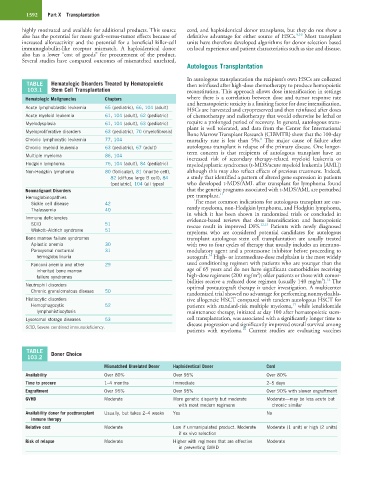
          TABLE   Hematologic Disorders Treated by Hematopoietic   then reinfused after high-dose chemotherapy to produce hemopoietic
          103.1   Stem Cell Transplantation                   reconstitution. This approach allows dose intensification in settings
         Hematologic Malignancies  Chapters                   where there is a correlation between dose and tumor response rate
                                                              and hematopoietic toxicity is a limiting factor for dose intensification.
         Acute lymphoblastic leukemia  65 (pediatric), 66, 104 (adult)  HSCs are harvested and cryopreserved and then reinfused after doses
         Acute myeloid leukemia    61, 104 (adult), 62 (pediatric)  of chemotherapy and radiotherapy that would otherwise be lethal or
         Myelodysplasia            61, 104 (adult), 63 (pediatric)  require a prolonged period of recovery. In general, autologous trans-
                                                              plant is well tolerated, and data from the Center for International
         Myeloproliferative disorders  63 (pediatric), 70 (myelofibrosis)
                                                              Bone Marrow Transplant Research (CIBMTR) show that the 100-day
                                                                                      8
         Chronic lymphocytic leukemia  77, 104                mortality  rate  is  less  than  5%.   The  major  cause  of  failure  after
         Chronic myeloid leukemia  63 (pediatric), 67 (adult)  autologous transplant is relapse of the primary disease. One longer-
                                                              term  concern  is  that  recipients  of  autologous  transplant  have  an
         Multiple myeloma          86, 104
                                                              increased  risk  of  secondary  therapy-related  myeloid  leukemia  or
         Hodgkin lymphoma          75, 104 (adult), 84 (pediatric)  myelodysplastic syndromes (t-MDS/acute myeloid leukemia [AML])
         Non-Hodgkin lymphoma      80 (follicular), 81 (mantle cell),   although this may also reflect effects of previous treatment. Indeed,
                                     82 (diffuse large B cell), 84   a study that identified a pattern of altered gene expression in patients
                                     (pediatric), 104 (all types)  who developed t-MDS/AML after transplant for lymphoma found
         Nonmalignant Disorders                               that the genetic programs associated with t-MDS/AML are perturbed
                                                                         11
         Hemoglobinopathies                                   pre transplant.
            Sickle cell disease    42                            The most common indications for autologous transplant are cur-
            Thalassemia            40                         rently myeloma, non-Hodgkin lymphoma, and Hodgkin lymphoma,
                                                              in  which  it  has  been  shown  in  randomized  trials  or  concluded  in
         Immune deficiencies                                  evidence-based  reviews  that  dose  intensification  and  hemopoietic
            SCID                   51                         rescue  result  in  improved  DFS. 12,13   Patients  with  newly  diagnosed
            Wiskott–Aldrich syndrome  51                      myeloma  who  are  considered  potential  candidates  for  autologous
         Bone marrow failure syndromes                        transplant  autologous  stem  cell  transplantation  are  usually  treated
            Aplastic anemia        30                         with two to four cycles of therapy that usually includes an immuno-
            Paroxysmal nocturnal   31                         modulatory agent and a proteasome inhibitor before proceeding to
                                                                     14
             hemoglobulinuria                                 autograft.  High- or intermediate-dose melphalan is the most widely
            Fanconi anemia and other   29                     used conditioning regimen with patients who are younger than the
             inherited bone marrow                            age of 65 years and do not have significant comorbidities receiving
                                                                                     2
             failure syndromes                                high-dose regimens (200 mg/m ); older patients or those with comor-
                                                                                                          2 14
                                                              bidities receive a reduced dose regimen (usually 140 mg/m ).  The
         Neutrophil disorders                                 optimal postautograft therapy is under investigation. A multicenter
            Chronic granulomatous disease  50
                                                              randomized trial showed no advantage for performing nonmyeloabla-
         Histiocytic disorders                                tive allogeneic HSCT compared with tandem autologous HSCT for
            Hemophagocytic         52                         patients with standard-risk multiple myeloma,  while lenalidomide
                                                                                                 15
             lymphohistiocytosis                              maintenance therapy, initiated at day 100 after hematopoietic stem-
         Lysosomal storage diseases  53                       cell transplantation, was associated with a significantly longer time to
         SCID, Severe combined immunodeficiency.              disease progression and significantly improved overall survival among
                                                                                16
                                                              patients  with  myeloma.   Current  studies  are  evaluating  vaccines
          TABLE   Donor Choice
          103.2
                                   Mismatched Unrelated Donor  Haploidentical Donor     Cord
         Availability              Over 80%               Over 95%                      Over 80%
         Time to procure           1–4 months             Immediate                     2–5 days
         Engraftment               Over 95%               Over 95%                      Over 90% with slower engraftment
         GVHD                      Moderate               More genetic disparity but moderate   Moderate—may be less acute but
                                                           with most modern regimens      chronic similar
         Availability donor for posttransplant   Usually, but takes 2–4 weeks  Yes      No
           immune therapy
         Relative cost             Moderate               Low if unmanipulated product. Moderate   Moderate (1 unit) or high (2 units)
                                                           if ex vivo selection
         Risk of relapse           Moderate               Higher with regimens that are effective   Moderate
                                                           in preventing GVHD

