


Page 1793 - Hematology_ Basic Principles and Practice ( PDFDrive )
P. 1793
Chapter 104  Indications and Outcomes of Allogeneic Hematopoietic Cell Transplantation for Hematologic Malignancies in Adults  1597


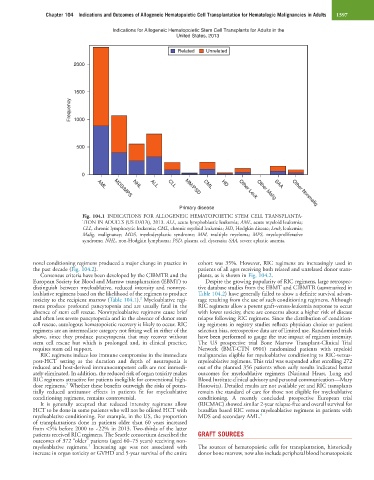
                                      Indications for Allogeneic Hematopoietic Stem Cell Transplants for Adults in the
                                                           United States, 2013

                                                           Related  Unrelated
                         2000


                         1500
                        Frequency  1000


                          500


                            0    AML  MDS/MPS NHL  ALL  CLL   MM/PSD  CML  HD  Other Leuk  Other Malig

                                                                                           SAA


                                                            Primary disease                      Other Nonmalig
                            Fig. 104.1  INDICATIONS FOR ALLOGENEIC HEMATOPOIETIC STEM CELL TRANSPLANTA-
                            TION IN ADULTS (US DATA), 2013. ALL, acute lymphoblastic leukemia; AML, acute myeloid leukemia;
                            CLL, chronic lymphocytic leukemia; CML, chronic myeloid leukemia; HD, Hodgkin disease; Leuk, leukemia;
                            Malig,  malignancy;  MDS,  myelodysplastic  syndrome;  MM,  multiple  myeloma;  MPS,  myeloproliferative
                            syndrome; NHL, non-Hodgkin lymphoma; PSD, plasma cell dyscrasia; SAA, severe aplastic anemia.


            novel conditioning regimens produced a major change in practice in   cohort was 35%. However, RIC regimens are increasingly used in
            the past decade (Fig. 104.2).                         patients of all ages receiving both related and unrelated donor trans-
              Consensus criteria have been developed by the CIBMTR and the   plants, as is shown in Fig. 104.2.
            European Society for Blood and Marrow transplantation (EBMT) to   Despite the growing popularity of RIC regimens, large retrospec-
            distinguish between myeloablative, reduced intensity and nonmye-  tive database studies from the EBMT and CIBMTR (summarized in
            loablative regimens based on the likelihood of the regimen to produce   Table 104.2) have generally failed to show a definite survival advan-
                                               2
            toxicity to the recipient marrow (Table 104.1).  Myeloablative regi-  tage resulting from the use of such conditioning regimens. Although
            mens  produce  profound  pancytopenia  and  are  usually  fatal  in  the   RIC regimens allow a potent graft-versus-leukemia response to occur
            absence of stem cell rescue. Nonmyeloablative regimens cause brief   with lower toxicity, there are concerns about a higher risk of disease
            and often less severe pancytopenia and in the absence of donor stem   relapse following RIC regimens. Since the distribution of condition-
            cell rescue, autologous hematopoietic recovery is likely to occur. RIC   ing regimens in registry studies reflects physician choice or patient
            regimens are an intermediate category not fitting well in either of the   selection bias, retrospective data are of limited use. Randomized trials
            above,  since  they  produce  pancytopenia  that  may  recover  without   have been performed to gauge the true impact of regimen intensity.
            stem  cell  rescue  but  which  is  prolonged  and,  in  clinical  practice,   The  US  prospective  trial  Bone  Marrow  Transplant-Clinical  Trial
            requires stem cell support.                           Network  (BMT-CTN  0901)  randomized  patients  with  myeloid
              RIC regimens induce less immune compromise in the immediate   malignancies eligible for myeloablative conditioning to RIC-versus-
            post-HCT  setting  as  the  duration  and  depth  of  neutropenia  is   myeloablative regimens. This trial was suspended after enrolling 272
            reduced and host-derived immunocompetent cells are not immedi-  out of the planned 356 patients when early results indicated better
            ately eliminated. In addition, the reduced risk of organ toxicity makes   outcomes  for  myeloablative  regimens  (National  Heart,  Lung  and
            RIC regimens attractive for patients ineligible for conventional high-  Blood Institute clinical advisory and personal communication—Mary
                       3
            dose regimens.  Whether these benefits outweigh the risks of poten-  Horowitz). Detailed results are not available yet and RIC transplants
            tially  reduced  antitumor  effects  in  patients  fit  for  myeloablative   remain the standard of care for those not eligible for myeloablative
            conditioning regimens, remains controversial.         conditioning.  A  recently  concluded  prospective  European  trial
              It  is  generally  accepted  that  reduced  intensity  regimens  allow   (RICMAC) showed similar 2-year relapse-free and overall survival for
            HCT to be done in some patients who will not be offered HCT with   busulfan based RIC versus myeloablative regimens in patients with
            myeloablative conditioning. For example, in the US, the proportion   MDS and secondary AML. 4
            of  transplantations  done  in  patients  older  than  60  years  increased
            from <5% before 2000 to ~22% in 2013. Two-thirds of the latter
            patients received RIC regimens. The Seattle consortium described the   GRAFT SOURCES
            outcomes of 372 “older” patients (aged 60–75 years) receiving non-
                              3
            myeloablative  regimens.   Increasing  age  was  not  associated  with   The  sources  of  hematopoietic  cells  for  transplantation,  historically
            increase in organ toxicity or GVHD and 5-year survival of the entire   donor bone marrow, now also include peripheral blood hematopoietic

