


Page 2038 - Hematology_ Basic Principles and Practice ( PDFDrive )
P. 2038
Chapter 120  Transfusion-Transmitted Diseases  1809


                   DOLLARS PER QUALITY-ADJUSTED LIFE-YEAR (QALY)   TABLE   Patients Benefiting From Cytomegalovirus Risk–
                                                                    120.2  Reduced Blood Components a
                                                                   Infants <1200 g with CMV-seronegative mothers
                                                                   Seronegative autologous and allogeneic (CMV-seronegative donors) stem
                                                                     cell transplant recipients
                            $100,000
                    $10,000
                                   $1,000,000
                                                   $100,000,000
                                           $10,000,000
                                                                   Seronegative stem cell transplant candidates
             1983    Revised HIV risk behavior donor criteria      Seronegative recipients of seronegative solid organ transplants
             1984                                                  Seronegative pregnant women
                                                                   Fetuses receiving intrauterine transfusions
             1985    HIV serotesting
                                                                   Immunosuppressed patients receiving granulocyte transfusions
             1986                                                  HIV-seropositive/CMV-seronegative patients
             1987    Non-A, non-B serotesting (ALT, anti-HBc)      a CMV risk–reduced components include CMV-seronegative and leukocyte-
                                                                   reduced components.
             1988    HLTV seroscreening                            CMV, Cytomegalovirus; HIV, human immunodeficiency virus.
             1989
                                                                  Cytomegalovirus
             1990    HCV seroscreening
                                                                  CMV, a betaherpesvirus, infects a wide range of cell types, including
                                                                  leukocytes of the monocyte-macrophage lineage and their progeni-
             1991                                                 tors. In the United States, in the population-based National Health
             1992                                                 and Nutrition Examination Survey (NHANES) III study, 58.9% of
                                                                  individuals more than 5 years old were seropositive, indicating prior
             1993
                                                                  CMV infection. Prevalence increases with age and is dependent on
             1994                                                 race/ethnicity  and  other  demographic  factors.  The  prevention  of
             1995                                                 transfusion-transmitted CMV infection has depended on the use of
                                                                  “CMV  safe”  blood  including  a  combination  of  leukoreduced  and
             1996    HIV p24 antigen testing needs cost effectiveness  CMV-seronegative  blood.  There  is,  however,  some  evidence  that
             1997                                                 acute infection may result in plasma viremia and thus the potential
                                                                  for transfusion infectivity.
             1998                                                   Primary  CMV  infection  in  immunocompetent  individuals  is
                                                                  usually community acquired, often asymptomatic or associated with
             1999    HIV and HCV NAT                              a mild, self-limited infectious mononucleosis syndrome. After virtu-
                     (p24 antigen testing discontinued)           ally all infections, latent virus persists permanently in cellular reser-
                                                                  voirs, allowing lifelong reactivation, and in the setting of transfusion
             2000                                                 or transplantation, the potential for viral transmission via nonleuko-
                                                                  reduced cellular blood products, and allografts.
             2001                                                   In immunosuppressed patients, CMV infection can cause severe
             2002                                                 morbidity and mortality from pneumonitis, hepatitis, gastroenteritis,
                     West Nile virus NAT                          retinitis, and other inflammatory conditions. CMV infection in low-
             2003    platelets bacterial testing                  birth-weight infants is associated with sepsis-like syndromes, respira-
                                                                  tory distress, and liver and bone marrow dysfunction. Their infections
             2004                                                 can  be  acquired  in  utero,  from  breast  milk,  or  from  transfusion.
             2005                                                 Reported infant morbidity varies considerably but can approach 50%
                                                                  of seronegative low-birth-weight infants receiving unscreened, non-
             2006                                                 leukoreduced blood. CMV-seronegative marrow transplant patients
             2007    T. cruzi serotesting (all donors)            are also susceptible to CMV infection; but the adoption of routine
                                                                  monitoring for CMV antigen or nucleic acid in transplant recipients
             2008
                                                                  and of preemptive antiviral therapy have decreased this risk. Sero-
             2009    T. cruzi serotesting (first-time donors only)  negative  solid  organ  transplant  recipients  are  also  susceptible  to
             2010    Minipool HIV/HCV/HBV NAT                     symptomatic  transfusion-transmitted  CMV  infections.  CMV-
                                                                  seronegative,  HIV-infected  patients  are  another  group  at  risk  for
                                                                  transfusion-transmitted primary CMV infection. The historical risk
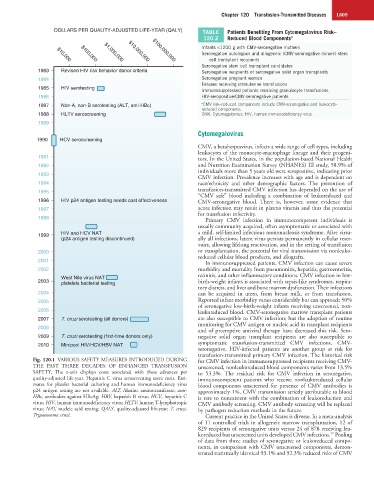
            Fig. 120.1  VARIOUS SAFETY MEASURES INTRODUCED DURING   for CMV infection in immunosuppressed recipients receiving CMV-
            THE  PAST  THREE  DECADES  OF  ENHANCED  TRANSFUSION   unscreened, nonleukoreduced blood components varies from 13.5%
            SAFETY.  The  x-axis  displays  costs  associated  with  these  advances  per   to  53.3%.  The  residual  risk  for  CMV  infection  in  seronegative,
            quality-adjusted  life-year.  Hepatitis  C  virus  seroscreening  saves  costs.  Esti-  immunocompetent  patients  who  receive  nonleukoreduced  cellular
            mates  for  platelet  bacterial  culturing  and  human  immunodeficiency  virus   blood  components  unscreened  for  presence  of  CMV  antibodies  is
            p24 antigen testing are not available. ALT, Alanine aminotransferase; anti-  approximately 1%. CMV transmission strictly attributable to blood
            HBc, antibodies against HBcAg; HBV, hepatitis B virus; HCV, hepatitis C   is rare to nonexistent with the combination of leukoreduction and
            virus; HIV, human immunodeficiency virus; HLTV, human T-lymphotropic   CMV antibody screening. CMV antibody screening will be replaced
            virus; NAT, nucleic acid testing; QALY, quality-adjusted life-year; T. cruzi,   by pathogen reduction methods in the future.
            Trypanosoma cruzi.                                      Current practice in the United States is diverse. In a meta-analysis
                                                                  of 11 controlled trials in allogeneic marrow transplantation, 12 of
                                                                  829 recipients of seronegative units versus 24 of 878 receiving leu-
                                                                                                             30
                                                                  koreduced but unscreened units developed CMV infections.  Pooling
                                                                  of data from three studies of seronegative or leukoreduced compo-
                                                                  nents, in comparison with CMV unscreened components, demon-
                                                                  strated statistically identical 93.1% and 92.3% reduced risks of CMV

