


Page 2033 - Hematology_ Basic Principles and Practice ( PDFDrive )
P. 2033
1804   Part XI  Transfusion Medicine


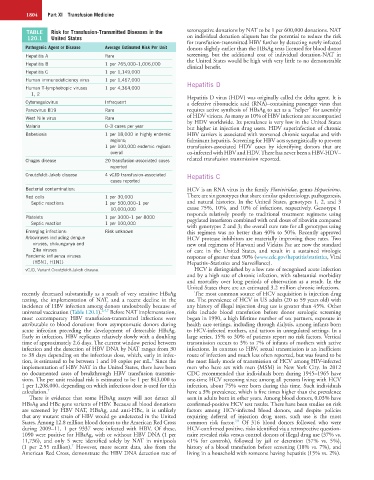
          TABLE   Risk for Transfusion-Transmitted Diseases in the   seronegative donations by NAT to be 1 per 600,000 donations. NAT
          120.1   United States                               on individual donation aliquots has the potential to reduce the risk
                                                              for transfusion-transmitted HBV further by detecting newly infected
         Pathogenic Agent or Disease  Average Estimated Risk Per Unit  donors slightly earlier than the HBsAg tests licensed for blood donor
         Hepatitis A               Rare                       screening,  but  the  additional  cost  of  individual  donation-NAT  in
                                                              the United States would be high with very little to no demonstrable
         Hepatitis B               1 per 765,000–1,006,000
                                                              clinical benefit.
         Hepatitis C               1 per 1,149,000
         Human immunodeficiency virus  1 per 1,467,000
         Human T-lymphotropic viruses   1 per 4,364,000       Hepatitis D
           1, 2
                                                              Hepatitis D virus (HDV) was originally called the delta agent. It is
         Cytomegalovirus           Infrequent                 a defective ribonucleic acid (RNA)–containing passenger virus that
         Parvovirus B19            Rare                       requires active synthesis of HBsAg to act as a “helper” for assembly
         West Nile virus           Rare                       of HDV virions. As many as 10% of HBV infections are accompanied
                                                              by HDV worldwide. Its prevalence is very low in the United States
         Malaria                   0–3 cases per year         but higher in injection drug users. HDV superinfection of chronic
         Babesiosis                1 per 18,000 in highly endemic   HBV carriers is associated with worsened chronic sequelae and with
                                     regions;                 fulminant hepatitis. Screening for HBV acts synergistically to prevent
                                   1 per 100,000 endemic regions   transfusion-associated  HDV  cases  by  identifying  donors  that  are
                                     overall                  co-infected with HBV and HDV. There has never been a HBV-HDV–
         Chagas disease            20 transfusion-associated cases   related transfusion transmission reported.
                                     reported
         Creutzfeldt-Jakob disease  4 vCJD transfusion-associated   Hepatitis C
                                     cases reported
         Bacterial contamination:                             HCV is an RNA virus in the family Flaviviridae, genus Hepacivirus.
         Red cells                 1 per 30,000               There are six genotypes that share similar epidemiology, pathogenesis,
            Septic reactions       1 per 500,000–1 per        and  natural  histories.  In  the  United  States,  genotypes  1,  2,  and  3
                                     10,000,000               cause 75%, 10%, and 10% of infections, respectively. Genotype 1
                                                              responds  relatively  poorly  to  traditional  treatment  regimens  using
         Platelets                 1 per 3000–1 per 8000      pegylated interferon combined with oral doses of ribavirin compared
            Septic reaction        1 per 100,000
                                                              with genotypes 2 and 3; the overall cure rate for all genotypes using
         Emerging infections:      Risk unknown               this regimen was no better than 40% to 50%. Recently approved
         Arboviruses including dengue                         HCV protease inhibitors are materially improving these rates. Two
            viruses, chikungunya and                          new oral regimens of Harvoni and Viekira Pac are now the standard
            Zika viruses                                      of  care  in  the  United  States,  and  result  in  a  sustained  virologic
         Pandemic influenza viruses                           response of greater than 90% (www.cdc.gov/hepatitis/statistics, Viral
            (H5N1, H1N1)                                      Hepatitis–Statistics and Surveillance).
         vCJD, Variant Creutzfeldt-Jakob disease.                HCV is distinguished by a low rate of recognized acute infection
                                                              and by a high rate of chronic infection, with substantial morbidity
                                                              and  mortality  over  long  periods  of  observation  as  a  result.  In  the
                                                              United States there are an estimated 3.2 million chronic infections.
        recently decreased substantially as a result of very sensitive HBsAg   The most common source of HCV acquisition is injection drug
        testing,  the  implementation  of  NAT,  and  a  recent  decline  in  the   use. The prevalence of HCV in US adults (20 to 59 years old) with
        incidence of HBV infection among donors undoubtedly because of   any history of illegal injection drug use is greater than 45%. Other
        universal vaccination (Table 120.1). 3,4,7  Before NAT implementation,   risks  include  blood  transfusion  before  donor  serologic  screening
        most  contemporary  HBV  transfusion-transmitted  infections  were   began in 1990, a high lifetime number of sex partners, exposure in
        attributable to blood donations from asymptomatic donors during   health care settings, including through dialysis, among infants born
        acute  infection  preceding  the  development  of  detectable  HBsAg.   to HCV-infected mothers, and tattoos in unregulated settings. In a
        Early in infection, HBV replicates relatively slowly with a doubling   large series, 15% to 30% of patients report no risk factors. Vertical
        time of approximately 2.6 days. The current window period between   transmission occurs to 3% to 7% of infants of mothers with active
        infection and the detection of HBV DNA by NAT ranges from 30   infections. In contrast to HBV, sexual transmission is an inefficient
        to 38 days depending on the infectious dose, which, early in infec-  route of infection and much less often reported, but was found to be
                                                   8
        tion, is estimated to be between 1 and 10 copies per mL.  Since the   the most likely mode of transmission of HCV among HIV-infected
        implementation of HBV NAT in the United States, there have been   men  who  have  sex  with  men  (MSM)  in  New York  City. In 2012
        no  documented  cases  of  breakthrough  HBV  transfusion  transmis-  CDC recommended that individuals born during 1945–1965 have
        sions. The per unit residual risk is estimated to be 1 per 843,000 to   one-time HCV screening since among all persons living with HCV
        1 per 1,208,000, depending on which infectious dose is used for this   infection, about 75% were born during this time. Such individuals
        calculation. 7                                        have a 3% prevalence, which is five times higher than the prevalence
           There  is  evidence  that  some  HBsAg  assays  will  not  detect  all   seen in adults born in other years. Among blood donors, 0.03% have
        HBsAg and HBc gene variants of HBV. Because all blood donations   confirmed-positive HCV test results. There have been studies on risk
        are  screened  by  HBV  NAT,  HBsAg,  and  anti-HBc,  it  is  unlikely   factors  among  HCV-infected  blood  donors,  and  despite  policies
        that any mutant strain of HBV would go undetected in the United   requiring  deferral  of  injection  drug  users,  such  use  is  the  most
                                                                              2,9
        States. Among 12.8 million blood donors to the American Red Cross   common  risk  factor.   Of  316  blood  donors  followed  who  were
        during  2009–11,  1  per  9337  were  infected  with  HBV.  Of  these,   HCV-confirmed positive, risks identified via a retrospective question-
        1090 were positive for HBsAg, with or without HBV DNA (1 per   naire revealed risks versus control donors of illegal drug use (37% vs.
        11,736),  and  only  5  were  identified  solely  by  NAT  in  minipools   <1%  for  controls),  followed  by  jail  or  detention  (57%  vs.  5%),
                        7
        (1  per  2.55  million).   However,  more  recent  data,  also  from  the   history of a blood transfusion before screening (18% vs. 7%), and
        American Red Cross, demonstrate the HBV DNA detection rate of   living in a household with someone having hepatitis (15% vs. 2%).

