


Page 2180 - Hematology_ Basic Principles and Practice ( PDFDrive )
P. 2180
Chapter 130  Acquired Disorders of Platelet Function  1933


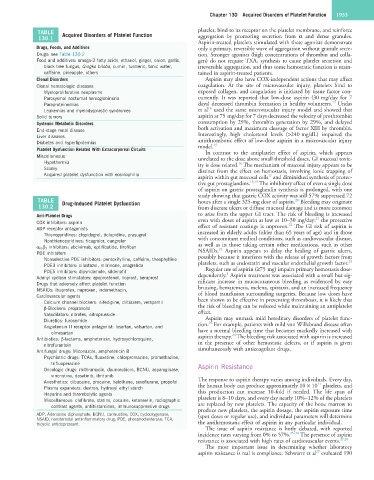
             TABLE   Acquired Disorders of Platelet Function      platelet, bind to its receptor on the platelet membrane, and reinforce
              130.1                                               aggregation  by  promoting  secretion  from  α  and  dense  granules.
                                                                  Aspirin-treated platelets stimulated with these agonists demonstrate
             Drugs, Foods, and Additives                          only a primary, reversible wave of aggregation without granule secre-
             Drugs: see Table 130.2                               tion. Stronger agonists (high concentrations of thrombin and colla-
             Food and additives: omega-3 fatty acids, ethanol, ginger, onion, garlic,   gen) do not require TXA 2 synthesis to cause platelet secretion and
               black tree fungus, Gingko biloba, cumin, turmeric, tonic water,   irreversible aggregation, and thus some hemostatic function is main-
               caffeine, pineapple, others                        tained in aspirin-treated patients.
             Clonal Disorders                                       Aspirin may also have COX-independent actions that may affect
             Clonal hematologic diseases                          coagulation.  At  the  site  of  microvascular  injury,  platelets  bind  to
               Myeloproliferative neoplasms                       exposed collagen, and coagulation is initiated by tissue factor con-
               Paroxysmal nocturnal hemoglobinuria                currently.  It  was  reported  that  low-dose  aspirin  (30 mg/day  for  7
                                                                                                              13
               Paraproteinemias                                   days) decreased thrombin formation in healthy volunteers.  Undas
                                                                     14
               Leukemias and myelodysplastic syndromes            et al  used the same microvascular injury model and showed that
             Solid tumors                                         aspirin at 75 mg/day for 7 days decreased the velocity of prothrombin
             Systemic Metabolic Disorders                         consumption  by  29%,  thrombin  generation  by  29%,  and  delayed
             End-stage renal disease                              both activation and maximum cleavage of factor XIII by thrombin.
             Liver diseases                                       Interestingly,  high  cholesterol  levels  (>240 mg/dL)  impaired  the
             Diabetes and hyperlipidemias                         antithrombotic effect of low-dose aspirin in a microvascular injury
                                                                       15
             Platelet Dysfunction Related With Extracorporeal Circuits  model.
                                                                    In  contrast  to  the  antiplatelet  effect  of  aspirin,  which  appears
             Miscellaneous                                        unrelated to the dose above small threshold doses, GI mucosal toxic-
               Hypothermia                                        ity is dose related.  The mechanism of mucosal injury appears to be
                                                                               16
               Scurvy                                             distinct from the effect on hemostasis, involving ionic trapping of
               Acquired platelet dysfunction with eosinophilia                           17
                                                                  aspirin within gut mucosal cells  and diminished synthesis of protec-
                                                                  tive gut prostaglandins. 18,19  The inhibitory effect of even a single dose
                                                                  of aspirin on gastric prostaglandin synthesis is prolonged, with one
                                                                  study showing that gastric COX activity was still 57% suppressed 72
             TABLE   Drug-Induced Platelet Dysfunction            hours after a single 325-mg dose of aspirin.  Bleeding may originate
                                                                                                  20
              130.2                                               from discrete ulcers or diffuse mucosal damage and is more common
             Anti-Platelet Drugs                                  to arise from the upper GI tract. The risk of bleeding is increased
                                                                                                        21
             COX inhibitors: aspirin                              even with doses of aspirin as low as 10–30 mg/day;  the protective
                                                                                               22
             ADP receptor antagonists                             effect of resistant coatings is unproven.  The GI risk of aspirin is
               Thienopyridines: clopidogrel, ticlopidine, prasugrel  increased in elderly adults (older than 65 years of age) and in those
               Nonthienopyridines: ticagrelor, cangrelor          with concomitant medical conditions, such as cardiovascular disease,
             α IIb β 3  inhibitors: abciximab, eptifibatide, tirofiban  as well as in those taking certain other medications, such as other
                                                                         22
             PDE inhibitors                                       NSAIDs.   Aspirin  appears  to  delay  the  healing  of  gastric  ulcers,
               Nonselective PDE inhibitors: pentoxifylline, caffeine, theophylline  possibly because it interferes with the release of growth factors from
                                                                                                                   23
               PDE3 inhibitors: cilostazol, milrinone, anagrelide  platelets, such as endostatin and vascular endothelial growth factor.
               PDE5 inhibitors: dipyridamole, sildenafil            Regular use of aspirin (≥75 mg) impairs primary hemostasis dose-
                                                                           8
             Adenyl cyclase stimulators: epoprostenol, iloprost, beraprost  dependently.  Aspirin treatment was associated with a small but sig-
             Drugs that adversely affect platelet function        nificant  increase  in  mucocutaneous  bleeding  as  evidenced  by  easy
             NSAIDs: ibuprofen, naproxen, indomethacin,           bruising, hematemesis, melena, epistaxis, and an increased frequency
             Cardiovascular agents                                of blood transfusion surrounding surgeries. Because low doses have
               Calcium channel blockers: nifedipine, diltiazem, verapamil  been shown to be effective in preventing thrombosis, it is likely that
               β-Blockers: propranolol                            the risk of bleeding can be reduced while maintaining an antiplatelet
               Vasodilators: nitrates, nitroprusside              effect.
               Diuretics: furosemide                                Aspirin may unmask mild hereditary disorders of platelet func-
                                                                     24
               Angiotensin II receptor antagonist: losartan, valsartan, and   tion.  For example, patients with mild von Willebrand disease often
                  olmesartan                                      have a normal bleeding time that becomes markedly increased with
                                                                             24
             Antibiotics: β-lactams, amphotericin, hydroxychloroquine,   aspirin therapy.  The bleeding risk associated with aspirin is increased
               nitrofurantoin                                     in  the  presence  of  other  hemostatic  defects,  or  if  aspirin  is  given
             Antifungal drugs: Miconazole, amphotericin B         simultaneously with anticoagulant drugs.
               Psychiatric drugs: TCAs, fluoxetine, chlorpromazine, promethazine,
                  trifluoperazine
               Oncologic drugs: mithramycin, daunorubicin, BCNU, asparaginase,   Aspirin Resistance
                  vincristine, dasatinib, ibritunib
               Anesthetics: dibucaine, procaine, halothane, sevoflurane, propofol  The response to aspirin therapy varies among individuals. Every day,
                                                                                                         11
               Plasma expanders: dextran, hydroxyl ethyl starch   the human body can produce approximately 10 × 10  platelets, and
               Heparins and thrombolytic agents                   this  production  can  increase  10-fold  if  needed.  The  life  span  of
               Miscellaneous: clofibrate, statins, cocaine, ketanserin, radiographic   platelets is 8–10 days, and every day nearly 10%–12% of the platelets
                  contrast agents, antihistamines, immunosuppressive drugs  are replaced by new platelets. The capacity of the bone marrow to
                                                                  produce new platelets, the aspirin dosage, the aspirin exposure time
             ADP, Adenosine diphosphate; BCNU, carmustine; COX, cyclooxygenase;   (spot doses or regular use), and individual parameters will determine
             NSAID, nonsteroidal antiinflammatory drug; PDE, phosphodiesterase; TCA,
             tricyclic antidepressant.                            the antihemostatic effect of aspirin in any particular individual.
                                                                    The  issue  of  aspirin  resistance  is  hotly  debated,  with  reported
                                                                  incidence rates varying from 0% to 57%. 25–28  The presence of aspirin
                                                                  resistance is associated with high rates of cardiovascular events. 27,28
                                                                    The  most  important  issue  in  determining  whether  laboratory
                                                                                                        29
                                                                  aspirin resistance is real is compliance. Schwartz et al  evaluated 190

