


Page 2181 - Hematology_ Basic Principles and Practice ( PDFDrive )
P. 2181
1934   Part XII  Hemostasis and Thrombosis


                                                             ADP
                                                             Thrombin            Outside-In signaling
                                                             Epinephrine           by integrins  Receptors
                                                             PAF                                coupled to
                                                             Thromboxane A2                     tyrosine
                                            ADP          Receptors coupled to G-protein         kinases
                                                               2+
                                        Receptors coupled to  induced Ca  increase via PLC                   VCL
                                      G protein–induced inhibition  activation (e.g., P2Y1)                  ATA
                                     of adenyl cyclase (e.g., P2Y 12)  Ridogrel                GPIb-IX-V   Shear
                            Ticlopidine                                                         Complex  stress
                            Clopidogrel                                                               (via) vWF
                  Receptors coupled to
                G protein–induced stimulation                   γ PIP2
                   of adenyl cyclase               γ        α  β
                                                 β                           Src
                                    Adenyl     α              PLCβ2  PLCγ         PI3
               Epoprostenol         cyclase                                   FAK kinase                Collagen
                IIioprost                    ATP                                                       GPVI
                Beraprost                                      IP3  DAG      Focal contact  ITAM
                                 γ                                            formation    ITAM
                                β                                                              ITAM        Immune
                               α                        IP3                         Syk  FcRγ-chains  ITAM  complexes
                                                                                                           FcγRII
                                          2+
                                         Ca
                                Guanyl cyclase
                                 cGMP
                                                                         LAT,ZAP,70,Vav SLP-76,
             NO,                 cAMP  sequestration  Ca 2+  Ca 2+  Ca 2+  and other phosphotyrosine  Syk  FcRγ-chains
            Nitrates                             Dense tubular system     kinases and adaptors
          Nitroprusside           GTP                     Ca 2+      Ca 2+                  PI3K
                                          Dense
                                         granule     Pleckstrin   Protein kinase C
                            Release reaction       phosphorylation  MLCK
                ADP                       ADP              Cytosolic Ca 2+  Myosin
                5-HT                      5-HT                          phosphorylation
                              Phospholipase A2  Activation of phosholipase A2
                                Arachidonic acid                    GP IIb/IIIa activation
                                       Cyclooxygenase  Aspirin                          Platelet
                                    Cyclic endoperoxide                                aggregation
                                                                               2+
                                       Thromboxane synthase  Ridogrel         Ca -Induced
                                                                             conformational
                                        Thromboxane A 2                        changes
                                                         Scramblase activation                        Abciximab
                                                        (transbilayer movement of                     Eptifibatide
                                                        procoagulant phospholipid)                     Tirofiban
                                                                                 GP IIb/IIIa complex
                                     Thromboxane A 2


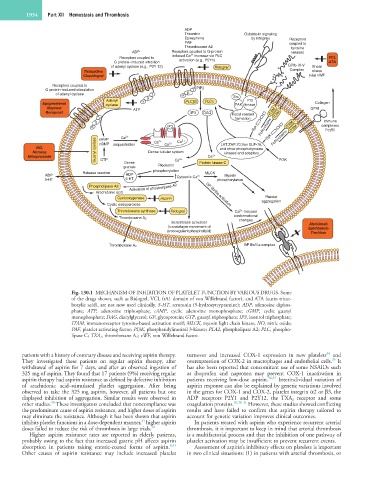
                        Fig. 130.1  MECHANISM OF INHIBITION OF PLATELET FUNCTION BY VARIOUS DRUGS. Some
                        of the drugs shown, such as Ridogrel, VCL (rA1 domain of von Willebrand factor), and ATA (aurin tricar-
                        boxylic acid), are not now used clinically. 5-HT, serotonin (5-hydroxytryptamine); ADP, adenosine diphos-
                        phate;  ATP,  adenosine  triphosphate;  cAMP,  cyclic  adenosine  monophosphate;  cGMP,  cyclic  guanyl
                        monophosphate; DAG, diacylglycerol; GP, glycoprotein; GTP, guanyl triphosphate; IP3, inositol triphosphate;
                        ITAM, immunoreceptor tyrosine-based activation motif; MLCK, myosin light chain kinase; NO, nitric oxide;
                        PAF, platelet activating factor; PI3K, phosphatidylinositol 3-kinase; PLA2, phospholipase A2; PLC, phospho-
                        lipase C; TXA 2 , thromboxane A 2 ; vWF, von Willebrand factor.


                                                                                                            34
        patients with a history of coronary disease and receiving aspirin therapy.   turnover  and  increased  COX-1  expression  in  new  platelets   and
                                                                                                              35
        They  investigated  these  patients  on  regular  aspirin  therapy,  after   overexpression of COX-2 in macrophages and endothelial cells.  It
        withdrawal of aspirin for 7 days, and after an observed ingestion of   has also been reported that concomitant use of some NSAIDs such
        325 mg of aspirin. They found that 17 patients (9%) receiving regular   as  ibuprofen  and  naproxen  may  prevent  COX-1  inactivation  in
        aspirin therapy had aspirin resistance as defined by defective inhibition   patients  receiving  low-dose  aspirin. 36,37   Interindividual  variation  of
        of  arachidonic  acid–stimulated  platelet  aggregation.  After  being   aspirin response can also be explained by genetic variations involved
        observed  to  take  the  325 mg  aspirin,  however,  all  patients  but  one   in the genes for COX-1 and COX-2, platelet integrin α2 or β3, the
        displayed inhibition of aggregation. Similar results were observed in   ADP  receptors  P2Y1  and  P2Y12,  the  TXA 2   receptor  and  some
                  30
        other studies.  These investigators concluded that noncompliance was   coagulation proteins. 26,38–41  However, these studies showed conflicting
        the predominant cause of aspirin resistance, and higher doses of aspirin   results  and  have  failed  to  confirm  that  aspirin  therapy  tailored  to
        may eliminate the resistance. Although it has been shown that aspirin   account for genetic variation improves clinical outcomes.
                                               31
        inhibits platelet functions in a dose-dependent manner,  higher aspirin   In patients treated with aspirin who experience recurrent arterial
        doses failed to reduce the risk of thrombosis in large trials. 32  thrombosis, it is important to keep in mind that arterial thrombosis
           Higher  aspirin  resistance  rates  are  reported  in  elderly  patients,   is a multifactorial process and that the inhibition of one pathway of
        probably owing to the fact that increased gastric pH affects aspirin   platelet activation may be insufficient to prevent recurrent events.
        absorption  in  patients  taking  enteric-coated  forms  of  aspirin. 8,33    Assessment of aspirin’s inhibitory effects on platelets is important
        Other  causes  of  aspirin  resistance  may  include  increased  platelet   in two clinical situations: (1) in patients with arterial thrombosis, or

