


Page 2249 - Hematology_ Basic Principles and Practice ( PDFDrive )
P. 2249
1996   Part XII  Hemostasis and Thrombosis


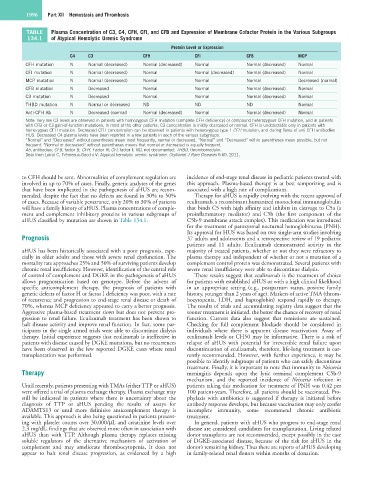
          TABLE   Plasma Concentration of C3, C4, CFH, CFI, and CFB and Expression of Membrane Cofactor Protein in the Various Subgroups
          134.1   of Atypical Hemolytic Uremic Syndrome
                                                         Protein Level or Expression
                        C4    C3                CFH              CFI              CFB              MCP
         CFH mutation   N     Normal (decreased)  Normal (decreased)  Normal      Normal (decreased)  Normal
         CFI mutation   N     Normal (decreased)  Normal         Normal (decreased)  Normal (decreased)  Normal
         MCP mutation   N     Normal (decreased)  Normal         Normal           Normal           Decreased (normal)
         CFB mutation   N     Decreased         Normal           Normal           Normal (decreased)  Normal
         C3 mutation    N     Decreased         Normal           Normal           Normal (decreased)  Normal
         THBD mutation  N     Normal or decreased  ND            ND               ND               Normal
         Anti-CFH Ab    N     Decreased (normal)  Normal (decreased)  Normal      Normal (decreased)  Normal
         Note: Very low C3 levels are observed in patients with homozygous CFH mutation (complete CFH deficiency) or compound heterozygous CFH mutation, and in patients
         with CFB or C3 gain-of-function mutations. In most of the other patients, C3 concentration is mildly decreased or normal. CFH is undetectable only in patients with
         homozygous CFH mutation. Decreased CFH concentration can be observed in patients with heterozygous type 1 CFH mutation, and during flares of anti-CFH antibodies-
         HUS. Decreased C4 plasma levels have been reported in a few patients in each of the various subgroups.
         “Normal” and “Decreased” without parentheses mean most frequently, normal or decreased. “Normal” and “Decreased” within parentheses mean possible, but not
         frequent. “Normal or decreased” without parentheses means that normal or decreased is equally frequent.
         Ab, antibodies; CFB, factor B; CFH, Factor H; CFI, factor I; ND, not documented; THBD, thrombomodulin.
         Data from Loirat C, Frémeaux-Bacchi V: Atypical hemolytic uremic syndrome. Orphanet J Rare Diseases 6:60, 2011.


        to CFH should be sent. Abnormalities of complement regulation are   incidence of end-stage renal disease in pediatric patients treated with
        involved in up to 70% of cases. Finally, genetic analyses of the genes   this  approach.  Plasma-based  therapy  is  at  best  temporizing  and  is
        that have been implicated in the pathogenesis of aHUS are recom-  associated with a high rate of complications.
        mended, despite the fact that no defects are found in 30% to 50%   Therapy for aHUS is rapidly evolving with the recent approval of
        of cases. Because of variable penetrance, only 20% to 30% of patients   eculizumab, a recombinant humanized monoclonal immunoglobulin
        will have a family history of aHUS. Plasma concentrations of comple-  that binds C5 with high affinity and inhibits its cleavage to C5a (a
        ment and complement inhibitory proteins in various subgroups of   proinflammatory  mediator)  and  C5b  (the  first  component  of  the
        aHUS classified by mutation are shown in Table 134.1.  C5b-9 membrane attack complex). This medication was introduced
                                                              for the treatment of paroxysmal nocturnal hemoglobinurea (PNH).
                                                              Its approval for HUS was based on two single-arm studies involving
        Prognosis                                             37 adults and adolescents and a retrospective review of 19 pediatric
                                                              patients  and  11  adults.  Eculizumab  demonstrated  activity  in  the
        aHUS has been historically associated with a poor prognosis, espe-  majority of treated patients, whether or not they were refractory to
        cially in older adults and those with severe renal dysfunction. The   plasma therapy and independent of whether or not a mutation of a
        mortality rate approaches 25% and 50% of surviving patients develop   complement control protein was demonstrated. Several patients with
        chronic renal insufficiency. However, identification of the central role   severe renal insufficiency were able to discontinue dialysis.
        of control of complement and DGKE in the pathogenesis of aHUS   These results suggest that eculizumab is the treatment of choice
        allows  prognostication  based  on  genotype.  Before  the  advent  of   for patients with established aHUS or with a high clinical likelihood
        specific  anticomplement  therapy,  the  prognosis  of  patients  with   in  an  appropriate  setting  (e.g.,  postpartum  status,  positive  family
        genetic defects of factor H or factor I deficiency was poor, with a rate   history, younger than 2 years of age). Markers of active TMA (throm-
        of recurrence and progression to end-stage renal disease or death of   bocytopenia,  LDH,  and  haptoglobin)  respond  rapidly  to  therapy.
        70%, whereas MCP deficiency appeared to carry a better prognosis.   The results of trials and accumulating registry data suggest that the
        Aggressive plasma-based treatment slows but does not prevent pro-  sooner treatment is initiated, the better the chance of recovery of renal
        gression to renal failure. Eculizumab treatment has been shown to   function.  Current  data  also  suggest  that  remissions  are  sustained.
        halt disease activity and improve renal function. In fact, some par-  Checking  for  full  complement  blockade  should  be  considered  in
        ticipants in the single armed trials were able to discontinue dialysis   individuals  where  there  is  apparent  disease  reactivation.  Assay  of
        therapy. Initial experience suggests that eculizumab is ineffective in   eculizumab levels or CH50 may be informative. There is a risk of
        patients with disease caused by DGKE mutations, but no recurrences   relapse  of  aHUS  with  potential  for  irreversible  renal  failure  upon
        have  been  observed  in  the  few  reported  DGKE  cases  where  renal   discontinuation of eculizumab, therefore, life-long treatment is cur-
        transplantation was performed.                        rently recommended. However, with further experience, it may be
                                                              possible to identify subgroups of patients who can safely discontinue
                                                              treatment. Finally, it is important to note that immunity to Neisseria
        Therapy                                               meningitis  depends  upon  the  lytic  terminal  complement  C5b-9
                                                              mechanism,  and  the  reported  incidence  of  Neisseria  infection  in
        Until recently, patients presenting with TMAs (either TTP or aHUS)   patients taking this medication for treatment of PNH was 0.42 per
        were offered a trial of plasma exchange therapy. Plasma exchange may   100 patient-years. Therefore, all patients should be vaccinated. Pro-
        still  be  indicated  in  patients  where  there  is  uncertainty  about  the   phylaxis  with  antibiotics  is  suggested  if  therapy  is  initiated  before
        diagnosis  of  TTP  or  aHUS  pending  the  results  of  assays  for   antibody response develops, but because vaccination may only confer
        ADAMTS13  or  until  more  definitive  anticomplement  therapy  is   incomplete  immunity,  some  recommend  chronic  antibiotic
        available. This approach is also being questioned in patients present-  treatment.
        ing with platelet counts over 30,000/µL and creatinine levels over   In general, patients with aHUS who progress to end-stage renal
        2.3 mg/dL, findings that are observed more often in association with   disease are considered candidates for transplantation. Living related
        aHUS  than  with TTP.  Although  plasma  therapy  replaces  missing   donor transplants are not recommended, except possibly in the case
        soluble  regulators  of  the  alternative  mechanism  of  activation  of   of  DGKE-associated  disease,  because  of  the  risk  for  aHUS  in  the
        complement  and  may  ameliorate  thrombocytopenia,  it  does  not   donor’s remaining kidney. Thus there are reports of aHUS developing
        appear  to  halt  renal  disease  progression,  as  evidenced  by  a  high   in family-related renal donors within months of donation.

