


Page 2247 - Hematology_ Basic Principles and Practice ( PDFDrive )
P. 2247
1994   Part XII  Hemostasis and Thrombosis


                          Protease                            except erythrocytes. Mutations are found throughout the extracellular
              C3                               C3b + C3a      domain of the protein (see Fig. 134.7) and most commonly lead to
            A                                                 diminished  cell  surface  expression,  although  some  impair  protein
                                                              activity.
                            C3                                   MCP and factor H bind C3b and facilitate its cleavage on the cell
                                                              membrane by factor I. Factor I mutations are observed in approxi-
                                                              mately 12% of aHUS patients and most commonly result in decreased
                                                              protein expression; although some mutations cause decreased catalytic
                                               AP
                                                              activity, which is mediated through the factor I light chain. Throm-
                                     B, D, P                  bomodulin  also  enhances  CFI-mediated  degradation  of  C3b,  and
                           C3b                                mutations of thrombomodulin have been observed in 5% of patients
                                                              with aHUS in one series.
              B, SP           C3b + B  →   C3bB                  Mutations in factor B and C3 are observed in approximately 3%
              D, SP           C3bB + D →   C3bBb              and 10% of aHUS patients, respectively. Mutations in factor B lead
            B P, stabilizer   C3bBb + P →  C3bBbP             to enhanced formation or greater stability of C3 convertase on cell
                                                              surfaces.  Mutations  in  C3  may  result  in  resistance  to  regulation,
                                                              principally  mediated  by  diminished  ability  of  regulatory  proteins
                                 Alternative pathway          (CHF, MCP or CFI) to interact with mutant C3b.
                                  C3 convertase                  Recently,  mutations  in  the  gene  encoding  for  DGKE,  a  lipid
                            C3       C3bBbP                   kinase  expressed  in  endothelium,  platelets,  and  renal  podocytes,
                                                              has been identified as the cause of an autosomal recessive form of
                                                              aHUS with high penetrance. The mechanism of disease is attributed
                                                              to  deregulation  of  intracellular  signaling,  leading  to  activation  of
                   AP                          AP             protein kinase C with a subsequent shift of the balance of endothe-
                                                              lial cells and platelets toward a more activated and prothrombotic
                                     B, D, P                  phenotype. Altered podocyte homeostasis has been hypothesized to
                           C3b                                occur  as  a  consequence  of  abnormal  protein  kinase  C-dependent
              Endothelial cell     C3a and C5a                vascular  endothelial  growth  factor  (VEGF)  receptor  expression,
                membrane                                      disrupting  this  important  cell  nurturing  pathway.  In  general,
                                  (Anaphylatoxins)            patients  with  DGKE-related  aHUS  have  no  evidence  of  comple-
            C             C5b-C9                              ment  dysregulation.  Furthermore,  unlike  patients  with  defects  of
                                                              the complement mechanism, patients with DGKE-associated aHUS
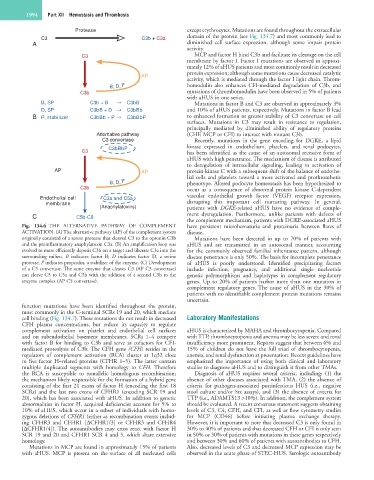
        Fig.  134.6  THE  ALTERNATIVE  PATHWAY  OF  COMPLEMENT   have  persistent  microhematuria  and  proteinuria  between  flares  of
        ACTIVATION. (A) The alternative pathway (AP) of the complement system   disease.
        originally consisted of a serine protease that cleaved C3 to the opsonin C3b   Mutations  have  been  detected  in  up  to  70%  of  patients  with
        and the proinflammatory anaphylatoxin C3a. (B) An amplification loop was   aHUS  and  are  transmitted  in  an  autosomal  manner,  accounting
        evolved to more efficiently deposit C3b on a target and liberate C3a into the   for  the  commonly  observed  familial  inheritance  pattern,  although
        surrounding  milieu.  B  indicates  factor  B;  D  indicates  factor  D,  a  serine   disease penetrance is only 50%. The basis for incomplete penetrance
        protease; P indicates properdin, a stabilizer of the enzyme. (C) Development   of  aHUS  is  poorly  understood.  Identified  precipitating  factors
        of a C5 convertase. The same enzyme that cleaves C3 (AP C3 convertase)   include  infection,  pregnancy,  and  additional  single  nucleotide
        can cleave C5 to C5a and C5b with the addition of a second C3b to the   genetic  polymorphisms  and  haplotypes  in  complement  regulatory
        enzyme complex (AP C5 convertase).                    genes.  Up  to  20%  of  patients  harbor  more  than  one  mutation  in
                                                              complement  regulatory  genes. The  cause  of  aHUS  in  the  30%  of
                                                              patients with no identifiable complement protein mutations remains
                                                              uncertain.
        function  mutations  have  been  identified  throughout  the  protein,
        most commonly in the C-terminal SCRs 19 and 20, which mediate
        cell binding (Fig. 134.7). These mutations do not result in decreased   Laboratory Manifestations
        CFH  plasma  concentrations,  but  reduce  its  capacity  to  regulate
        complement  activation  on  platelet  and  endothelial  cell  surfaces   aHUS is characterized by MAHA and thrombocytopenia. Compared
        and  on  subendothelial  basement  membranes.  SCRs  1–4  compete   with TTP, thrombocytopenia and anemia may be less severe and renal
        with  factor  B  for  binding  to  C3b  and  serve  as  cofactors  for  CFI-  insufficiency more prominent. Reports suggest that between 6% and
        mediated proteolysis of C3b. The CFH gene (CFH) resides in the   15%  of  children  do  not  have  the  full  triad  of  thrombocytopenia,
        regulators  of  complement  activation  (RCA)  cluster  at  1q32  close   anemia, and renal dysfunction at presentation. Recent guidelines have
        to  five  factor  H–related  proteins  (CFHR  1–5). The  latter  contain   emphasized  the  importance  of  using  both  clinical  and  laboratory
        multiple  duplicated  segments  with  homology  to  CFH.  Therefore   studies to diagnose aHUS and to distinguish it from other TMAs.
        the  RCA  is  susceptible  to  nonallelic  homologous  recombination;   Diagnosis  of  aHUS  requires  several  criteria,  including:  (1)  the
        the mechanism likely responsible for the formation of a hybrid gene   absence of other diseases associated with TMA, (2) the absence of
        consisting of the first 21 exons of factor H (encoding the first 18   criteria  for  pathogen-associated  postinfectious  HUS  (i.e.,  negative
        SCRs)  and  the  last  two  exons  of  CFHR1  (encoding  SCR  19  and   stool culture and/or Stx assays), and (3) the absence of criteria for
        20), which has been associated with aHUS. In addition to genetic   TTP (i.e., ADAMTS13 >10%). In addition, the complement system
        abnormalities in factor H, acquired deficiencies account for 5% to   should be evaluated. A recent consensus statement suggests obtaining
        10% of aHUS, which occur in a subset of individuals with homo-  levels of C3, C4, CFH, and CFI, as well as flow cytometry studies
        zygous deletions of CFHR1 (either as recombination events includ-  for  MCP  (CD46)  before  initiating  plasma  exchange  therapy.
        ing  CFHR3  and  CFHR1  [ΔCFHR1/3]  or  CFHR3  and  CFHR4   However, it is important to note that decreased C3 is only found in
        [ΔCFHR1/4]). The  autoantibodies  may  cross  react  with  factor  H   30% to 40% of patients and that decreased CFH or CFI is only seen
        SCR 19 and 20 and CFHR1 SCR 4 and 5, which share extensive     in 50% or 30% of patients with mutations in these genes respectively
        homology.                                             and between 30% and 60% of patients with autoantibodies to CFH.
           Mutations in MCP are found in approximately 15% of patients   Also, decreased levels of C3 and decreased MCP expression may be
        with  aHUS.  MCP  is  present  on  the  surface  of  all  nucleated  cells   observed in the acute phase of STEC-HUS. Serologic autoantibody

