


Page 2303 - Hematology_ Basic Principles and Practice ( PDFDrive )
P. 2303
Chapter 137  Rare Coagulation Factor Deficiencies  2045


            but do not prevent dimer formation (e.g., Gly400Val). In heterozy-
            gotes, mutant and wild-type polypeptides form nonsecretable dimers,                  3
            trapping normal protein in the cell. This phenomenon likely accounts        α−kal
            for families in which severe to moderate factor XI deficiency appears                     XII
            to be a dominant trait.
              Factor  XI  levels  decrease  in  liver  disease  and  DIC  but  are  not   2       1
            affected by vitamin K deficiency or warfarin therapy. Mild to moder-
            ate factor XI deficiency occurs in approximately 25% of patients with   PK   XIIIa          XIa
            Noonan syndrome and is common in carbohydrate-deficient glyco-
            protein syndrome, a group of inherited disorders involving defects in   HK          4
            glycosylation of secretory glycoproteins. Antibody inhibitors to factor
            XI  are  common  after  replacement  therapy,  particularly  in  patients    XI
            with no circulating factor XI. For example, one-third of individuals
            homozygous for Glu117Stop develop inhibitors, often after a single            HK
            exposure to plasma.
              Bleeding in severe factor XI deficiency is usually injury-related and
            is most frequent in tissues with robust fibrinolytic activity, such as
                                                 22
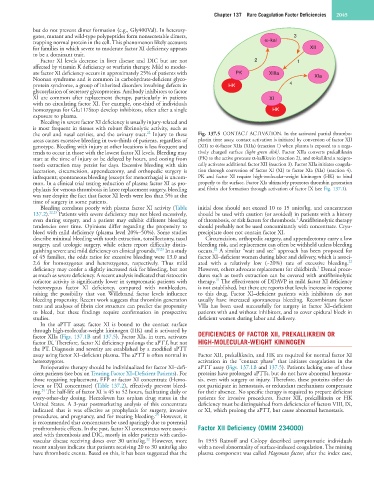
            the oral and nasal cavities, and the urinary tract.  Injury to these   Fig. 137.5  CONTACT ACTIVATION. In the activated partial thrombo-
            areas causes excessive bleeding in two-thirds of patients, regardless of   plastin time assay, contact activation is initiated by conversion of factor XII
            genotype. Bleeding with injury at other locations is less frequent and   (XII) to α-factor XIIa (XIIa) (reaction 1) when plasma is exposed to a nega-
            tends to occur in those with the lowest factor XI levels. Bleeding may   tively  charged  surface  (light  green  disk).  Factor  XIIa  converts  prekallikrein
            start at the time of injury or be delayed by hours, and oozing from   (PK) to the active protease α-kallikrein (reaction 2), and α-kallikrein recipro-
            tooth extraction may persist for days. Excessive bleeding with skin   cally activates additional factor XII (reaction 3). Factor XIIa initiates coagula-
            laceration,  circumcision,  appendectomy,  and  orthopedic  surgery  is   tion through conversion of factor XI (XI) to factor XIa (XIa) (reaction 4).
            infrequent; spontaneous bleeding (except for menorrhagia) is uncom-  PK  and  factor  XI  require  high-molecular-weight  kininogen  (HK)  to  bind
            mon. In a clinical trial testing reduction of plasma factor XI as pro-  properly to the surface. Factor XIa ultimately promotes thrombin generation
            phylaxis for venous thrombosis in knee replacement surgery, bleeding   and fibrin clot formation through activation of factor IX (see Fig. 137.1).
            was rare despite the fact that factor XI levels were less than 5% at the
            time of surgery in some patients.
              Bleeding correlates poorly with plasma factor XI activity (Table   initial dose should not exceed 10 to 15 units/kg, and concentrates
            137.2). 22,23  Patients with severe deficiency may not bleed excessively,   should be used with caution (or avoided) in patients with a history
                                                                                                  2
            even  during  surgery,  and  a  patient  may  exhibit  different  bleeding   of thrombosis, or risk factors for thrombosis.  Antifibrinolytic therapy
            tendencies  over  time.  Opinions  differ  regarding  the  propensity  to   should probably not be used concomitantly with concentrate. Cryo-
            bleed with mild deficiency (plasma level 20%–50%). Some studies   precipitate does not contain factor XI.
            describe minimal bleeding with tooth extraction, tonsillectomy, nasal   Circumcision, orthopedic surgery, and appendectomy carry a low
            surgery,  and  urologic  surgery,  while  others  report  difficulty  distin-  bleeding risk, and replacement can often be withheld unless bleeding
                                                                       22
            guishing severe and mild deficiency on clinical grounds. 22,23  In a study   occurs.  A similar “wait and see” approach has been proposed for
            of 45 families, the odds ratios for excessive bleeding were 13.0 and   factor XI–deficient women during labor and delivery, which is associ-
                                                                                                                   22
            2.6  for  homozygotes  and  heterozygotes,  respectively.  Thus  mild   ated  with  a  relatively  low  (~20%)  rate  of  excessive  bleeding.
                                                                                                         2
            deficiency may confer a slightly increased risk for bleeding, but not   However, others advocate replacement for childbirth.  Dental proce-
            as much as severe deficiency. A recent analysis indicated that ristocetin   dures such as tooth extraction can be covered with antifibrinolytic
                                                                        22
            cofactor activity is significantly lower in symptomatic patients with   therapy.  The effectiveness of DDAVP in mild factor XI deficiency
            heterozygous  factor  XI  deficiency,  compared  with  nonbleeders,   is not established, but there are reports that levels increase in response
            raising  the  possibility  that  von  Willebrand  factor  levels  influence   to  this  drug.  Factor  XI–deficient  patients  with  inhibitors  do  not
            bleeding propensity. Recent work suggests that thrombin generation   usually  have  increased  spontaneous  bleeding.  Recombinant  factor
            tests and analyses of fibrin clot structure can predict the propensity   VIIa  has  been  used  successfully  for  surgery  in  factor  XI–deficient
            to  bleed,  but  these  findings  require  confirmation  in  prospective   patients with and without inhibitors, and to cover epidural block in
            studies.                                              deficient women during labor and delivery.
              In  the  aPTT  assay,  factor  XI  is  bound  to  the  contact  surface
            through high-molecular-weight kininogen (HK) and is activated by
            factor XIIa (Figs. 137.1B and 137.5). Factor XIa, in turn, activates   DEFICIENCIES OF FACTOR XII, PREKALLIKREIN OR
            factor IX. Therefore, factor XI deficiency prolongs the aPTT, but not   HIGH-MOLECULAR-WEIGHT KININOGEN
            the PT. Diagnosis and severity are established by a modified aPTT
            assay using factor XI–deficient plasma. The aPTT is often normal in   Factor XII, prekallikrein, and HK are required for normal factor XI
            heterozygotes.                                        activation  in  the  “contact  phase”  that  initiates  coagulation  in  the
              Perioperative therapy should be individualized for factor XI–defi-  aPTT assay (Figs. 137.1B and 137.5). Patients lacking one of these
            cient patients (see box on Treating Factor XI–Deficient Patients). For   proteins have prolonged aPTTs, but do not have abnormal hemosta-
            those requiring replacement, FFP or factor XI concentrate (Hemo-  sis, even with surgery or injury. Therefore, these proteins either do
            leven or FXI concentrate) (Table 137.2), effectively prevent bleed-  not participate in hemostasis, or redundant mechanisms compensate
               24
            ing.  The half-life of factor XI is 45 to 52 hours, facilitating daily or   for their absence. No specific therapy is required to prepare deficient
            every-other-day  dosing.  Hemoleven  has  orphan  drug  status  in  the   patients  for  invasive  procedures.  Factor  XII,  prekallikrein  or  HK
            United  States.  A  3-year  postmarketing  analysis  of  this  concentrate   deficiency must be distinguished from deficiencies of factors VIII, IX,
            indicated  that  it  was  effective  as  prophylaxis  for  surgery,  invasive   or XI, which prolong the aPTT, but cause abnormal hemostasis.
                                                    24
            procedures, and pregnancy, and for treating bleeding.  However, it
            is recommended that concentrates be used sparingly due to potential
            prothrombotic effects. In the past, factor XI concentrates were associ-  Factor XII Deficiency (OMIM 234000)
            ated with thrombosis and DIC, mostly in older patients with cardio-
                                                 22
            vascular disease receiving doses over 30 units/kg.  However, more   In  1955  Ratnoff  and  Colopy  described  asymptomatic  individuals
            recent analyses indicate that patients receiving 20 to 30 units/kg also   with a novel abnormality of surface-induced coagulation. The missing
            have thrombotic events. Based on this, it has been suggested that the   plasma component was called Hageman factor, after the index case,

