


Page 2299 - Hematology_ Basic Principles and Practice ( PDFDrive )
P. 2299
Chapter 137  Rare Coagulation Factor Deficiencies  2041


            relatively low (<2%). It is reasonable to maintain the factor VII, IX,   Factor V
            and  X  levels  at  less  than  150%  of  normal  to  reduce  risk.  Dental   Heavy chain  B domain  Light chain
            procedures  or  minor  hemorrhage  may  respond  to  antifibrinolytic
                                     1
            therapy with ε-amino caproic acid.  Prothrombin deficiency may also   R709
            be treated with FFP for bleeding episodes or surgical intervention (15
            to 20 mL/kg loading dose followed by 3 mL/kg/day). Because of the   Heavy chain                Light chain
            long half-life, additional doses may not be required in all situations.   R1018
            Cryoprecipitate  is  not  a  source  of  prothrombin,  and  plasma  pro-
            thrombin levels do not increase after infusion or inhalation of des-  Heavy chain              Light chain
            mopressin (1-desamino-8-D-arginine vasopressin [DDAVP]).
              The postviral hypoprothrombinemia seen in young children often                           R1545
            spontaneously resolves. Intravenous immunoglobulin has been effec-  Factor Va
            tive is this population. Treatment of acquired prothrombin deficiency   Heavy chain  Ca 2      Light chain

            associated  with  lupus  anticoagulants  in  patients  with  autoimmune   Factor V-short
            diseases often requires immune suppression. Steroids are effective in
            most patients, although many relapse during weaning or after stop-  Heavy chain  Light chain
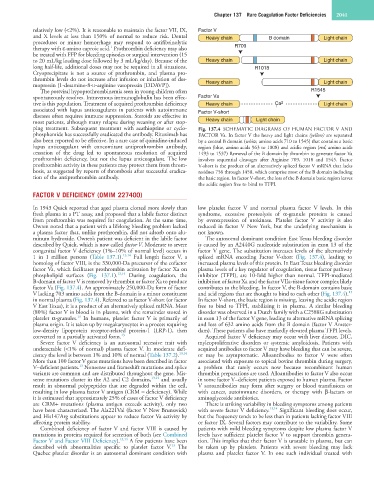
            ping  treatment.  Subsequent  treatment  with  azathioprine  or  cyclo-  Fig. 137.4  SCHEMATIC DIAGRAMS OF HUMAN FACTOR V AND
            phosphamide has successfully eradicated the antibody. Rituximab has   FACTOR Va. In factor V the heavy and light chains (yellow) are separated
            also been reported to be effective. In a rare case of quinidine-induced   by a central B domain (white, amino acids 710 to 1545) that contains a basic
            lupus  anticoagulant  with  concomitant  antiprothrombin  antibody,   region (blue, amino acids 963 to 1008) and acidic region (red, amino acids
            cessation  of  the  drug  led  to  spontaneous  resolution  of  acquired   1493 to 1537) Removal of the B domain by thrombin to generate factor Va
            prothrombin deficiency, but not the lupus anticoagulant. The low   involves  sequential  cleavages  after  Arginine  709,  1018  and  1545.  Factor
            prothrombin activity in these patients may protect them from throm-  V-short is the product of an alternatively spliced factor V mRNA that lacks
            bosis, as suggested by reports of thrombosis after successful eradica-  residues 756 through 1458, which comprise most of the B domain including
            tion of the antiprothrombin antibody.                 the basic region. In factor V-short, the loss of the B domain basic region leaves
                                                                  the acidic region free to bind to TFPI.
            FACTOR V DEFICIENCY (OMIM 227400)

            In 1943 Quick reported that aged plasma clotted more slowly than   low  platelet  factor  V  and  normal  plasma  factor  V  levels.  In  this
            fresh plasma in a PT assay, and proposed that a labile factor distinct   syndrome,  excessive  proteolysis  of  α-granule  proteins  is  caused
            from prothrombin was required for coagulation. At the same time,   by  overexpression  of  urokinase.  Platelet  factor  V  activity  is  also
            Owren noted that a patient with a lifelong bleeding problem lacked   reduced  in  factor  V  New  York,  but  the  underlying  mechanism  is
            a plasma factor that, unlike prothrombin, did not adsorb onto alu-  not known.
            minum hydroxide. Owren’s patient was deficient in the labile factor   The autosomal dominant condition East Texas bleeding disorder
            described by Quick, which is now called factor V. Moderate to severe   is caused by an A2440G nucleotide substitution in exon 13 of the
            congenital factor V deficiency (1%–10% of normal level) occurs in   factor V gene. The substitution increases levels of the alternatively
            1  in  1  million  persons  (Table  137.1). 13,14   Full  length  factor  V,  a   spliced  mRNA  encoding  Factor  V-short  (Fig.  137.4),  leading  to
            homolog of factor VIII, is the 330,000-Da precursor of the cofactor   increased plasma levels of this protein. In East Texas bleeding disorder
            factor Va, which facilitates prothrombin activation by factor Xa on   plasma levels of a key regulator of coagulation, tissue factor pathway
            phospholipid  surfaces  (Fig.  137.1). 13,14   During  coagulation,  the   inhibitor  (TFPI),  are  10-fold  higher  than  normal. TFPI-mediated
            B-domain of factor V is removed by thrombin or factor Xa to produce   inhibition of factor Xa and the factor VIIa-tissue factor complex likely
            factor Va (Fig. 137.4). An approximately 250,000-Da form of factor   contributes to the bleeding. In factor V, the B-domain contains basic
                                                                                                                   13
            V lacking 703 amino acids from the B-domain is a minor constituent   and acid regions that are thought to bind to each other (Fig. 137.4).
            in normal plasma (Fig. 137.4). Referred to as factor V-short (or factor   In factor V-short, the basic region is missing, leaving the acidic region
            V East Texas), it is a product of an alternatively spliced mRNA. Most   free  to  bind  to TFPI,  stabilizing  it  in  plasma.  A  similar  bleeding
            (80%) factor V in blood is in plasma, with the remainder stored in   disorder was observed in a Dutch family with a C2588G substitution
                          13
            platelet  α-granules.   In  humans,  platelet  factor  V  is  primarily  of   in exon 13 of the factor V gene, leading to alternative mRNA splicing
            plasma origin. It is taken up by megakaryocytes in a process requiring   and loss of 632 amino acids from the B domain (factor V Amster-
            low-density  lipoprotein  receptor-related  protein-1  (LRP-1),  then   dam). These patients also have markedly elevated plasma TFPI levels.
            converted to a partially activated form. 13             Acquired factor V deficiency may occur with liver disease, DIC,
              Severe  factor  V  deficiency  is  an  autosomal  recessive  trait  with   myleoproliferative  disorders  or  systemic  amyloidosis.  Patients  with
            undetectable  (<1%  of  normal)  plasma  factor V.  In  moderate  defi-  acquired antibodies to factor V may have bleeding that can be severe,
            ciency the level is between 1% and 10% of normal (Table 137.2). 13,14    or  may  be  asymptomatic.  Alloantibodies  to  factor  V  were  often
            More than 100 factor V gene mutations have been described in factor   associated with exposure to topical bovine thrombin during surgery,
                           13
            V–deficient patients.  Nonsense and frameshift mutations and splice   a  problem  that  rarely  occurs  now  because  recombinant  human
            variants are common and are distributed throughout the gene. Mis-  thrombin preparations are used. Alloantibodies to factor V also occur
            sense mutations cluster in the A2 and C2 domains, 13,14  and usually   in some factor V–deficient patients exposed to human plasma. Factor
            result  in  abnormal  polypeptides  that  are  degraded  within  the  cell,   V  autoantibodies  may  form  after  surgery  or  blood  transfusions  or
            resulting in low plasma factor V antigen (CRM − deficiency). While   with  cancer,  autoimmune  disorders,  or  therapy  with  β-lactam  or
            it is estimated that approximately 25% of cases of factor V deficiency   aminoglycoside antibiotics.
            are  CRM+  mutations  (plasma  antigen  exceeds  activity),  only  two   There is striking variability in bleeding symptoms among patients
            have been characterized. The Ala221Val (factor V New Brunswick)   with severe factor V deficiency. 13,14  Significant bleeding does occur,
            and His147Arg substitutions appear to reduce factor Va activity by   but the frequency tends to be less than in patients lacking factor VIII
            affecting protein stability.                          or factor IX. Several factors may contribute to the variability. Some
              Combined  deficiency  of  factor  V  and  factor  VIII  is  caused  by   patients with mild bleeding symptoms despite low plasma factor V
            mutations in proteins required for secretion of both (see Combined   levels have sufficient platelet factor V to support thrombin genera-
            Factor V and Factor VIII Deficiency). 13,14  A few patients have been   tion. This implies that their factor V is unstable in plasma, but can
                                                         13
            described  with  abnormalities  specific  to  platelet  factor  V.   The   be  taken  up  by  platelets.  Patients  with  severe  bleeding  may  lack
            Quebec platelet disorder is an autosomal dominant condition with   plasma  and  platelet  factor  V.  In  one  such  individual  treated  with

