


Page 2484 - Hematology_ Basic Principles and Practice ( PDFDrive )
P. 2484
2216   Part XIII  Consultative Hematology


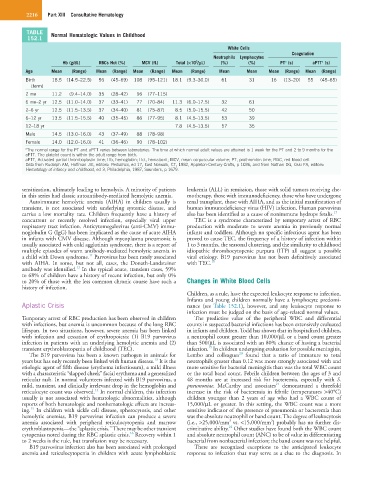
          TABLE   Normal Hematologic Values in Childhood
          152.1
                                                                            White Cells
                                                                                                Coagulation
                                                                       Neutrophils  Lymphocytes
                      Hb (g/dL)  RBCs Hct (%)  MCV (fL)    Total (×10 /µL)  (%)   (%)        PT  (s)   aPTT  (s)
                                                                                              a
                                                                                                          a
                                                                 3
         Age      Mean  (Range)  Mean  (Range)  Mean  (Range)  Mean  (Range)  Mean  Mean  Mean  (Range)  Mean  (Range)
         Birth    18.5  (14.5–22.5)  56  (45–69)  108  (95–121)  18.1  (9.3–30.0)  61  31  16  (13–20)  55  (45–65)
           (term)
         2 mo     11.2  (9.4–14.0)  35  (28–42)  96  (77–115)
         6 mo–2 yr  12.5  (11.0–14.0)  37  (33–41)  77  (70–84)  11.3  (6.0–17.5)  32  61
         2–6 yr   12.5  (11.5–13.5)  37  (34–40)  81  (75–87)  8.5  (5.0–15.5)  42  50
         6–12 yr  13.5  (11.5–15.5)  40  (35–45)  86  (77–95)  8.1  (4.5–13.5)  53  39
         12–18 yr                                         7.8  (4.5–13.5)  57     35
         Male     14.5  (13.0–16.0)  43  (37–49)  88  (78–98)
         Female   14.0  (12.0–16.0)  41  (36–46)  90  (78–102)
         a The normal range for the PT and aPTT varies between laboratories. The time at which normal adult values are attained is 1 week for the PT and 2 to 9 months for the
         aPTT. The platelet count is within the adult range from birth.
         aPTT, Activated partial thromboplastin time; Hb, hemoglobin; Hct, hematocrit; MCV, mean corpuscular volume; PT, prothrombin time; RBC, red blood cell.
         Data from Rudolph AM, Hoffman JIE, editors: Pediatrics, ed 17, East Norwalk, CT, 1982, Appleton-Century-Crofts, p 1036, and from Nathan DG, Oski FA, editors:
         Hematology of infancy and childhood, ed 3, Philadelphia, 1987, Saunders, p 1679.


        sensitization, ultimately leading to hemolysis. A minority of patients   leukemia (ALL) in remission, those with solid tumors receiving che-
        in this series had classic autoantibody-mediated hemolytic anemia.  motherapy, those with immunodeficiency, those who have undergone
           Autoimmune  hemolytic  anemia  (AIHA)  in  children  usually  is   renal transplant, those with AIHA, and as the initial manifestation of
        transient,  is  not  associated  with  underlying  systemic  disease,  and   human immunodeficiency virus (HIV) infection. Human parvovirus
        carries  a  low  mortality  rate.  Children  frequently  have  a  history  of   also has been identified as a cause of nonimmune hydrops fetalis. 17
        concurrent  or  recently  resolved  infection,  especially  viral  upper   TEC  is  a  syndrome  characterized  by  temporary  arrest  of  RBC
        respiratory tract infection. Anticytomegalovirus (anti-CMV) immu-  production  with  moderate  to  severe  anemia  in  previously  normal
        noglobulin G (IgG) has been implicated as the cause of acute AIHA   infants and toddlers. Although no specific infectious agent has been
        in infants with CMV disease. Although mycoplasma pneumonia is   proved to cause TEC, the frequency of a history of infection within
        usually associated with cold agglutinin syndrome, there is a report of   1 to 3 months, the seasonal clustering, and the similarity to childhood
        multiple episodes of warm antibody-mediated hemolytic anemia in   idiopathic  thrombocytopenic  purpura  (ITP)  all  suggest  a  possible
                              11
        a child with Down syndrome.  Parvovirus has been rarely associated   viral  etiology.  B19  parvovirus  has  not  been  definitively  associated
        with  AIHA.  In  some,  but  not  all,  cases,  the  Donath-Landsteiner   with TEC. 18
                          12
        antibody was identified.  In the typical acute, transient cases, 59%
        to 68% of children have a history of recent infection, but only 0%
        to 20% of those with the less common chronic course have such a   Changes in White Blood Cells
        history of infection.
                                                              Children, as a rule, have the expected leukocyte response to infection.
                                                              Infants and young children normally have a lymphocyte predomi-
        Aplastic Crisis                                       nance  (see  Table  152.1),  however,  and  any  leukocyte  response  to
                                                              infection must be judged on the basis of age-related normal values.
        Temporary arrest of RBC production has been observed in children   The  predictive  value  of  the  peripheral  WBC  and  differential
        with infections, but anemia is uncommon because of the long RBC   counts in suspected bacterial infections has been extensively evaluated
        lifespan. In two situations, however, severe anemia has been linked   in infants and children. Todd has shown that in hospitalized children,
        with  infection  and  cessation  of  erythropoiesis:  (1)  B19  parvovirus   a neutrophil count greater than 10,000/µL or a band count greater
        infection in patients with an underlying hemolytic anemia and (2)   than 500/µL is associated with an 80% chance of having a bacterial
                                                                     19
        transient erythroblastopenia of childhood (TEC).      infection.  In children undergoing evaluation for possible meningitis,
                                                                               20
           The B19 parvovirus has been a known pathogen in animals for   Lembo  and  colleagues   found  that  a  ratio  of  immature  to  total
                                                    13
        years but has only recently been linked with human disease.  It is the   neutrophils greater than 0.12 was more strongly associated with and
        etiologic agent of fifth disease (erythema infectiosum), a mild illness   more sensitive for bacterial meningitis than was the total WBC count
        with a characteristic “slapped cheek” facial erythema and a generalized   or the total band count. Febrile children between the ages of 3 and
        reticular rash. In normal volunteers infected with B19 parvovirus, a   48  months  are  at  increased  risk  for  bacteremia,  especially  with  S.
                                                                                           21
        mild, transient, and clinically irrelevant drop in the hemoglobin and   pneumoniae.  McCarthy  and  associates   demonstrated  a  threefold
                                14
        reticulocyte count was observed.  In normal children, this infection   increase  in  the  risk  of  bacteremia  in  febrile  (temperatures  >40°C)
        usually is not associated with hematologic abnormalities, although   children  younger  than  2  years  of  age  who  had  a  WBC  count  of
        reports of both hematologic and nonhematologic effects are increas-  15,000/µL or greater. In this setting, the WBC count was a more
           15
        ing.   In  children  with  sickle  cell  disease,  spherocytosis,  and  other   sensitive indicator of the presence of pneumonia or bacteremia than
        hemolytic anemias, B19 parvovirus infection can produce a severe   was the absolute neutrophil or band count. The degree of leukocytosis
                                                                            2
                                                                                          2
        anemia  associated  with  peripheral  reticulocytopenia  and  marrow   (i.e., >25,000/mm  vs. <15,000/mm ) probably has no further dis-
                                                                            22
        erythroblastopenia—the “aplastic crisis.” There may be other transient   criminative ability.  Other studies have found both the WBC count
                                            16
        cytopenias noted during the RBC aplastic crisis.  Recovery within 1   and absolute neutrophil count (ANC) to be of value in differentiating
        to 2 weeks is the rule, but transfusion may be necessary.  bacterial from nonbacterial infection; the band count was not helpful.
           B19 parvovirus infection also has been associated with prolonged   There  are  recognized  exceptions  to  the  anticipated  leukocyte
        anemia and reticulocytopenia in children with acute lymphoblastic   response to infection that may serve as a clue to the diagnosis. In

