


Page 2488 - Hematology_ Basic Principles and Practice ( PDFDrive )
P. 2488
2220   Part XIII  Consultative Hematology


        elevated fibrinogen, factor VIII, and fibrinopeptide A levels in up to   Preliminary Diagnostic Guidelines for Macrophage
                         96
        50% of these patients,  but other studies have not confirmed such   TABLE   Activation Syndrome in Systemic Juvenile Idiopathic
        findings. Another study found elevation of D-dimer levels in 96% of   152.2  Arthritis a
        systemic-onset JIA patients; serial measurements of D-dimer levels
                                       97
        appeared to parallel response to treatment.  In apparent distinction,   Laboratory Criteria
        decreased  fibrinolytic  activity  and  increased  plasminogen  activator   1.  Decreased platelet count (≤262 × 10 /L)
                                                                                           9
        inhibitor have been found in patients with active JIA, especially those   2.  Elevated levels of aspartate aminotransferase (>59 IU/L)
        with the systemic form. Antibodies against factor VIII and the lupus   3.  Decreased white blood cell count (≤4.0 × 10 /L)
                                                                                                9
        anticoagulant are occasionally seen in children with JIA.  4.  Hypofibrinogenemia (≤250 mg/dL)
                                                               Clinical Criteria
        Macrophage Activation Syndrome                         1.  Central nervous system dysfunction (irritability, disorientation,
                                                                  lethargy, headache, seizures, coma)
                                                               2.  Hemorrhages (purpura, easy bruising, mucosal bleeding)
        MAS is a life-threatening multisystem disorder most closely resem-  3.  Hepatomegaly (≥3 cm below the costal margin)
        bling hemophagocytic lymphohistiocytosis (HLH) that occurs pri-  Histopathologic Criterion
        marily  in  patients  with  systemic-onset  juvenile  idiopathic  arthritis
        (sJIA). 98,99  This syndrome usually occurs early in the course of active   Evidence of macrophage hemophagocytosis in the bone marrow aspirate
                                         100
        sJIA and can even be a presenting feature,  although it has been   Diagnostic Rule
                                              101
        reported to occur later and during a quiescent phase.  It is estimated   The diagnosis of macrophage activation syndrome requires the presence
        that approximately 7% of patients with sJIA develop MAS, and the   of any two or more laboratory criteria or of at least two clinical or
                                         102
        mortality  rate  is  between  10%  and  20%.   MAS  has  also  been   laboratory criteria. A bone marrow aspirate for the demonstration of
        reported  in  other  systemic  inflammatory  disorders,  including  SLE   hemophagocytosis may be required only in doubtful cases.
        and Kawasaki disease. 100                              a The suggested criteria are useful only in patients with active systemic-onset
           The  main  clinical  features  of  MAS  include  a  high  unremitting   juvenile idiopathic arthritis. The laboratory thresholds are examples only and are
        fever,  hepatosplenomegaly,  lymphadenopathy,  bleeding,  rash,  and   not specific for the diagnosis (see text).
                                                               From Ravelli A, Magni-Manzoni S, Pistorio A, et al: Preliminary diagnostic
        central nervous system manifestations. Neurologic symptoms include   guidelines for macrophage activation syndrome complicating systemic juvenile
        lethargy,  irritability,  disorientation,  headache,  seizures,  and  coma.   idiopathic arthritis. J Pediatr 146:598, 2005.
        Children with MAS are acutely ill, and almost 50% require intensive
                  103
        care unit care.  The diagnosis may be delayed because the presenta-
        tion  mimics  an  acute  exacerbation  of  sJIA  or  severe  infection.  Of
        interest, some patients have shown a paradoxical improvement in the   be emphasized. In MAS, clinical features are weaker discriminators
        underlying inflammatory disease at the onset of MAS. Precipitating   than laboratory features. Although the presence of fever was universal
        factors that have been implicated include a flare-up of the underlying   in patients with MAS, it had a low specificity rate because of the high
        disease, aspirin or other NSAID toxicity, viral infections, a second   incidence of fever in patients with sJIA without MAS. The pattern
        injection  of  gold  salts,  methotrexate  therapy,  and  sulfasalazine   of fever may be of more importance because patients with MAS tend
        therapy. 103                                          to have nonremitting fever as opposed to the high spiking fevers seen
           Typical laboratory features include pancytopenia, hypofibrinogen-  in sJIA. The other clinical criteria may occur late in the course of
        emia (<250 mg/dL), elevated liver enzymes (>40 IU/mL), hypertri-  MAS, resulting in abnormal laboratory findings being more helpful
        glyceridemia  (>160 mg/dL),  and  marked  elevation  of  ferritin   in making a diagnosis early in the course of the illness. Because blood
        (>10,000 ng/mL). Other laboratory findings with less sensitivity and   counts  are  usually  elevated  in  patients  with  sJIA,  the  decrease  in
        specificity  include  coagulopathy,  hyponatremia,  and  hypoalbumin-  counts seen with MAS may actually result in a “normal” blood count,
        emia. The hallmark of this disorder is the presence of hemophagocytic   although in patients with HLH, cytopenias are usually well below the
        histiocytes, usually seen in the bone marrow, although they can also   normal levels. Laboratory markers of T-cell activation (soluble IL-2
        be found in the liver and other organs. These characteristic macro-  receptor [SCD25]) and of macrophage activation (soluble CD163
        phages are regarded as confirmatory evidence rather than a require-  [SCD163]) have been shown to be elevated in patients with MAS
        ment for a diagnosis because they have not been documented in as   and may serve as useful diagnostic markers in the future. 107
        many as 20% of patients with the classical clinical and laboratory   The  pathogenesis  of  MAS  is  similar  to  that  proposed  for
        findings of MAS. 103,104                              HLH. 106,108  Indeed, it has been proposed that MAS be considered
                                                                                           102
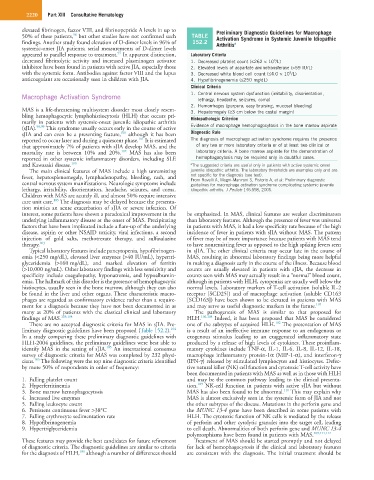
           There are no accepted diagnostic criteria for MAS in sJIA. Pre-  one of the subtypes of acquired HLH.  The presentation of MAS
                                                         104
        liminary diagnostic guidelines have been proposed (Table 152.2).    is a result of an ineffective immune response to an endogenous or
        In a study comparing these preliminary diagnostic guidelines with   exogenous  stimulus  leading  to  an  exaggerated  inflammatory  state
        HLH-2004 guidelines, the preliminary guidelines were best able to   produced by a release of high levels of cytokines. These proinflam-
                                    105
        identify MAS in the setting of sJIA.  An international consensus   matory  cytokines  include TNF-α,  IL-1,  IL-6,  IL-8,  IL-12,  IL-18,
        survey of diagnostic criteria for MAS was completed by 232 physi-  macrophage inflammatory protein-1α (MIP-1-α), and interferon-γ
            105
        cians.  The following were the top nine diagnostic criteria identified   (IFN-γ) released by stimulated lymphocytes and histiocytes. Defec-
        by more 50% of respondents in order of frequency:     tive natural killer (NK) cell function and cytotoxic T-cell activity have
                                                              been documented in patients with MAS as well as in those with HLH
        1.  Falling platelet count                            and may be the common pathway leading to the clinical presenta-
                                                                  109
        2.  Hyperferritinemia                                 tion.   NK-cell  function  in  patients  with  active  sJIA  but  without
                                                                                              110
        3.  Bone marrow hemophagocytosis                      MAS has also been found to be abnormal.  This may explain why
        4.  Increased live enzymes                            MAS is almost exclusively seen in the systemic form of JIA and not
        5.  Falling leukocyte count                           the other subtypes of the disease. Mutations in the perforin gene and
        6.  Persistent continuous fever >38°C                 the MUNC  13-4  gene  have  been  described  in  some  patients  with
        7.  Falling erythrocyte sedimentation rate            HLH. The cytotoxic function of NK cells is mediated by the release
        8.  Hypofibrinogenemia                                of perforin and other cytolytic granules into the target cell, leading
        9.  Hypertriglyceridemia                              to cell death. Abnormalities of both perforin gene and MUNC 13-4
                                                              polymorphisms have been found in patients with MAS. 109,111,112
        These features may provide the best candidates for future refinement   Treatment of MAS should be started promptly and not delayed
        of diagnostic criteria. The diagnostic guidelines are similar to criteria   for lack of hemophagocytosis if the clinical and laboratory features
                           106
        for the diagnosis of HLH,  although a number of differences should   are  consistent  with  the  diagnosis. The  initial  treatment  should  be

