


Page 2490 - Hematology_ Basic Principles and Practice ( PDFDrive )
P. 2490
2222   Part XIII  Consultative Hematology

                                                                                   154
        radiographic features are present. Other rare manifestations of HSP   system  thrombi  may  result.  To  prevent  these  complications,  the
        include neurologic, cardiac, and pulmonary events.    hematocrit level should be maintained around 60% through the use
           Anemia occasionally develops as a result of gastrointestinal (GI)   of  exchange  transfusions.  Small  aliquots  of  the  patient’s  blood  are
        tract blood loss or decreased RBC production caused by renal failure.   slowly  removed  and  replaced  by  equal  volumes  of  plasma  or  5%
        The leukocyte count is normal. Despite the impressive purpura, the   albumin. Care should be taken to remove blood slowly because vas-
        platelet count is normal or increased with normal platelet function.   cular collapse, cyanosis, stroke, and seizures have been reported with
        Coagulation  factor  levels  usually  are  normal,  although  transient   too rapid an exchange. Apheresis (erythrocytapheresis) also has been
        decreases in factor XIII activity and vitamin K deficiency from severe   shown to be an effective means of decreasing viscosity in patients with
        vasculitis-induced intestinal malabsorption have been reported. Signs   polycythemia.
        of increased fibrinolysis, as evidenced by elevation of D-dimer and   Infants  with  CCHD  are  at  risk  of  developing  iron-deficiency
                                   139
        other markers, have been described.  Bleeding in the GI tract; the   anemia. The deficiency may result from the combination of poor iron
        lungs; or, rarely, the central nervous system is caused by a necrotizing   stores at birth (especially in premature infants), increased iron needed
                                    138
        vasculitis and not a hemostatic defect.  Hypercoagulability does not   for enhanced erythropoiesis, poor iron intake because of poor feeding,
        play  a  role  with  normal  frequency  of  MTHFR,  prothrombin,  and   and ongoing iron losses as a consequence of phlebotomy or exchange
        factor V Leiden gene mutations. 140                   transfusion. These children may exhibit symptoms of iron deficiency
           HSP is considered an IgA-mediated inflammation of small vessels.   (irritability, anorexia, poor weight gain) or worsening cyanosis. The
        Biopsy  of  skin  or  other  involved  tissue  reveals  a  leukocytoclastic   hemoglobin may be normal for age but inappropriately low for the
        vasculitis. Immune complexes of IgA with complement, IgG, or IgM   degree of hypoxemia. Low RBC indices and hypochromic, microcytic
                                                                                                        155
                                       141
        have been found circulating in the serum  and deposited in blood   RBCs are the best indices of iron deficiency in this setting.  Children
                                                     142
        vessel walls of the kidneys and in intestinal and skin lesions.  The   with polycythemia who have iron-deficiency anemia are at increased
        mechanism  of  production,  accumulation,  and  deposition  of  IgA   risk for cerebral vein thrombosis because of the poor deformability
                                                                                                               156
        immune complexes in the blood vessel is unclear. It has been sug-  of the iron-deficient RBCs, which further increases blood viscosity.
        gested that HSP may be a systemic form of IgA nephropathy, although   To prevent this complication and to allow for maximal tissue oxy-
        this is controversial. 143,144  Both disorders have identical features on   genation,  all  infants  should  be  fed  iron-rich  infant  formula  and
        renal biopsy and are characterized by mesangial proliferation, occa-  receive iron replacement therapy as needed to normalize RBC indices.
        sional focal sclerosis, and crescent formation. 145   Hemolytic anemia, characterized by mechanical destruction of RBCs
           Treatment  is  mainly  supportive,  although  corticosteroids  have   and manifested by the presence of schistocytes in the peripheral blood
        been found to provide symptomatic relief with severe joint, scrotal,   smear,  is  occasionally  seen  after  the  placement  of  prosthetic  heart
        or  abdominal  pain. 146,147   They  do  not  alter  skin  involvement  or   valves.
        prevent  renal  involvement.  Recent  studies  have  suggested  that   Routine screening of patients with CHD has demonstrated coagu-
        corticosteroids plus azathioprine, cyclosporin A, or cyclophosphamide   lation  abnormalities  in  20%  to  59%  of  children  with  acyanotic
        may have a role in the management of severe renal involvement. 148–152    defects and in 40% to 50% of those with cyanotic heart disease (Table
                                                                    157
        Rituximab has been reported to be effective in decreasing the symp-  152.3).  Only 11% of children with CCHD have any clinical evi-
                                                     153
        toms  of  three  patients  with  severe,  refractory  chronic  HSP.  The   dence of bleeding preoperatively. However, children with underlying
        prognosis  is  good  for  full  recovery,  except  in  children  with  renal   hemostatic defects have a greater frequency and severity of postopera-
        failure.                                              tive bleeding. 157,158  Presurgical screening tests should include at least
                                                              a platelet count, platelet function assay (e.g., closure time), PT, and
                                                              aPTT. Further investigations may be indicated if there is a history of
        CARDIOPULMONARY DISEASE                               bleeding or abnormal results on screening tests. Acquired von Will-
                                                              ebrand syndrome has been reported in patients with CHD and is
        Congenital Heart Disease
        Congenital heart disease (CHD) occurs in about 1% of live births.
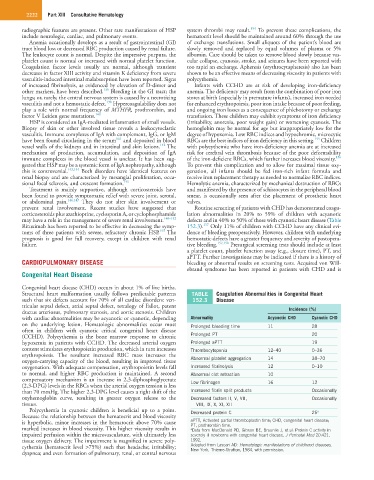
        Structural  heart  malformation  usually  follows  predictable  patterns   TABLE   Coagulation Abnormalities in Congenital Heart
        such that six defects account for 70% of all cardiac disorders: ven-  152.3  Disease
        tricular septal defect, atrial septal defect, tetralogy of Fallot, patent
        ductus arteriosus, pulmonary stenosis, and aortic stenosis. Children                    Incidence (%)
        with cardiac abnormalities may be acyanotic or cyanotic, depending   Abnormality  Acyanotic CHD  Cyanotic CHD
        on  the  underlying  lesion.  Hematologic  abnormalities  occur  most   Prolonged bleeding time  11  28
        often  in  children  with  cyanotic  critical  congenital  heart  disease
        (CCHD).  Polycythemia  is  the  bone  marrow  response  to  chronic   Prolonged PT             20
        hypoxemia in patients with CCHD. The decreased arterial oxygen   Prolonged aPTT                19
        content stimulates erythropoietin production, which in turn increases   Thrombocytopenia  12–40  0–36
        erythropoiesis.  The  resultant  increased  RBC  mass  increases  the
        oxygen-carrying capacity of the blood, resulting in improved tissue   Abnormal platelet aggregation  14  38–70
        oxygenation. With adequate compensation, erythropoietin levels fall   Increased fibrinolysis  12  0–10
        to  normal,  and  higher  RBC  production  is  maintained.  A  second   Abnormal clot retraction  10
        compensatory mechanism is an increase in 2,3-diphosphoglycerate   Low fibrinogen  16           12
        (2,3-DPG) levels in the RBCs when the arterial oxygen tension is less
        than 70 mmHg. The higher 2,3-DPG level causes a right shift of the   Increased fibrin split products  Occasionally
        oxyhemoglobin  curve,  resulting  in  greater  oxygen  release  to  the   Decreased factors II, V, VII,   Occasionally
        tissues.                                                 VIII, IX, X, XI, XII
           Polycythemia  in  cyanotic  children  is  beneficial  up  to  a  point.   Decreased protein C  25 a
        Because the relationship between the hematocrit and blood viscosity
        is  hyperbolic,  minor  increases  in  the  hematocrit  above  70%  cause   aPTT, Activated partial thromboplastin time; CHD, congenital heart disease;
                                                               PT, prothrombin time.
        marked increases in blood viscosity. This higher viscosity results in   a Data from MacDonald PD, Gibson BE, Braunlie J, et al: Protein C activity in
        impaired perfusion within the microvasculature, with ultimately less   severely ill newborns with congenital heart disease. J Perinatal Med 20:421,
        tissue oxygen delivery. The impairment is magnified in severe poly-  1992.
        cythemia  (hematocrit  level  >75%)  such  that  headache;  irritability;   Adapted from Lascari AD: Hematologic manifestations of childhood diseases,
                                                               New York, Thieme-Stratton, 1984, with permission.
        dyspnea; and even formation of pulmonary, renal, or central nervous

