


Page 2503 - Hematology_ Basic Principles and Practice ( PDFDrive )
P. 2503
Chapter 152  Hematologic Manifestations of Childhood Illness  2235


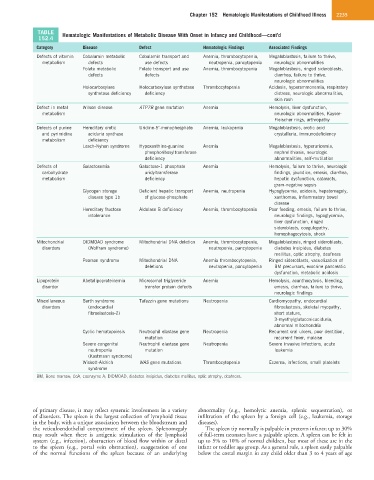
             TABLE   Hematologic Manifestations of Metabolic Disease With Onset in Infancy and Childhood—cont’d
              152.4
             Category       Disease            Defect              Hematologic Findings  Associated Findings
             Defects of vitamin   Cobalamin metabolic   Cobalamin transport and   Anemia, thrombocytopenia,   Megaloblastosis, failure to thrive,
               metabolism     defects           use defects          neutropenia, pancytopenia  neurologic abnormalities
                            Folate metabolic   Folate transport and use   Anemia, thrombocytopenia  Megaloblastosis, ringed sideroblasts,
                              defects           defects                                    diarrhea, failure to thrive,
                                                                                           neurologic abnormalities
                            Holocarboxylase    Holocarboxylase synthetase   Thrombocytopenia  Acidosis, hyperammonemia, respiratory
                              synthetase deficiency  deficiency                            distress, neurologic abnormalities,
                                                                                           skin rash
             Defect in metal   Wilson disease  ATP7B gene mutation  Anemia               Hemolysis, liver dysfunction,
               metabolism                                                                  neurologic abnormalities, Kayser-
                                                                                           Fleischer rings, arthropathy
             Defects of purine   Hereditary orotic   Uridine-5′-monophosphate  Anemia, leukopenia  Megaloblastosis, orotic acid
               and pyrimidine   aciduria synthase                                          crystalluria, immunodeficiency
               metabolism     deficiency
                            Lesch-Nyhan syndrome  Hypoxanthine-guanine   Anemia          Megaloblastosis, hyperuricemia,
                                                phosphoribosyltransferase                  nephrolithiasis, neurologic
                                                deficiency                                 abnormalities, self-mutilation
             Defects of     Galactosemia       Galactose-1 phosphate   Anemia            Hemolysis, failure to thrive, neurologic
               carbohydrate                     uridyltransferase                          findings, jaundice, emesis, diarrhea,
               metabolism                       deficiency                                 hepatic dysfunction, cataracts,
                                                                                           gram-negative sepsis
                            Glycogen storage   Deficient hepatic transport   Anemia, neutropenia  Hypoglycemia, acidosis, hepatomegaly,
                              disease type 1b   of glucose-phosphate                       xanthomas, inflammatory bowel
                                                                                           disease
                            Hereditary fructose   Aldolase B deficiency  Anemia, thrombocytopenia  Poor feeding, emesis, failure to thrive,
                              intolerance                                                  neurologic findings, hypoglycemia,
                                                                                           liver dysfunction, ringed
                                                                                           sideroblasts, coagulopathy,
                                                                                           hemophagocytosis, shock
             Mitochondrial   DIDMOAD syndrome   Mitochondrial DNA deletion  Anemia, thrombocytopenia,   Megaloblastosis, ringed sideroblasts,
               disorders      (Wolfram syndrome)                     neutropenia, pancytopenia  diabetes insipidus, diabetes
                                                                                           mellitus, optic atrophy, deafness
                            Pearson syndrome   Mitochondrial DNA   Anemia thrombocytopenia,   Ringed sideroblasts, vacuolization of
                                                deletions            neutropenia, pancytopenia  BM precursors, exocrine pancreatic
                                                                                           dysfunction, metabolic acidosis
             Lipoprotein    Abetalipoproteinemia  Microsomal triglyceride   Anemia       Hemolysis, acanthocytosis, bleeding,
               disorder                         transfer protein defects                   emesis, diarrhea, failure to thrive,
                                                                                           neurologic findings
             Miscellaneous   Barth syndrome    Tafazzin gene mutations  Neutropenia      Cardiomyopathy, endocardial
               disorders      (endocardial                                                 fibroelastosis, skeletal myopathy,
                              fibroelastosis-2)                                            short stature,
                                                                                           3-myethylglutaconicaciduria,
                                                                                           abnormal mitochondria
                            Cyclic hematopoiesis  Neutrophil elastase gene   Neutropenia  Recurrent oral ulcers, poor dentition,
                                                mutation                                   recurrent fever, malaise
                            Severe congenital   Neutrophil elastase gene   Neutropenia   Severe invasive infections, acute
                              neutropenia       mutation                                   leukemia
                              (Kostmann syndrome)
                            Wiskott-Aldrich    WAS gene mutations  Thrombocytopenia      Eczema, infections, small platelets
                              syndrome
             BM, Bone marrow; CoA, coenzyme A; DIDMOAD, diabetes insipidus, diabetes mellitus, optic atrophy, deafness.


            of primary disease, it may reflect systemic involvement in a variety   abnormality  (e.g.,  hemolytic  anemia,  splenic  sequestration),  or
            of disorders. The spleen is the largest collection of lymphoid tissue   infiltration  of  the  spleen  by  a  foreign  cell  (e.g.,  leukemia,  storage
            in the body, with a unique association between the bloodstream and   diseases).
            the  reticuloendothelial  compartment  of  the  spleen.  Splenomegaly   The spleen tip normally is palpable in preterm infants; up to 30%
            may  result  when  there  is  antigenic  stimulation  of  the  lymphoid   of full-term neonates have a palpable spleen. A spleen can be felt in
            system (e.g., infection), obstruction of blood flow within or distal   up to 5% to 10% of normal children, but most of these are in the
            to  the  spleen  (e.g.,  portal  vein  obstruction),  exaggeration  of  one   infant or toddler age group. As a general rule, a spleen easily palpable
            of  the  normal  functions  of  the  spleen  because  of  an  underlying   below the costal margin in any child older than 3 to 4 years of age

