


Page 2504 - Hematology_ Basic Principles and Practice ( PDFDrive )
P. 2504
2236   Part XIII  Consultative Hematology


        must  be  considered  abnormal  until  proven  otherwise.  That  some   TABLE
        palpable spleens may indeed be normal is attested to by the study of   152.5  Causes of Splenomegaly in Children
                          407
        McIntyre  and  Ebaugh,   who  found  that  3%  of  healthy  college
        freshmen  have  palpable  spleens,  of  which  about  one-third  persist.   Disorders of the Blood
        “Pretenders” of splenomegaly include the left lobe of the liver, a left   Hemolytic anemia: congenital or acquired
        upper quadrant tumor such as Wilms tumor or neuroblastoma, the   Thalassemia
        “wandering spleen,” and the proptotic spleen (seen in children with   Sickle cell disease
        a depressed diaphragm from obstructive pulmonary disease, such as   Leukemia
        asthma or bronchiolitis).                              Osteopetrosis
           The  most  common  cause  of  acute  splenomegaly  in  children,   Myelofibrosis, myeloid metaplasia, thrombocythemia
        especially young children, is a viral infection. Splenic enlargement in   Infections: Acute and Chronic
        this  setting  is  mild  to  moderate  and  usually  transient.  When  the   Viral
        history  and  physical  findings  suggest  a  viral  etiology,  a  complete   Congenital (e.g., TORCH association)
        blood count with differential, platelet count, and reticulocyte count   Mononucleosis (e.g., EBV, CMV infection)
        should be performed to rule out unsuspected leukemia or hemolytic   Virus-associated hemophagocytic syndrome
        anemia and to determine whether there is an atypical lymphocytosis.   Human immunodeficiency virus
        The child should be reevaluated in approximately 4 weeks (or sooner   Bacterial
        if symptoms persist). If splenomegaly persists beyond 4 to 6 weeks,   Sepsis or abscess
        the splenic enlargement may be considered chronic.        Brucellosis
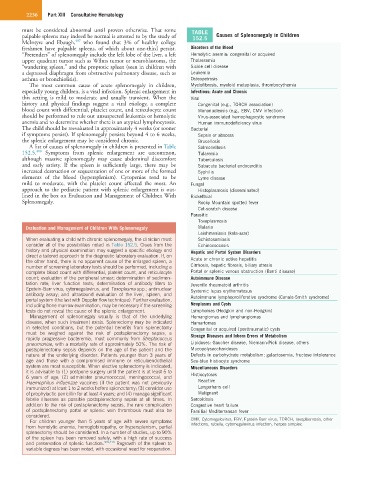
           A list of causes of splenomegaly in children is presented in Table   Salmonellosis
             408
        152.5.   Symptoms  from  splenic  enlargement  are  uncommon,   Tularemia
        although  massive  splenomegaly  may  cause  abdominal  discomfort   Tuberculosis
        and  early  satiety.  If  the  spleen  is  sufficiently  large,  there  may  be   Subacute bacterial endocarditis
        increased destruction or sequestration of one or more of the formed   Syphilis
        elements  of  the  blood  (hypersplenism).  Cytopenias  tend  to  be   Lyme disease
        mild  to  moderate,  with  the  platelet  count  affected  the  most.  An   Fungal
        approach to the pediatric patient with splenic enlargement is out-  Histoplasmosis (disseminated)
        lined in the box on Evaluation and Management of Children With    Rickettsial
        Splenomegaly.                                             Rocky Mountain spotted fever
                                                                  Cat-scratch disease
                                                               Parasitic
                                                                  Toxoplasmosis
         Evaluation and Management of Children With Splenomegaly  Malaria
                                                                  Leishmaniasis (kala-azar)
          When evaluating a child with chronic splenomegaly, the clinician must   Schistosomiasis
          consider all of the possibilities noted in Table 152.5. Clues from the   Echinococcosis
          history and physical examination may suggest a specific etiology and   Hepatic and Portal System Disorders
          direct a tailored approach to the diagnostic laboratory evaluation. If, on
          the other hand, there is no apparent cause of the enlarged spleen, a   Acute or chronic active hepatitis
          number of screening laboratory tests should be performed, including a   Cirrhosis, hepatic fibrosis, biliary atresia
          complete blood count with differential, platelet count, and reticulocyte   Portal or splenic venous obstruction (Banti disease)
          count; evaluation of the peripheral smear; determination of sedimen-  Autoimmune Disease
          tation  rate;  liver  function  tests;  determination  of  antibody  titers  to   Juvenile rheumatoid arthritis
          Epstein-Barr virus, cytomegalovirus, and Toxoplasma spp.; antinuclear   Systemic lupus erythematosus
          antibody  assay;  and  ultrasound  evaluation  of  the  liver,  spleen,  and
          portal system (the last with Doppler flow technique). Further evaluation,   Autoimmune lymphoproliferative syndrome (Canale-Smith syndrome)
          including bone marrow examination, may be necessary if the screening   Neoplasms and Cysts
          tests do not reveal the cause of the splenic enlargement.  Lymphomas (Hodgkin and non-Hodgkin)
           Management  of  splenomegaly  usually  is  that  of  the  underlying   Hemangiomas and lymphangiomas
          disease, when such treatment exists. Splenectomy may be indicated   Hamartomas
          in  selected  conditions,  but  the  potential  benefits  from  splenectomy   Congenital or acquired (posttraumatic) cysts
          must  be  weighed  against  the  risk  of  postsplenectomy  sepsis,  a
          rapidly  progressive  bacteremia,  most  commonly  from  Streptococcus   Storage Diseases and Inborn Errors of Metabolism
          pneumoniae, with a mortality rate of approximately 50%. The risk of   Lipidoses: Gaucher disease, Niemann-Pick disease, others
          postsplenectomy  sepsis  depends  on  the  age  of  the  patient  and  the   Mucopolysaccharidoses
          nature  of  the  underlying  disorder.  Patients  younger  than  3  years  of   Defects in carbohydrate metabolism: galactosemia, fructose intolerance
          age  and  those  with  a  compromised  immune  or  reticuloendothelial   Sea-blue histiocyte syndrome
          system are most susceptible. When elective splenectomy is indicated,   Miscellaneous Disorders
          it is advisable to (1) postpone surgery until the patient is at least 5 to
          6  years  of  age;  (2)  administer  pneumococcal,  meningococcal,  and   Histiocytoses
          Haemophilus  influenzae  vaccines  (if  the  patient  was  not  previously   Reactive
          immunized) at least 1 to 2 weeks before splenectomy; (3) consider use   Langerhans cell
          of prophylactic penicillin for at least 4 years; and (4) manage significant   Malignant
          febrile  illnesses  as  possible  postsplenectomy  sepsis  at  all  times.  In   Sarcoidosis
          addition to the risk of postsplenectomy sepsis, the rare complication   Congestive heart failure
          of  postsplenectomy  portal  or  splenic  vein  thrombosis  must  also  be   Familial Mediterranean fever
          considered.
           For  children  younger  than  5  years  of  age  with  severe  symptoms   CMV, Cytomegalovirus; EBV, Epstein-Barr virus; TORCH, toxoplasmosis, other
          from hemolytic anemia, hemoglobinopathy, or hypersplenism, partial   infections, rubella, cytomegalovirus infection, herpes simplex.
          splenectomy should be considered. In a number of studies, up to 90%
          of the spleen has been removed safely, with a high rate of success
          and preservation of splenic function. 409,410  Regrowth of the spleen to
          variable degrees has been noted, with occasional need for reoperation.

