


Page 2588 - Hematology_ Basic Principles and Practice ( PDFDrive )
P. 2588
Chapter 159  Hematologic Problems in the Surgical Patient  2305


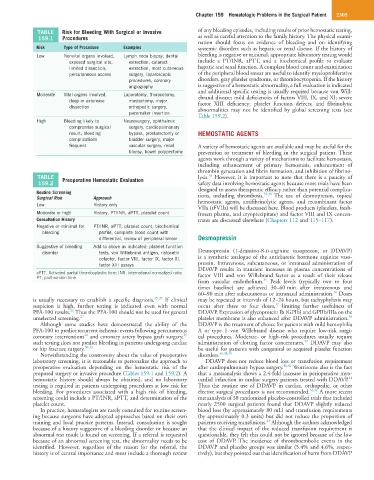
             TABLE   Risk for Bleeding With Surgical or Invasive   of any bleeding episodes, including results of prior hemostatic testing,
              159.1  Procedures                                   as well as careful attention to the family history. The physical exami-
                                                                  nation  should  focus  on  evidence  of  bleeding  and  on  identifying
             Risk     Type of Procedure  Examples                 systemic disorders such as hepatic or renal disease. If the history of
             Low      Nonvital organs involved,   Lymph node biopsy, dental   bleeding is negative or minimal, appropriate laboratory testing would
                        exposed surgical site,   extraction, cataract   include  a  PT/INR,  aPTT,  and  a  biochemical  profile  to  evaluate
                        limited dissection,   extraction, most cutaneous   hepatic and renal function. A complete blood count and examination
                        percutaneous access  surgery, laparoscopic   of the peripheral blood smear are useful to identify myeloproliferative
                                           procedures, coronary   disorders, gray platelet syndrome, or thrombocytopenia. If the history
                                           angiography            is suggestive of a hemostatic abnormality, a full evaluation is indicated
                                                                  and additional specific testing is usually required because von Will-
             Moderate  Vital organs involved,   Laparotomy, thoracotomy,   ebrand disease; mild deficiencies of factors VIII, IX, and XI; severe
                        deep or extensive   mastectomy, major     factor  XIII  deficiency;  platelet  function  defects;  and  fibrinolytic
                        dissection         orthopedic surgery,    abnormalities  may  not  be  identified  by  global  screening  tests  (see
                                           pacemaker insertion
                                                                  Table 159.2).
             High     Bleeding likely to   Neurosurgery, ophthalmic
                        compromise surgical   surgery, cardiopulmonary
                        result, bleeding   bypass, prostatectomy or   HEMOSTATIC AGENTS
                        complications      bladder surgery, major
                        frequent           vascular surgery, renal   A variety of hemostatic agents are available and may be useful for the
                                           biopsy, bowel polypectomy  prevention  or  treatment  of  bleeding  in  the  surgical  patient. These
                                                                  agents work through a variety of mechanisms to facilitate hemostasis,
                                                                  including  enhancement  of  primary  hemostasis,  enhancement  of
                                                                  thrombin generation and fibrin formation, and inhibition of fibrino-
             TABLE   Preoperative Hemostatic Evaluation           lysis.   However,  it  is  important  to  note  that  there  is  a  paucity  of
                                                                     33
              159.2                                               safety data involving hemostatic agents because most trials have been
                                                                  designed to assess therapeutic efficacy rather than potential complica-
             Routine Screening                                                         33,34
             Surgical Risk      Approach                          tions,  including  thrombosis.    The  use  of  desmopressin,  topical
             Low                History only                      hemostatic  agents,  antifibrinolytic  agents,  and  recombinant  factor
                                                                  VIIa (rFVIIa) will be discussed here. Blood products (platelets, fresh-
             Moderate or high   History, PT/INR, aPTT, platelet count  frozen plasma, and cryoprecipitate) and factor VIII and IX concen-
             Consultation History                                 trates are discussed elsewhere (Chapters 112 and 115–117).
             Negative or minimal for   PT/INR, aPTT, platelet count, biochemical
               bleeding          profile, complete blood count with
                                 differential, review of peripheral smear  Desmopressin
             Suggestive of bleeding   Add to above as indicated: platelet function
               disorder          tests, von Willebrand antigen, ristocetin   Desmopressin  (1-deamino-8-D-arginine  vasopressin,  or  DDAVP)
                                 cofactor, factor VIII, factor IX, factor XI,   is a synthetic analogue of the antidiuretic hormone arginine vaso-
                                 factor XIII assays               pressin. Intravenous, subcutaneous, or intranasal administration of
                                                                  DDAVP  results  in  transient  increases  in  plasma  concentrations  of
             aPTT, Activated partial thromboplastin time; INR, international normalized ratio;   factor  VIII  and  von  Willebrand  factor  as  a  result  of  their  release
             PT, prothrombin time.                                                     35
                                                                  from  vascular  endothelium.   Peak  levels  (typically  two  to  four
                                                                  times  baseline)  are  achieved  30–60 min  after  intravenous  and
                                                                                                              36
                                                                  60–90 min after subcutaneous or intranasal administration.  Doses
            is  usually  necessary  to  establish  a  specific  diagnosis. 25-27   If  clinical   may be repeated at intervals of 12–24 hours, but tachyphylaxis may
                                                                                           37
            suspicion  is  high,  further  testing  is  indicated  even  with  normal   occur  after  three  or  four  doses,   limiting  further  usefulness  of
                        26
            PFA-100 results.  Thus the PFA-100 should not be used for general   DDAVP. Expression of glycoprotein Ib (GPIb) and GPIIb/IIIa on the
                                                                                                                   38
            unselected screening. 27                              platelet membrane is also enhanced after DDAVP administration.
              Although  some  studies  have  demonstrated  the  ability  of  the   DDAVP is the treatment of choice for patients with mild hemophilia
            PFA-100 to predict recurrent ischemic events following percutaneous   A  or  type  1  von  Willebrand  disease  who  require  low-risk  surgi-
                                                             29
                             28
            coronary interventions  and coronary artery bypass graft surgery,    cal  procedures.  Moderate-  or  high-risk  procedures  usually  require
                                                                                                     37
            such testing does not predict bleeding in patients undergoing cardiac   administration  of  clotting  factor  concentrates.   DDAVP  may  also
            or hip fracture surgery. 30-32                        be useful for patients with congenital or acquired platelet function
              Notwithstanding the controversy about the value of preoperative   disorders. 36,38,39
            laboratory screening, it is reasonable to personalize the approach to   DDAVP does not reduce blood loss or transfusion requirement
            preoperative  evaluation  depending  on  the  hemostatic  risk  of  the   after cardiopulmonary bypass surgery. 40,41  Worrisome also is the fact
            proposed surgery or invasive procedure (Tables 159.1 and 159.2). A   that a metaanalysis shows a 2.4-fold increase in perioperative myo-
                                                                                                                   41
            hemostatic  history  should  always  be  obtained,  and  no  laboratory   cardial infarction in cardiac surgery patients treated with DDAVP.
            testing is required in patients undergoing procedures at low risk for   Thus  the  routine  use  of  DDAVP  in  cardiac,  orthopedic,  or  other
            bleeding.  For  procedures  associated  with  a  high  risk  of  bleeding,   elective surgical procedures is not recommended. 34,42  A more recent
            screening could include a PT/INR, aPTT, and determination of the   metaanalysis of 38 randomized placebo-controlled trials that included
            platelet count.                                       nearly  2500  surgical  patients  found  that  DDAVP  slightly  reduced
              In practice, hematologists are rarely consulted for routine screen-  blood loss (by approximately 80 mL) and transfusion requirements
            ing because surgeons have adopted approaches based on their own   (by approximately 0.3 units) but did not reduce the proportion of
                                                                                        43
            training and local practice patterns. Instead, consultation is sought   patients receiving transfusions.  Although the authors acknowledged
            because of a history suggestive of a bleeding disorder or because an   that  the  clinical  impact  of  the  reduced  transfusion  requirement  is
            abnormal test result is found on screening. If a referral is requested   questionable, they felt this could not be ignored because of the low
            because of an abnormal screening test, the abnormality needs to be   cost  of  DDAVP.  The  incidence  of  thromboembolic  events  in  the
            identified.  However,  regardless  of  the  reason  for  the  referral,  the   DDAVP and placebo groups was similar (5.4% and 4.6%, respec-
            history is of central importance and must include a thorough review   tively), but they pointed out that identification of harm from DDAVP

