


Page 2591 - Hematology_ Basic Principles and Practice ( PDFDrive )
P. 2591
2308   Part XIII  Consultative Hematology

                                                                                                          80
                                                              blood  loss  with  a  single  intraoperative  dose  of  rFVIIa,   rFVIIa
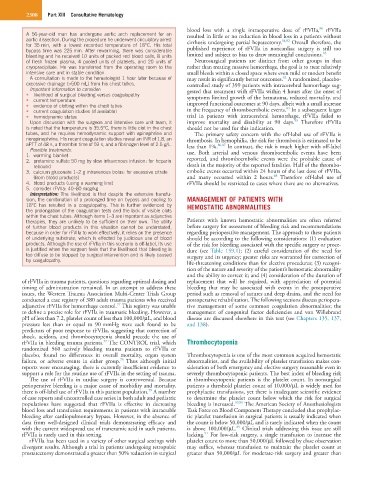
          A  56-year-old  man  has  undergone  aortic  arch  replacement  for  an   resulted in little or no reduction in blood loss in a patients without
          aortic dissection. During the procedure he underwent circulatory arrest   cirrhosis undergoing partial hepatectomy. 81,82  Overall therefore, the
          for  35 min,  with  a  lowest  recorded  temperature  of  18°C.  His  total
          bypass  time  was  225 min.  After  rewarming,  there  was  considerable   published  experience  of  rFVIIa  in  noncardiac  surgery  is  still  too
                                                                                                           83
          bleeding and he received 10 units of packed red blood cells, 8 units   limited and subject to bias to draw meaningful conclusions.
          of  fresh  frozen  plasma,  4  pooled  units  of  platelets,  and  20  units  of   Neurosurgical  patients  are  distinct  from  other  groups  in  that
          cryoprecipitate.  He  was  transferred  from  the  operating  room  to  the   rather than treating massive hemorrhage, the goal is to treat relatively
          intensive care unit in stable condition.            small bleeds within a closed space where even mild or modest benefit
                                                                                              83
           A consultation is made to the hematologist 1 hour later because of   may result in significantly better outcomes.  A randomized, placebo-
          excessive drainage (>500 mL) from his chest tubes.  controlled study of 399 patients with intracerebral hemorrhage sug-
           Important information to consider:                 gested that treatment with rFVIIa within 4 hours after the onset of
          •  likelihood of surgical bleeding versus coagulopathy  symptoms limited growth of the hematoma, reduced mortality, and
          •  current temperature
          •  evidence of clotting within the chest tubes      improved functional outcomes at 90 days, albeit with a small increase
                                                                                               84
          •  current coagulation studies (if available)       in the frequency of thromboembolic events.  In a subsequent larger
          •  hemodynamic status                               trial  in  patients  with  intracerebral  hemorrhage,  rFVIIa  failed  to
                                                                                                 85
           Upon discussion with the surgeon and intensive care unit team, it   improve  mortality  and  disability  at  90  days.   Therefore  rFVIIa
          is noted that the temperature is 35.5°C, there is little clot in the chest   should not be used for this indication.
          tubes, and he requires hemodynamic support with epinephrine and   The  primary  safety  concern  with  the  off-label  use  of  rFVIIa  is
          norepinephrine. His recent coagulation studies reveal an INR of 1.8, an   thrombosis. In hemophilia, the risk for thrombosis is estimated to be
          aPTT of 48 s, a thrombin time of 59 s, and a fibrinogen level of 2.5 g/L.  less than 1%. 86,87  In contrast, the risk is much higher with off-label
           Possible treatments:                               use.  Both  arterial  and  venous  thromboembolic  events  have  been
          1.  warming blanket
          2.  protamine sulfate 50 mg by slow intravenous infusion: for heparin   reported,  and  thromboembolic  events  were  the  probable  cause  of
            rebound                                           death in the majority of the reported fatalities. Half of the thrombo-
          3.  calcium gluconate 1–2 g intravenous bolus: for excessive citrate   embolic events occurred within 24 hours of the last dose of rFVIIa,
                                                                                           88
            (from blood products)                             and  many  occurred  within  2  hours.   Therefore  off-label  use  of
          4.  blood products (using a warming line)           rFVIIa should be restricted to cases where there are no alternatives.
          5.  consider rFVIIa: 40–80 mcg/kg
           Interpretation:  The  likelihood  is  that  despite  the  extensive  transfu-
          sion, the combination of a prolonged time on bypass and cooling to   MANAGEMENT OF PATIENTS WITH
          18°C  has  resulted  in  a  coagulopathy.  This  is  further  evidenced  by   HEMOSTATIC ABNORMALITIES
          the prolongation of the coagulation tests and the lack of visible clots
          within the chest tubes. Although items 1–3 are important as adjunctive
          therapies,  they  are  unlikely  to  be  sufficient  on  their  own.  The  utility   Patients  with  known  hemostatic  abnormalities  are  often  referred
          of  further  blood  products  in  this  situation  cannot  be  understated,   before surgery for assessment of bleeding risk and recommendations
          because in order for rFVIIa to work effectively, it relies on the presence   regarding perioperative management. The approach to these patients
          of  underlying  substrate,  which  is  effected  by  judicious  use  of  blood   should be according to the following considerations: (1) evaluation
          products. Although the use of rFVIIa in this scenario is off-label, its use   of the risk for bleeding associated with the specific surgery or proce-
          is justified when the surgeon feels that the likelihood that bleeding is   dure  (see  Table  159.1);  (2)  careful  consideration  of  the  need  for
          too diffuse to be stopped by surgical intervention and is likely caused   surgery and its urgency; greater risks are warranted for correction of
          by coagulopathy.
                                                              life-threatening conditions than for elective procedures; (3) recogni-
                                                              tion of the nature and severity of the patient’s hemostatic abnormality
                                                              and the ability to correct it; and (4) consideration of the duration of
        of rFVIIa in trauma patients, questions regarding optimal dosing and   replacement  that  will  be  required,  with  appreciation  of  potential
        timing of administration remained. In an attempt to address these   bleeding  that  may  be  associated  with  events  in  the  postoperative
        issues, the Western Trauma Association Multi-Center Trials Group   period such as removal of sutures and deep drains, and the need for
        conducted a case registry of 380 adult trauma patients who received   postoperative rehabilitation. The following sections discuss periopera-
                                       77
        adjunctive rFVIIa for hemorrhage control.  This registry was unable   tive management of some common coagulation abnormalities; the
        to define a precise role for rFVIIa in traumatic bleeding. However, a   management  of  congenital  factor  deficiencies  and  von  Willebrand
        pH of less than 7.2, platelet count of less than 100,000/µL, and blood   disease are discussed elsewhere in this text (see Chapters 135, 137,
        pressure  less  than  or  equal  to  90 mmHg  were  each  found  to  be   and 138).
        predictors of poor response to rFVIIa, suggesting that correction of
        shock,  acidosis,  and  thrombocytopenia  should  precede  the  use  of
                                   77
        rFVIIa in bleeding trauma patients.  The CONTROL trial, which   Thrombocytopenia
        randomized  560  actively  bleeding  trauma  patients  to  rFVIIa  or
        placebo,  found  no  differences  in  overall  mortality,  organ  system   Thrombocytopenia is one of the most common acquired hemostatic
                                        78
        failure,  or  adverse  events  in  either  group.   Thus  although  initial   abnormalities, and the availability of platelet transfusion makes con-
        reports were encouraging, there is currently insufficient evidence to   sideration of both emergency and elective surgery reasonable even in
        support a role for the routine use of rFVIIa in the setting of trauma.  severely thrombocytopenic patients. The best index of bleeding risk
           The  use  of  rFVIIa  in  cardiac  surgery  is  controversial.  Because   in  thrombocytopenic  patients  is  the  platelet  count.  In nonsurgical
        perioperative bleeding is a major cause of morbidity and mortality,   patients a threshold platelet count of 10,000/µL is widely used for
                                                  79
        there is off-label use of rFVIIa in this patient population.  A number   prophylactic transfusions, yet there is inadequate scientific evidence
        of case reports and uncontrolled case series in both adult and pediatric   to  determine  the  platelet  count  below  which  the  risk  for  surgical
        populations  have  suggested  that  rFVIIa  is  effective  in  decreasing   bleeding is increased. 89,90  The American Society of Anesthesiologists
        blood loss and transfusion requirements in patients with intractable   Task Force on Blood Component Therapy concluded that prophylac-
        bleeding after cardiopulmonary bypass. However, in the absence of   tic platelet transfusion in surgical patients is usually indicated when
        data  from  well-designed  clinical  trials  demonstrating  efficacy  and   the count is below 50,000/µL and is rarely indicated when the count
                                                                              89
        with the current widespread use of tranexamic acid in such patients,   is above 100,000/µL.  Clinical trials addressing this issue are still
                                                                    91
        rFVIIa is rarely used in this setting.                lacking.   For  low-risk  surgery,  a  single  transfusion  to  increase  the
           rFVIIa has been used in a variety of other surgical settings with   platelet count to more than 50,000/µL followed by close observation
        divergent results. Although a trial in patients undergoing retropubic   may  suffice,  whereas  transfusion  to  maintain  the  platelet  count  at
        prostatectomy demonstrated a greater than 50% reduction in surgical   greater than 50,000/µL for moderate-risk surgery and greater than

