


Page 375 - Hematology_ Basic Principles and Practice ( PDFDrive )
P. 375
Chapter 26  Biology of Erythropoiesis, Erythroid Differentiation, and Maturation  311


                                              PRENATAL                      POSTNATAL
                                 100                  Bone
                                          Yolk sac    marrow
                                                                                         Vertebrae
                                  80            Liver                                    and pelvis

                               Cellularity (%)  60                                       Sternum


                                  40
                                               Spleen             Tibias                 Ribs
                                  20                                        Femurs

                                   0
                                     0  1  2  3  4  5  6  7  8  9  10  20   30   40   50   60   70
                                              Fetal months    Birth          Age in years
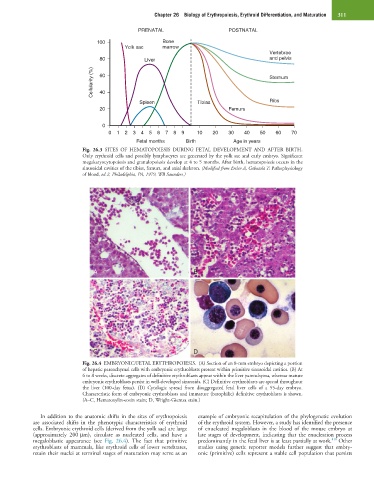
                            Fig.  26.3  SITES  OF  HEMATOPOIESIS  DURING  FETAL  DEVELOPMENT  AND  AFTER  BIRTH.
                            Only erythroid cells and possibly lymphocytes are generated by the yolk sac and early embryo. Significant
                            megakaryocytopoiesis and granulopoiesis develop at 4 to 5 months. After birth, hematopoiesis occurs in the
                            sinusoidal cavities of the tibias, femurs, and axial skeleton. (Modified from Erslev A, Gabuzda T: Pathophysiology
                            of blood, ed 2, Philadelphia, PA, 1979, WB Saunders.)


                                A                               B


                                C                               D

                            Fig. 26.4  EMBRYONIC/FETAL ERYTHROPOIESIS.  (A) Section of an 8-mm embryo depicting a portion
                            of hepatic parenchymal cells with embryonic erythroblasts present within primitive sinusoidal cavities. (B) At
                            6 to 8 weeks, discrete aggregates of definitive erythroblasts appear within the liver parenchyma, whereas mature
                            embryonic erythroblasts persist in well-developed sinusoids. (C) Definitive erythroblasts are spread throughout
                            the  liver  (100-day  fetus).  (D)  Cytologic  spread  from  disaggregated  fetal  liver  cells  of  a  55-day  embryo.
                            Characteristic form of embryonic erythroblasts and immature (basophilic) definitive erythroblasts is shown.
                            (A–C, Hematoxylin-eosin stain; D, Wright-Giemsa stain.)

              In addition to the anatomic shifts in the sites of erythropoiesis   example of embryonic recapitulation of the phylogenetic evolution
            are  associated  shifts  in  the  phenotypic  characteristics  of  erythroid   of the erythroid system. However, a study has identified the presence
            cells. Embryonic erythroid cells (derived from the yolk sac) are large   of  enucleated  megaloblasts  in  the  blood  of  the  mouse  embryo  at
            (approximately  200 µm),  circulate  as  nucleated  cells,  and  have  a   late stages of development, indicating that the enucleation process
                                                                                                             410
            megaloblastic  appearance  (see  Fig.  26.4).  The  fact  that  primitive   predominantly in the fetal liver is at least partially at work.  Other
            erythroblasts of mammals, like erythroid cells of lower vertebrates,   studies  using  genetic  reporter  models  further  suggest  that  embry-
            retain their nuclei at terminal stages of maturation may serve as an   onic (primitive) cells represent a stable cell population that persists

