


Page 370 - Hematology_ Basic Principles and Practice ( PDFDrive )
P. 370
306    Part IV  Disorders of Hematopoietic Cell Development


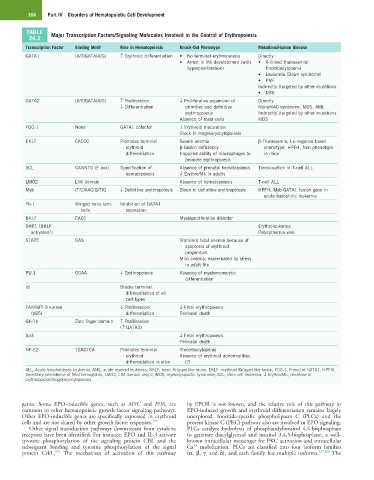
          TABLE   Major Transcription Factors/Signaling Molecules Involved in the Control of Erythropoiesis
          26.2
         Transcription Factor  Binding Motif  Role in Hematopoiesis  Knock-Out Phenotype  Mutations/Human Disease
         GATA1            (A/T)GATA(A/G)  ↑ Erythroid differentiation  •  No terminal erythropoiesis  Directly
                                                            •  Arrest in Mk development (with   •  X-linked thalassemia/
                                                              hyperproliferation)       thrombocytopenia
                                                                                      •  Leukemia (Down syndrome)
                                                                                      •  PMF
                                                                                      Indirectly (targeted by other mutations
                                                                                      •  DBA
         GATA2            (A/T)GATA(A/G)  ↑ Proliferation   ↓ Proliferative expansion of   Directly
                                        ↓ Differentiation     primitive and definitive   MonoMAC syndrome, MDS, AML
                                                              erythropoiesis          Indirectly (targeted by other mutations
                                                            Absence of mast cells     MDS
         FOG-1            None          GATA1 cofactor      ↓ Erythroid maturation
                                                            Block in megakaryocytopoiesis
         EKLF             CACCC         Promotes terminal   Severe anemia             β-Thalassemia, Lu-negative blood
                                          erythroid         β-Globin deficiency        phenotype, HPFH, Nan phenotype
                                          differentiation   Impaired ability of macrophages to   in mice
                                                              promote erythropoiesis
         SCL              CANNTG (E-box)  Specification of   Absence of prenatal hematopoiesis  Translocation in T-cell ALL
                                          hematopoiesis     ↓ Erythro/Mk in adults
         LMO2             LIM domain                        Absence of hematopoiesis  T-cell ALL
         Myb              (T/C)AAC(G/T)G  ↓ Definitive erythropoiesis  Block in definitive erythropoiesis  HPFH, Myb-GATA1 fusion gene in
                                                                                       acute basophilic leukemia
         Fli-1            Winged helix-turn-  Inhibition of GATA1
                           helix          expression
         BKLF             CACC                              Myeloproliferative disorder
         SHP1 (BKLF                                                                   Erythroleukemia
           activated?)                                                                Polycythemia vera
         STAT5            GAS                               Transient fetal anemia because of
                                                              apoptosis of erythroid
                                                              progenitors
                                                            Mild anemia, exacerbated by stress
                                                              in adult life
         PU.1             GGAA          ↓ Erythropoiesis    Absence of myelomonocytic
                                                              differentiation
         Id                             Blocks terminal
                                          differentiation of all
                                          cell types
         FAK/IaPI-3 kinase              ↓ Proliferation/    ↓ Fetal erythropoiesis
           (p85)                          differentiation   Perinatal death
         Gfi-1b           Zinc finger domain  ↑ Proliferation
                                        (↑ GATA2)
         Sp3                                                ↓ Fetal erythropoiesis
                                                            Perinatal death
         NF-E2            TGAGTCA       Promotes terminal   Thrombocytopenia
                                          erythroid         Absence of erythroid abnormalities
                                          differentiation in vitro  (?)
         ALL, Acute lymphoblastic leukemia; AML, acute myeloid leukemia; BKLF, basic Krüppel-like factor; EKLF, erythroid Krüppel-like factor; FOG-1, Friend of GATA1; HPFH,
         hereditary persistence of fetal hemoglobin; LMO2, LIM domain only 2; MDS, myelodysplastic syndrome; SCL, stem cell leukemia; ↓ Erythro/Mk, decrease in
         erythropoiesis/megakaryocytopoiesis.


        genes.  Some  EPO-inducible  genes,  such  as  MYC  and  FOS,  are   by  EPOR  is  not  known,  and  the  relative  role  of  this  pathway  in
        common to other hematopoietic growth factor signaling pathways.   EPO-induced growth and erythroid differentiation remains largely
        Other  EPO-inducible  genes  are  specifically  expressed  in  erythroid   unexplored.  Inositide-specific  phospholipases  C  (PLCs)  and  the
        cells and are not shared by other growth factor responses. 265  protein kinase C (PKC) pathway also are involved in EPO signaling.
           Other signal transduction pathways downstream from cytokine   PLCs  catalyze  hydrolysis  of  phosphatidylinositol  4,5-bisphosphate
        receptors have been identified. For instance, EPO and IL-3 activate   to  generate  diacylglycerol  and  inositol  3,4,5-bisphosphate,  a  well-
        tyrosine  phosphorylation  of  the  signaling  protein  CBL  and  the   known intracellular messenger for PKC activation and intracellular
                                                                2+
        subsequent  binding  and  tyrosine  phosphorylation  of  the  signal   Ca   mobilization.  PLCs  are  classified  into  four  isoform  families
                   266
        protein  CrkL.   The  mechanism  of  activation  of  this  pathway   (α, β, γ, and δ), and each family has multiple isoforms. 267,268  The

