


Page 431 - Hematology_ Basic Principles and Practice ( PDFDrive )
P. 431
352    Part IV  Disorders of Hematopoietic Cell Development


          TABLE   Inherited Bone Marrow Failure Syndromes: Inheritance and Mutated Genes—cont’d
          29.1
         Disorder                                Inheritance  Gene
         Thrombocytopenia absent radii syndrome  AR         RBM8A
         Thrombocytopenia with radioulnar synostosis  AD    HOXA11
         Familial autosomal dominant nonsyndromic   AD      MASTL, ANKRD26, ACBD5, CYCS
           thrombocytopenia
         Familial platelet disorder with AML     AD         CDC25C
         Thrombocytopenia with dyserythropoiesis  XL        GATA1
         X-linked thrombocytopenia               XL         WASP
         Mediterranean platelet disorder         AD         GP1BA
         Familial thrombocytopenia               AD         GFI1B
         Familial thrombocytopenia               AR         FYB, SBF2
         Gray platelet syndrome                  AR         NBEAL2
         Epstein/Fechtner/Sebastian/May-Hegglin/Alport   AD  MYH9
           syndrome
         Familial macrothrombocytopenia          AR         FLNA, ABCG5, ABCG8, ACTN1, MYSM1, PRKACG
         Familial macrothrombocytopenia          AD         TUBB1, ITGA2/ITGB3
         Stormorken syndrome (thrombocytopenia with   AD    STIM1
           anemia)
         AD, Autosomal dominant; AR, autosomal recessive; IBMFSs, inherited bone marrow failure syndromes; UK, unknown; WHIM, warts, hypogammaglobulinemia, infections,
         and myelokathexis; X-L, X-linked recessive.
         Modified from Dror Y: Inherited bone marrow failure syndromes: Genetic complexity of monogenic disorders. In Genetic disorders. InTech Open Access Publisher.
         Available at http://www.intechweb.org.


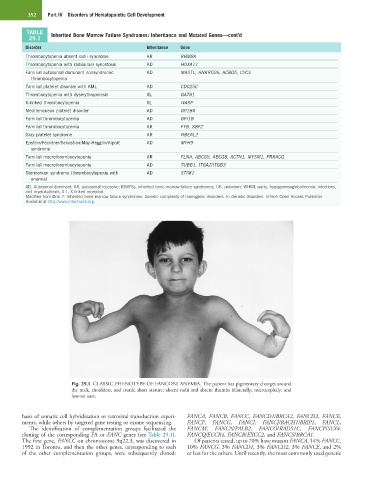
                        Fig. 29.1  CLASSIC PHENOTYPE OF FANCONI ANEMIA. The patient has pigmentary changes around
                        the neck, shoulders, and trunk; short stature; absent radii and absent thumbs bilaterally; microcephaly; and
                        low-set ears.


        basis of somatic cell hybridization or retroviral transduction experi-  FANCA,  FANCB,  FANCC,  FANCD1/BRCA2,  FANCD2,  FANCE,
        ments, while others by targeted gene testing or exome sequencing.  FANCF,  FANCG,  FANCI,  FANCJ/BACH1/BRIP1,  FANCL,
           The  identification  of  complementation  groups  facilitated  the   FANCM,  FANCN/PALB2,  FANCO/RAD51C,  FANCP/SLX4,
        cloning of the corresponding FA or FANC genes (see Table 29.1).   FANCQ/ECCR4, FANCR/EXCC2, and FANCS/BRCA1.
        The first gene, FANCC on chromosome 9q22.3, was discovered in   Of patients tested, up to 70% have mutant FANCA, 14% FANCC,
        1992 in Toronto, and then the other genes, corresponding to each     10% FANCG, 3% FANCD1, 3% FANCD2, 3% FANCE, and 2%
        of  the  other  complementation  groups,  were  subsequently  cloned:   or less for the others. Until recently, the most commonly used genetic

