


Page 434 - Hematology_ Basic Principles and Practice ( PDFDrive )
P. 434
Chapter 29  Inherited Bone Marrow Failure Syndromes  355


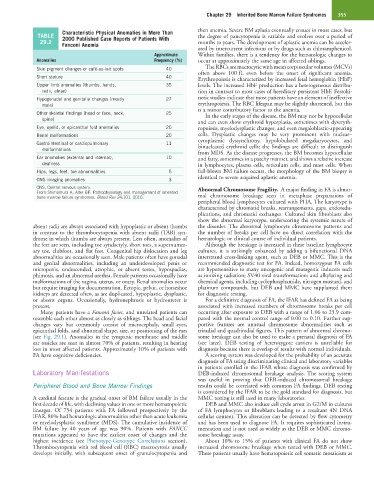
                     Characteristic Physical Anomalies in More Than    then anemia. Severe BM aplasia eventually ensues in most cases, but
             TABLE   2000 Published Case Reports of Patients With   the degree of pancytopenia is variable and evolves over a period of
              29.2   Fanconi Anemia                               months to years. The development of aplastic anemia can be acceler-
                                                                  ated by intercurrent infections or by drugs such as chloramphenicol.
                                                   Approximate    Within families, there is a tendency for the hematologic changes to
             Anomalies                             Frequency (%)  occur at approximately the same age in affected siblings.
             Skin pigment changes or café-au-lait spots  40         The RBCs are macrocytic with mean corpuscular volumes (MCVs)
                                                                  often  above  100 fL  even  before  the  onset  of  significant  anemia.
             Short stature                             40         Erythropoiesis is characterized by increased fetal hemoglobin (HbF)
             Upper limb anomalies (thumbs, hands,      35         levels. The increased HbF production has a heterogeneous distribu-
               radii, ulnae)                                      tion in contrast to most cases of hereditary persistent HbF. Ferroki-
             Hypogonadal and genitalia changes (mostly   27       netic studies indicate that most patients have an element of ineffective
               male)                                              erythropoiesis. The RBC lifespan may be slightly shortened, but this
                                                                  is a minor contributory factor to the anemia.
             Other skeletal findings (head or face, neck,   25      In the early stages of the disease, the BM may not be hypocellular
               spine)
                                                                  and can even show erythroid hyperplasia, sometimes with dyseryth-
             Eye, eyelid, or epicanthal fold anomalies  20        ropoiesis, myelodysplastic changes, and even megaloblastic-appearing
             Renal malformations                       20         cells.  Dysplastic  changes  may  be  very  prominent  with  nuclear–
                                                                  cytoplasmic  dyssynchrony,  hypolobulated  megakaryocytes,  and
             Gastrointestinal or cardiopulmonary       11         binucleated erythroid cells; the findings are difficult to distinguish
               malformations
                                                                  from MDS. As the disease progresses, the BM becomes hypocellular
             Ear anomalies (external and internal),    10         and fatty, sometimes in a patchy manner, and shows a relative increase
               deafness                                           in lymphocytes, plasma cells, reticulum cells, and mast cells. When
             Hips, legs, feet, toe abnormalities        5         full-blown BM failure occurs, the morphology of the BM biopsy is
             CNS imaging anomalies                      3         identical to severe acquired aplastic anemia.
             CNS, Central nervous system.                         Abnormal Chromosome Fragility.  A major finding in FA is abnor-
             From Shimamura A, Alter BP: Pathophysiology and management of inherited
             bone marrow failure syndromes. Blood Rev 24:101, 2010.  mal  chromosome  breakage  seen  in  metaphase  preparations  of
                                                                  peripheral blood lymphocytes cultured with PHA. The karyotype is
                                                                  characterized by chromatid breaks, rearrangements, gaps, endoredu-
                                                                  plications, and chromatid exchanges. Cultured skin fibroblasts also
                                                                  show the abnormal karyotype, underscoring the systemic nature of
            absent radii are always associated with hypoplastic or absent thumbs   the disorder. The abnormal lymphocyte chromosome patterns and
            in contrast to the thrombocytopenia with absent radii (TAR) syn-  the  number  of  breaks  per  cell  have  no  direct  correlation  with  the
            drome in which thumbs are always present. Less often, anomalies of   hematologic or clinical course of individual patients.
            the feet are seen, including toe syndactyly, short toes, a supernumer-  Although the breakage is increased in these baseline lymphocyte
            ary toe, clubfoot, and flat feet. Congenital hip dislocation and leg   cultures,  it  is  strikingly  enhanced  by  adding  a  bifunctional  DNA
            abnormalities are occasionally seen. Male patients often have gonadal   interstrand cross-linking agent, such as DEB or MMC. This is the
            and  genital  abnormalities,  including  an  underdeveloped  penis  or   recommended diagnostic test for FA. Indeed, homozygous FA cells
            micropenis,  undescended,  atrophic,  or  absent  testes,  hypospadias,   are hypersensitive to many oncogenic and mutagenic inducers such
            phimosis, and an abnormal urethra. Female patients occasionally have   as ionizing radiation; SV40 viral transformation; and alkylating and
            malformations of the vagina, uterus, or ovary. Renal anomalies occur   chemical agents, including cyclophosphamide, nitrogen mustard, and
            but require imaging for documentation. Ectopic, pelvic, or horseshoe   platinum compounds, but DEB and MMC have supplanted them
            kidneys are detected often, as are duplicated, hypoplastic, dysplastic,   for diagnostic testing.
            or  absent  organs.  Occasionally,  hydronephrosis  or  hydroureter  is   For a definitive diagnosis of FA, the IFAR has defined FA as being
            present.                                              associated  with  increased  numbers  of  chromosome  breaks  per  cell
              Many patients have a Fanconi facies, and unrelated patients can   occurring after exposure to DEB with a range of 1.06 to 23.9 com-
            resemble each other almost as closely as siblings. The head and facial   pared with the normal control range of 0.00 to 0.10. Further sup-
            changes  vary  but  commonly  consist  of  microcephaly,  small  eyes,   portive  features  are  unusual  chromosome  abnormalities  such  as
            epicanthal folds, and abnormal shape, size, or positioning of the ears   triradial and quadriradial figures. This pattern of abnormal chromo-
            (see Fig. 29.1). Anomalies in the tympanic membrane and middle   some breakage can also be used to make a prenatal diagnosis of FA
            ear ossicles are seen in almost 70% of patients, resulting in hearing   (see  later).  DEB  testing  of  heterozygote  carriers  is  unreliable  for
            loss in most affected patients. Approximately 10% of patients with   diagnosis because there is overlap of results with normal individuals.
            FA have cognitive deficiencies.                         A scoring system was developed for the probability of an accurate
                                                                  diagnosis of FA using discriminating clinical and laboratory variables
                                                                  in patients enrolled in the IFAR whose diagnosis was confirmed by
            Laboratory Manifestations                             DEB-induced  chromosomal  breakage  analysis. The  scoring  system
                                                                  was  useful  in  proving  that  DEB-induced  chromosomal  breakage
            Peripheral Blood and Bone Marrow Findings             results could be correlated with common FA findings. DEB testing
                                                                  is considered by the IFAR to be the gold standard for diagnosis, but
            A cardinal feature is the gradual onset of BM failure usually in the   MMC testing is still used in many laboratories.
            first decade of life, with declining values in one or more hematopoietic   DEB and MMC also induce cell cycle arrest in G2/M in cultures
            lineages.  Of  754  patients  with  FA  followed  prospectively  by  the   of  FA  lymphocytes  or  fibroblasts  leading  to  a  resultant  4N  DNA
            IFAR, 80% had hematologic abnormalities other than acute leukemia   cellular content. This alteration can be detected by flow cytometry
            or myelodysplastic syndrome (MDS). The cumulative incidence of   and has been used to diagnose FA. It requires sophisticated instru-
            BM  failure  by  40  years  of  age  was  90%.  Patients  with  FANCC   mentation and is not used as widely as the DEB or MMC chromo-
            mutations  appeared  to  have  the  earliest  onset  of  changes  and  the   some breakage assay.
            highest  incidence  (see  Phenotype-Genotype  Correlations  section).   About  10%  to  15%  of  patients  with  clinical  FA  do  not  show
            Thrombocytopenia with red blood cell (RBC) macrocytosis usually   increased chromosome breakage when tested with DEB or MMC.
            develops  initially,  with  subsequent  onset  of  granulocytopenia  and   These patients usually have hematopoietic cell somatic mosaicism as

